Iceland Travel Guides
Aldeyjarfoss: Water, Basalt, and the Geometry of the North
A fuller private guide to Aldeyjarfoss, with basalt-column geometry, Skjálfandafljót, North-Iceland-to-Highlands threshold mood, and the visual precision that makes the waterfall unforgettable.
GlaciGo Iceland / May 2026 / 10 min read
Aldeyjarfoss is one of those Icelandic waterfalls that seems to have been composed rather than merely formed. White water drops into a dark bowl of basalt columns so geometrically exact that the whole scene can feel half natural, half architectural. Many waterfalls in Iceland overwhelm through scale, sound, or sheer volume. Aldeyjarfoss works differently. It persuades through contrast: white against black, motion against stillness, irregular force against striking order. That balance is what makes it one of the most satisfying waterfalls in North Iceland for travelers who care as much about form as they do about power.
The official North Iceland material repeatedly places Aldeyjarfoss among the region's most photogenic waterfalls, and one recent brochure gets to the heart of it quickly by describing the fall as surrounded by basalt columns and ideal for photography. That may sound simple, but it is accurate in the right way. The columns are not incidental decoration beside the water. They are the reason the waterfall feels so distinct. Without them, Aldeyjarfoss would still be beautiful. With them, it becomes one of the clearest conversations in Iceland between volcanic structure and moving water.
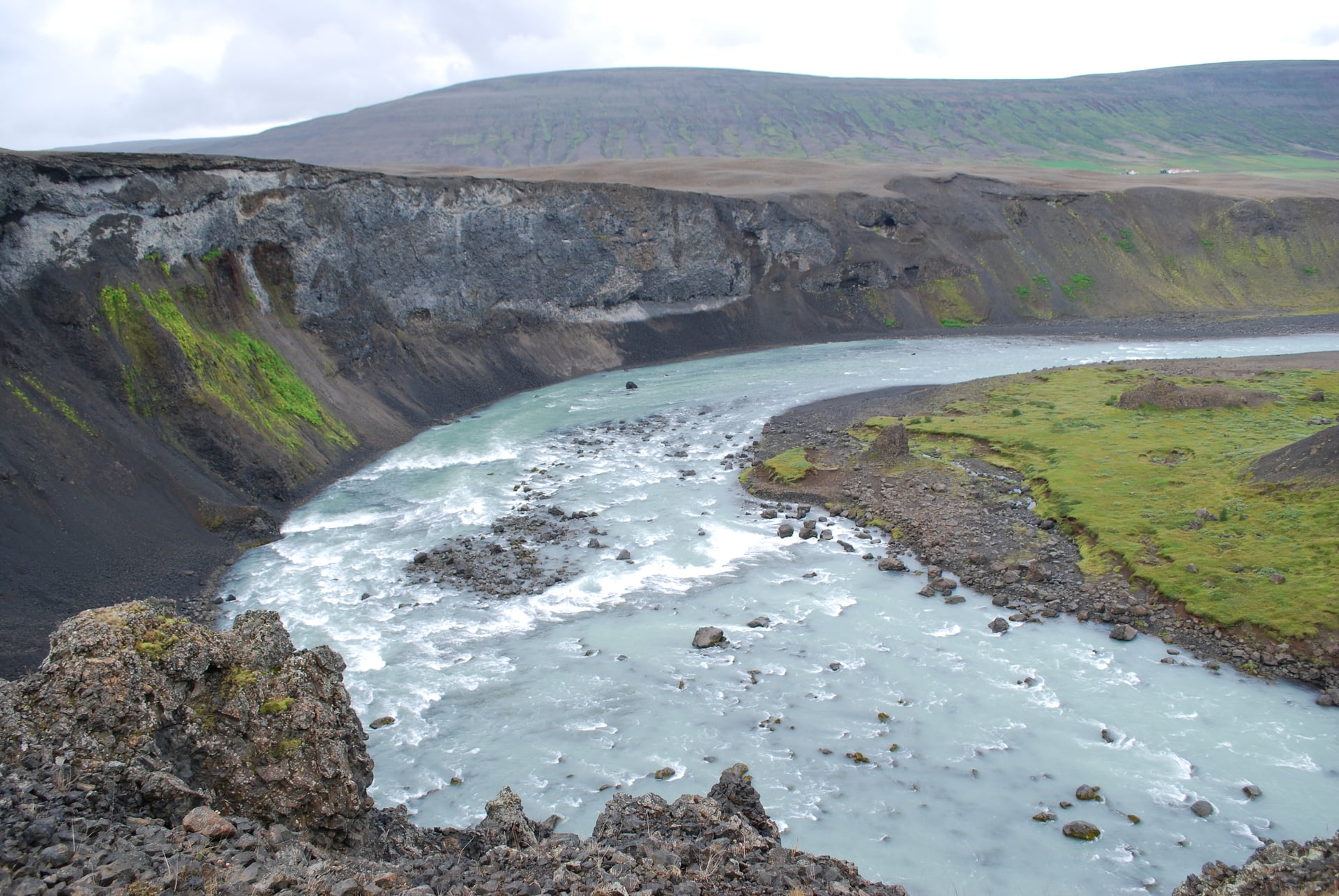
Wikimedia's category structure around the site helps make the geology legible. Aldeyjarfoss is classified not only as a waterfall of Skjálfandafljót, but also under columnar basalts of Iceland, escarpments, and the Highland of Norðurland eystra. That combination matters. The waterfall is not only a scenic stop on a river. It is part of a basaltic and Highland landscape system. The black walls around it are not a random visual accident. They are volcanic order revealed and then cut into by water.
The river itself gives the site its wider meaning. Skjálfandafljót appears elsewhere in North Iceland in more public, accessible, or historically resonant forms, most famously at Goðafoss. There, the river is broad and almost ceremonial. At Aldeyjarfoss, the same water feels more concentrated, more interior, and more physically framed by geology. This makes the two falls useful companions in the imagination. Goðafoss speaks to cultural memory and public beauty. Aldeyjarfoss speaks more to raw structure, upland movement, and the river's volcanic ancestry.
That upland feeling is crucial. Aldeyjarfoss does not behave like an ordinary roadside waterfall. It sits closer to the threshold between North Iceland and the interior, which changes the emotional tone of the stop. The approach begins to strip away lowland convenience and introduce a harsher, more open atmosphere. Even if the route is manageable in season, the place still feels like it belongs to the edge of a larger, emptier country. That is one reason Aldeyjarfoss lingers in memory. It is not only beautiful. It feels positioned at a meaningful border between settled north and Highland distance.
This threshold quality also explains why the waterfall photographs so well without feeling trivial in person. Some photogenic places lose authority when you arrive because the image has already consumed them. Aldeyjarfoss tends to do the opposite. The famous black-and-white contrast is real, but the scene gains weight through space, air, and texture. The basalt columns are darker, rougher, and more bodily than photographs usually manage to show. The fall itself can seem both more forceful and more delicate. It drops cleanly, but into a setting that feels old and stern.
There is a deeper Icelandic logic at work here too. Basalt columns often tempt people to talk about architecture, cathedrals, pipes, walls, and constructed order. At Aldeyjarfoss, that metaphor almost writes itself. But what makes the site better than a simple metaphor is that the order remains visibly volcanic. The columns do not feel imported from human design. They feel like the earth discovering one of its own most precise grammars and then allowing water to interrupt it. This is why Aldeyjarfoss can be so satisfying to stand beside. It looks arranged, yet nothing about it feels artificial.
The surrounding region matters as well. North Iceland's official material often presents Aldeyjarfoss in relation to broader routes through Bárðardalur and toward the Highlands, and that is the right scale for understanding it. You do not need to isolate the waterfall from everything around it to appreciate it. In fact, it becomes better when understood as one of the stops that teaches you how the land is changing as you move inland: more basaltic, more austere, more open, and less softened by village or forest logic.
Photographically, Aldeyjarfoss rewards discipline. The obvious shot is the classic centered composition with the waterfall framed by hexagonal black columns, and there is no shame in that image because it is genuinely good. But stronger photographs often work by preserving more of the river's approach, the asymmetry of the rock walls, or the sense of depth below the lip. The site is not only a graphic symbol. It is a landscape event. If you flatten it too much into pure geometry, you lose part of what makes it breathe.
Weather can alter the reading in useful ways. Under grey skies, the black basalt and white water become stark and severe, almost monochrome. In clearer light, subtler tones emerge in the stone and surrounding terrain, and the waterfall can look less like a dramatic emblem and more like part of a broader volcanic system. Mist and spray also matter here, because they soften the visual rigidity of the columns just enough to keep the scene from becoming overly static. Aldeyjarfoss works because order and motion never fully defeat each other.
Compared with Dettifoss, Aldeyjarfoss is far less about brute force. Compared with Hraunfossar, it is much more concentrated and architectural. Compared with Svartifoss, it shares the basalt-column fascination but feels wilder, broader in mood, and less attached to a park-path narrative. These comparisons help locate it without diminishing its individuality. Aldeyjarfoss is one of Iceland's best examples of a waterfall whose character comes not from being the tallest, widest, or loudest, but from being one of the most formally complete.
There is also a subtle psychological pleasure in how the place reveals itself. The waterfall is famous enough that many visitors arrive expecting to admire it quickly and move on. Instead, the scene often slows them down. The eye keeps traveling from the lip to the plunge, from the water to the basalt, from the river to the bowl, and then back again. Aldeyjarfoss is strangely re-readable. Even after the first impact, it continues to hold attention through detail and composition. That is usually the sign of a place stronger than its reputation.
Aldeyjarfoss benefits from being explained on its own terms because traveler questions around it is sharper than many summary pages acknowledge. People want to know whether it is worth the detour, what makes it different from other waterfalls in North Iceland, why the basalt columns matter so much, and whether it belongs more to a north-country route or to a Highlands itinerary. The strongest way to understand it is that it belongs to both. Aldeyjarfoss is a northern waterfall with Highland seriousness, and that hybrid identity is exactly what makes it special.
What stays with many travelers after Aldeyjarfoss is not simply the image of the fall. It is the feeling of seeing water discover a perfect frame inside volcanic stone, and of meeting a landscape that feels poised between accessibility and remoteness. Aldeyjarfoss lingers because it offers a rare kind of clarity. Nothing there is overexplained, yet everything feels exact: the river, the drop, the basalt, the bowl, the edge of the interior. Few Icelandic waterfalls are so visually strict and so emotionally spacious at the same time.