Iceland Travel Guides
Arctic Henge: Light, Myth, and the Thoughtful Edge of Iceland
A fuller private guide to Arctic Henge, with its Raufarhöfn setting, mythological gates, sundial logic, Arctic light, and the reason this remote monument means more than a quick photo stop.
GlaciGo Iceland / May 2026 / 10 min read
Arctic Henge is one of those Iceland places that can seem either profound or a little ridiculous depending on how it is approached. A careless visit turns it into an isolated photo stop in a remote village. A patient one reveals something more unusual: a work of art, a light instrument, a mythic thought experiment, and a local act of stubborn imagination all standing together on a rise above Raufarhöfn. What makes the place interesting is not that it resembles Stonehenge in the broadest possible sense. It is that it tries to translate the specific conditions of Northeast Iceland into built form: flat horizons, Arctic light, vast sky, and a village living right at the psychological edge of the country.
Visit North Iceland gives the clearest short introduction, calling Arctic Henge a huge stone sundial with allusions to mythology and folklore, designed to interact with the unique natural light in this Arctic-edge village. That is a strong starting point because it immediately stops the monument from being misunderstood as just decorative architecture. The project is about light, direction, and meaning. The stones matter, but what really activates the site is what happens between them: sun, shadow, alignment, and sky.
The official Arctic Henge project site adds the richer history. It explains that the idea was to connect Icelandic culture, literary history, and classical science with the environmental conditions near the Arctic Circle. It also states that the project is a community effort led by residents of northeast Iceland. That combination matters more than it may first appear. Arctic Henge is not simply a government monument dropped onto a map. It is a village-scale act of self-definition. Raufarhöfn, now quiet and remote, chose not to answer its marginal location with smallness of vision. It answered with a large, slow, improbable work that asks people to come north and think.
Raufarhöfn itself is part of the meaning. Visit North Iceland describes it as the northernmost town on the Icelandic mainland, on the eastern shore of the Melrakkaslétta peninsula. The same source recounts its older harbor history, its growth through herring, and its present quieter life as a fishing village redefining itself. This context is essential. Arctic Henge would read differently beside a busy urban center. In Raufarhöfn it becomes part of a place wrestling honestly with remoteness, memory, and reinvention. The monument is not there in spite of the village's scale. It is there because of it.
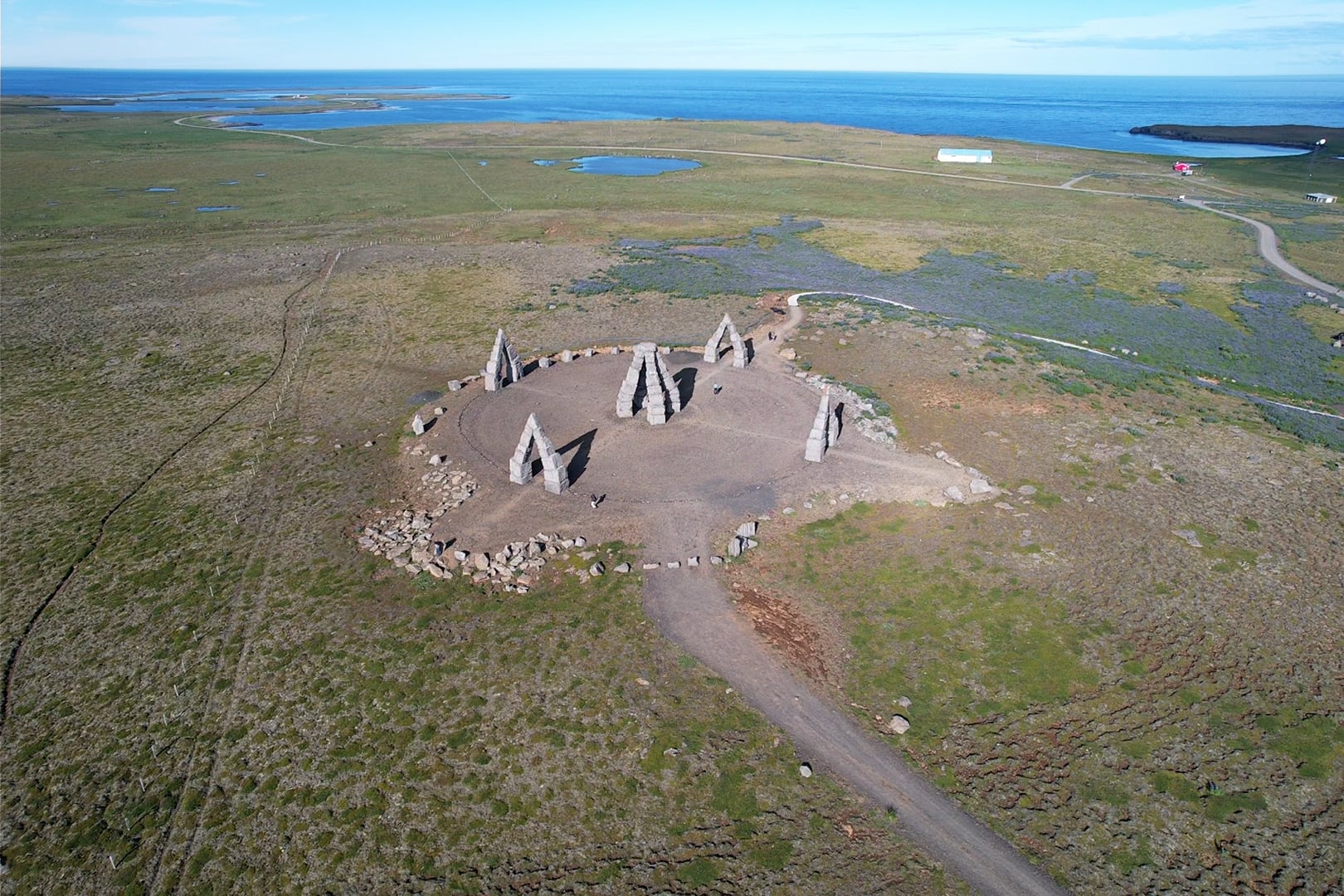
The official project page makes the physical design much more legible. Arctic Henge has a diameter of roughly 50 meters, with gates about six meters high oriented toward the cardinal directions. At the center stands a ten-meter column on four pillars, planned to be crowned with a crystal top that refracts sunlight across the site. The monument also functions as a compass, and the midnight sun is intended to appear through the northern alignment. These are not just technical details. They explain the emotional logic of the experience. You are not merely walking through sculptural arches. You are moving through a structure designed to frame time, direction, and the northern sky.
The mythological layer is equally important and should not be reduced to generic Viking atmosphere. The official site says the project draws on the Dvergatal, the Dwarves' List from Völuspá and Snorri's Edda, and reimagines that mythic world through the play of sunlight. Austri, Vestri, Norðri, and Suðri are especially meaningful because they are the dwarves associated with holding up the sky and with the cardinal directions. Suddenly the gates stop being abstract openings and start reading as names, roles, and cosmological gestures. Arctic Henge becomes less about copied antiquity and more about giving old northern texts a new physical life under northern light.
This is where the place becomes much better than the label 'Icelandic Stonehenge' suggests. That comparison is useful for first orientation, and even the official site acknowledges architectural inspiration from Stonehenge. But the real content is different. Stonehenge carries prehistoric distance and ritual opacity. Arctic Henge is a consciously modern construction, transparent about its authorship and still unfinished in some respects. Its power comes from the blend of old symbolic language and contemporary intention. It is not an ancient mystery rediscovered. It is a new one being invented in public.
The Arctic conditions around Raufarhöfn are not background to this idea; they are the entire reason it works. The official site emphasizes that the village lies close to the Arctic Circle, that the days are longest there in summer and shortest in winter, and that the flat terrain gives an unobstructed 360-degree horizon. This is one of the strongest facts to hold onto. In much of Iceland, mountains and valleys choreograph the sky. At Raufarhöfn, openness does more of the work. That openness gives Arctic Henge its stage. The monument needs horizon the way a musical instrument needs resonance.
It also explains why so many travelers connect the site with midnight sun and northern lights. These are not simply extra seasonal bonuses. They are part of the larger argument of the place. Around the summer solstice, the sun's path becomes unusually legible. In winter, darkness makes the architecture of light even more dramatic when moonlight, stars, or aurora arrive. Arctic Henge is one of those rare locations where weather and celestial conditions do not merely beautify a site; they complete it.
Photographically, this makes the monument both generous and difficult. The stones are striking enough for immediate framing, but the stronger images usually come when the surrounding emptiness is allowed to participate. Too tight a composition can make the site look like a detached sculpture park. Too broad a one can lose the force of the gates. Good images usually carry both: the built form and the loneliness around it. That loneliness is not a flaw. It is the truth the monument is working with.
From a travel perspective, Arctic Henge is also a test of what kind of Iceland experience a person wants. If the goal is dense sightseeing efficiency, it can seem out of the way. If the goal is to understand how far northeastern Iceland feels from the standard tourist circuits, it becomes one of the most eloquent stops in the region. The drive to Raufarhöfn is part of the point. You do not happen upon Arctic Henge accidentally in the same mood that you happen upon a waterfall near the Ring Road. You go because you are willing to let remoteness become part of the experience.
That remoteness is emotionally valuable because it changes the scale of the monument. Arctic Henge is large, but not in the way of an urban monument built to dominate crowds. It feels large because there is so much sky around it and so little visual competition. The stones rise into wind and light rather than into busyness. That is why the place can feel unexpectedly intimate despite its size. There is room to think there. The monument does not rush to explain itself.
The project's still-developing nature also adds something honest. The official site speaks openly about ongoing construction, funding needs, and the phased completion of the henge. Rather than weakening the experience, this can deepen it. You are seeing not just a finished object but a continuing act of village-scale cultural ambition. Arctic Henge remains a living project, one that says something about hope in rural Iceland as much as it says something about myth or astronomy.
Arctic Henge deserves its own fuller guide because traveler questions here is unusually layered. Some travelers want a northern-lights photo stop. Some want a mythology-rich landmark. Some want to know whether the detour to Raufarhofn is worth it. Others are trying to understand if this is art, architecture, astronomy, folklore, or all of them at once. The fuller way to understand it is that Arctic Henge works precisely because it refuses to stay in just one category. It is a monument built from overlap: literature and light, science and imagination, local reinvention and very old names.
What stays with many visitors after Arctic Henge is often not only the gates themselves but the sensation of standing in a place that was built to pay attention to the sky. That is rarer than it sounds. In Raufarhöfn, on a rise above a quiet northern village, the monument asks you to notice direction, season, horizon, and the old human urge to give shape to time. Arctic Henge lingers because it turns remoteness into meaning rather than treating it as a problem to overcome.