Iceland Travel Guides
Arnarstapi: Cliffs, Birds, and the Story-Thick Coast of Snæfellsnes
A fuller private guide to Arnarstapi, with coastal geology, the Arnarstapi-Hellnar nature reserve, birdlife, old trading history, and the saga presence of Bárður Snæfellsás.
GlaciGo Iceland / May 2026 / 10 min read
Arnarstapi is the kind of place people often underestimate because it is small, easy to stop at, and almost too visibly beautiful. Cars pull in, cameras come out, someone walks toward the cliffs, someone else heads straight for coffee, and within a few minutes it can look as if Arnarstapi has already given up its whole secret. But it rarely does. This is not just a pretty village on the Snæfellsnes coast. It is a place where geology, seabirds, old trade history, protected shoreline, and one of western Iceland's strongest saga presences all sit unusually close together.
West Iceland's official material starts with an important historical fact: Arnarstapi was once an important trading post and had a much larger population than it has now. That line matters because it immediately changes the mood of the place. The quiet you meet in Arnarstapi today is not the quiet of a place that never mattered. It is the quiet of a place that has passed through busier centuries. Once you know that, the harbor, the landing places, and the shape of the settlement stop feeling decorative. They begin to read as traces.
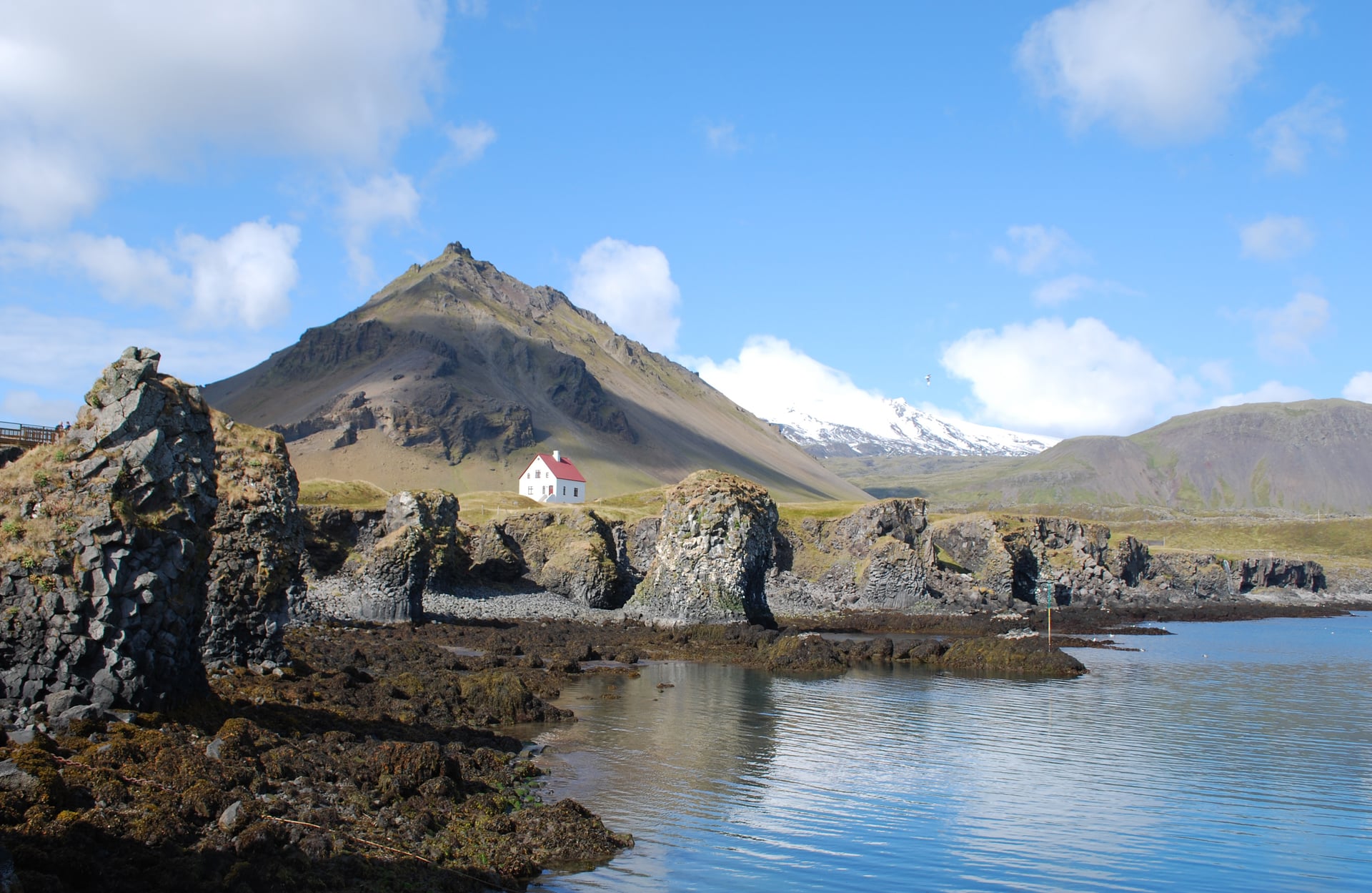
The village's physical setting is what makes those traces so memorable. Columnar basalt, ravines, grottoes, and a pierced coastline surround the old pier. The official Snæfellsnes overview describes the shore around Arnarstapi as one of the peninsula's characteristic combinations of hazardous cliffs, dramatic geology, and bird-rich edges. The Environment Agency's park brochure adds that the coastal area around Arnarstapi and Hellnar was designated a nature reserve in 1979, covering about 0.6 square kilometres of shoreline with peculiar rock formations carved by the surf. That protected status is not just administrative detail. It tells you that the coast here is considered special even by Iceland's demanding standards.
What makes Arnarstapi feel so vivid is that the sea is never just background. It cuts, hollows, bites, tunnels, and stages the whole village. You can see this in the arches, in the coves, in the sea-polished cliff forms, and in places like Gatklettur, where rock seems less like a wall than a temporarily stable conversation between lava and surf. The cliffs are beautiful, but they are also active in the deeper sense. They are records of pressure. Standing there, you do not feel that the land ends cleanly and the ocean begins. You feel an ongoing argument between them.
Birdlife gives that argument sound. West Iceland notes that the old coastal path lets you see many birds, including kittiwakes, Arctic terns, and fulmars. The national-park brochure specifically mentions the rare chance to inspect kittiwake flocks up close along this protected coast. That is one of Arnarstapi's great strengths as a stop for tourists: it offers drama without requiring abstraction. The geology is visible. The birds are visible. The weather is visible. The scale stays human enough that even a short visit can feel textured rather than rushed.
The walk toward Hellnar is a major reason why Arnarstapi deserves a full article rather than a short listing. Official material describes this old route along the coastline as passing lending places used by fishermen, birds, and lava terrain, and it remains one of the most satisfying short walks on Snæfellsnes. A private itinerary can use this path almost like a slow-reading tool. You leave the village edge and begin noticing how the coast changes metre by metre: one opening in the rock full of white bird noise, another section gentler and grassy, another shaped into arches and black volcanic ribs. The walk teaches you that Arnarstapi is not a viewpoint but a threshold into a longer coastal story.
That story is partly geological and partly social. The Snæfellsjökull park brochure explains that the Hellnahraun lava field just north of Arnarstapi and Hellnar is thought to be around 4,000 years old and to have flowed from a crater now beneath the glacier. So even when the glacier itself is not dominating the sky, Snæfellsjökull still reaches into the ground under your feet. This matters because Arnarstapi can otherwise be mistaken for a purely coastal destination. In reality, it belongs to the larger glacier-volcano system of western Snæfellsnes. Lava, settlement, bird cliffs, and sea pressure are all part of the same district logic.
Then there is Bárður. Any serious article about Arnarstapi has to make room for him, not as gimmick but as local imagination with deep roots. The official park brochure says plainly that Bárðar saga Snæfellsáss takes place around Arnarstapi and Hellnar and that many place names in the area are tied to the story. It recounts Bárður as a being half man and half troll who lived nearby, lost patience with human company after family violence, and eventually walked into Snæfellsjökull, never to be seen again. Many later generations came to think of him as a guardian of the region.
That saga layer fits Arnarstapi unusually well because the landscape already feels half-natural and half-storied. A sculpture of Bárður Snæfellsás by Ragnar Kjartansson stands near the coast at Arnarstapi, according to both West Iceland and the Environment Agency brochure. It is one of those monuments that could have felt silly in the wrong place, but here it does not. The cliffs, sea caves, lava, bird cries, and open weather make the village feel like a believable home for a figure who belongs somewhere between human memory and myth. Tourists do not need to take the saga literally to feel that the story belongs here.
Arnarstapi also works beautifully because it balances softness and severity. There are houses, paths, food, and easy access. But the coast itself stays sharp. The old fishing and trading context helps explain that balance. This was a working shoreline. Boats needed shelter. People watched the sea for opportunity and danger at the same time. Even now, the beauty of the place is inseparable from that older practicality. The harbor is lovely, but it is lovely because it solved a problem before it became a photograph.
For a tourist, that makes Arnarstapi more emotionally satisfying than some larger attractions. It does not overwhelm through size. It gathers detail. The best visits happen when people give it a little more time than the average stop deserves. Sit with the cliffs. Walk farther than the first arch. Notice how the light changes the basalt from black to silver to brown depending on cloud cover. Watch how seabirds make the rock seem inhabited rather than monumental. If the weather turns, let it. Arnarstapi becomes more itself under moving sky.
This is also why the village works so well on a private tour. Large bus logic treats it as a quick scenic break on the way to something else. But private pacing allows Arnarstapi to function as one of the peninsula's interpretive centers without needing a museum wall. From here, you can read the relationship between Snæfellsjökull's volcanic influence, the south-coast cliff systems, old fishing routes, and the saga imagination of the district. In a surprisingly compact area, Arnarstapi brings together many of the things that make Snæfellsnes feel richer than a checklist destination.
Arnarstapi rewards a substantial guide because it is more layered than it first appears. Some travelers come for the coastal walk to Hellnar, some for basalt arches and bird cliffs, some for the Bardur statue, and others simply want to know whether it is worth more than a quick photo stop. It is worth time precisely because it is former trading post, protected coastline, saga landscape, bird station, and one of the clearest places on Snaefellsnes to feel settlement and geology meeting.
What stays with many travelers after Arnarstapi is not one dramatic scene, but a particular coastal intimacy. The village is open enough to welcome you quickly, yet strange enough to keep unfolding after the first impression. The rock seems sculpted but unfinished. The sea feels beautiful but not tame. The stories do not sit on top of the land; they seem to have grown out of it. That is why Arnarstapi lingers. It is not just a stop on the peninsula. It is one of the places where Snæfellsnes becomes legible, both as landscape and as memory.