Iceland Travel Guides
Ásbyrgi Canyon: Softness, Myth, and Flood Memory in North Iceland
A fuller private guide to Ásbyrgi Canyon, with its horseshoe form, Sleipnir legend, outburst-flood geology, wooded floor, and the reason it feels so different from the harsher landscapes around it.
GlaciGo Iceland / May 2026 / 10 min read
Ásbyrgi does not look like the North Iceland many travelers think they are driving toward. By the time people reach this part of Jökulsárgljúfur, they often expect exposed stone, raw glacial force, black desert tones, and big volcanic severity. Ásbyrgi gives them something else. The canyon opens as a giant horseshoe-shaped hollow with sheltered woodland, calmer walking, softer light, and a peculiar feeling of enclosure. The shift is so dramatic that it can feel almost improbable. That is part of the power of the place. Ásbyrgi is not only beautiful in itself. It changes the emotional climate of the whole region around it.
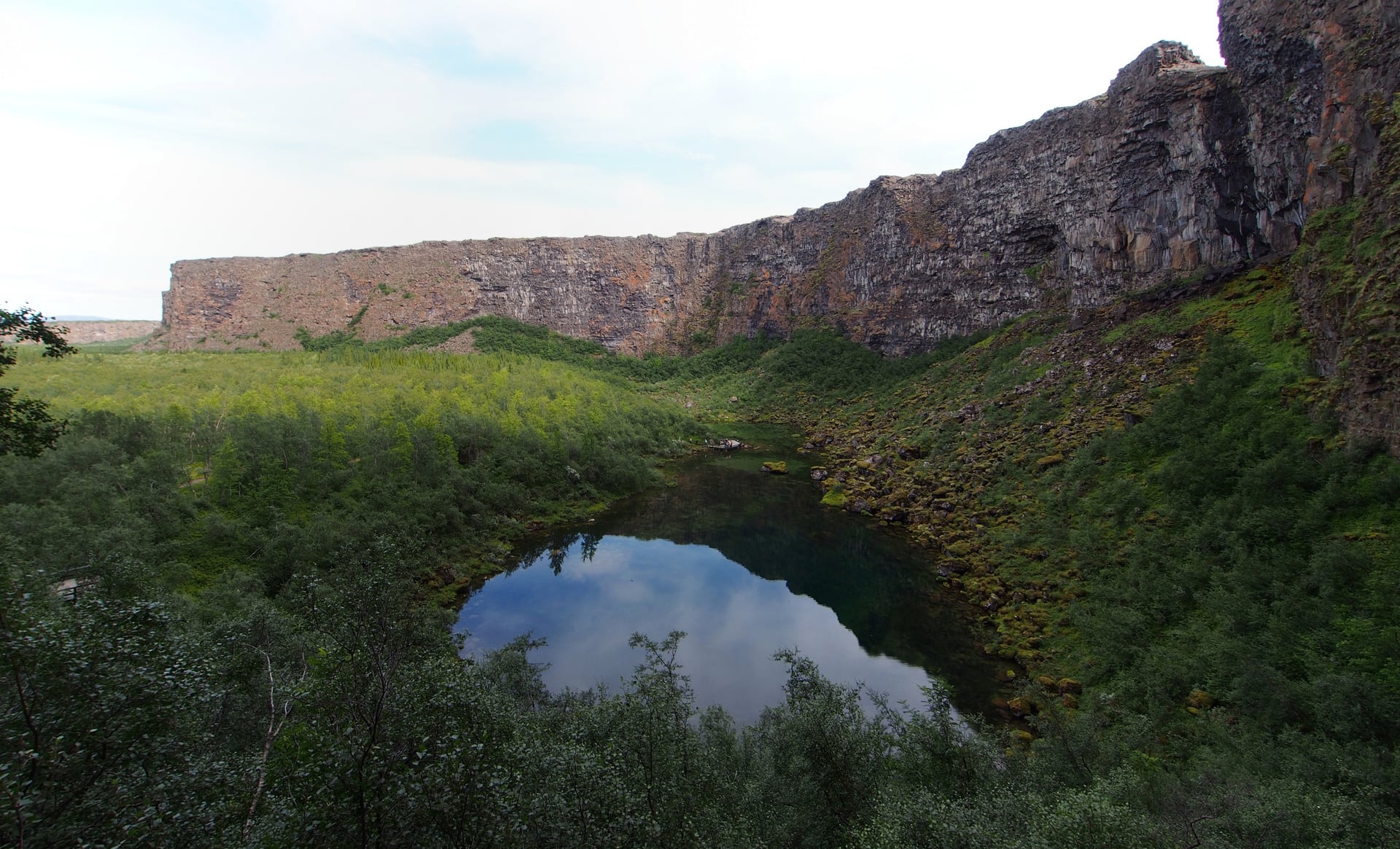
Vatnajökull National Park's official Ásbyrgi page describes the canyon as a unique natural formation that offers a pleasant experience for a wide variety of visitors. The wording is modest, but the details are memorable. The cliffs rise to around 100 meters at the innermost part of the canyon. The hollow is about 3.5 kilometers long and approximately 1.1 kilometers wide. At its center stands Eyjan, a distinctive rock formation or island-like ridge up to 250 meters wide. The floor is wooded with birch and willow, joined by mountain ash and planted pines. Those facts explain why Ásbyrgi feels so unlike the harsher landscapes nearby. It is not only a canyon. It is also a sheltered interior world.
The official geological explanation matters because it gives the shape its real weight. According to the national park, Ásbyrgi was formed by catastrophic glacial outburst floods from Vatnajökull during at least two major natural events, one 8 to 10 thousand years ago and another about 3 thousand years ago. Since then, the river Jökulsá á Fjöllum has shifted eastward. This is a remarkable frame for understanding the place. Ásbyrgi does not owe its form to slow, patient ordinary erosion alone. It is the trace of extreme water history, the fossilized geometry of sudden force that has long since moved elsewhere. That gap between violent origin and present calm is one of the canyon's deepest pleasures.
And yet geology is only half the story visitors carry away. The other half is myth. The same national park page records the traditional legend that Sleipnir, Odin's eight-legged horse, placed one of his hooves here while the god rode past. Because the canyon resembles a giant hoofprint, the story has survived with unusual force. In Iceland, many landscape legends feel like delicate additions to a place that could stand perfectly well without them. At Ásbyrgi, the myth fits almost alarmingly well. The shape invites story. The story, in turn, gives the shape an older emotional vocabulary. You do not need to believe literally in Sleipnir to understand why generations of people felt that an ordinary explanation, however accurate, did not quite satisfy the imagination.
Visit North Iceland adds another layer by presenting Ásbyrgi as one of the central stops on the Diamond Circle and stressing both the geological and mythic readings of the canyon. That double identity is crucial. Ásbyrgi can be approached as earth history or as cultural memory, and the place loses something if you choose only one. The horseshoe shape is not merely scenic; it is interpretive. People have been trying to explain it for a very long time, first through story and later through glaciology, and both responses remain visible in how the canyon is introduced today.
The walk to Botnstjörn is one of the clearest examples of how Ásbyrgi works. The national park describes Botnstjörn as a peaceful pond set deep within the cliffs, surrounded by birch forest, with a small waterfall sometimes entering it in spring or after heavy rain. The trail is short and accessible for people with limited mobility. That accessibility matters because it means Ásbyrgi is not reserved only for hikers or high-energy travelers. One of North Iceland's most distinctive landscapes can be experienced gently, almost at strolling pace. The calm at Botnstjörn is not a lesser version of the canyon. It is one of its essential moods.
Eyjan changes the scale of that mood. The official trail page for Eyjan says the route is easy overall, though the cliffs are high and demand care. From there, the view over Ásbyrgi becomes much more legible. You begin to understand not only that the canyon is horseshoe-shaped, but how unusually complete the form feels when seen from above. The wooded floor, the enclosing walls, and the lifted central ridge all come together in a way that feels both geological and theatrical. Few places in Iceland reveal their form so clearly while still keeping some inward quiet.
The forest itself deserves more attention than it often gets in short summaries. North Iceland is not usually imagined first through woodland shelter, but Ásbyrgi gives exactly that. The birch, willow, and heathland soften the canyon and create habitat for birds beyond the famous highland or seabird images people carry elsewhere in Iceland. The national park notes fulmars nesting in the cliffs and other bird species using the woods and heathland below. That living texture helps explain why Ásbyrgi can feel so restorative after harder landscapes. You are not only looking at shape. You are entering an ecological pocket.
This pocket-like feeling is one reason Ásbyrgi is emotionally different from Dettifoss, even though both belong to the same greater Jökulsárgljúfur system. Dettifoss feels like active force still cutting the land. Ásbyrgi feels like the memory of force after the water has gone elsewhere. Dettifoss overwhelms. Ásbyrgi receives. Dettifoss moves through your body by noise and vibration. Ásbyrgi changes your pace by enclosure and shade. Together they make a fuller North Iceland experience, but they do not duplicate each other in any meaningful way.
The visitor infrastructure matters here too, and in a good way. Gljúfrastofa, the national park visitor centre at the mouth of Ásbyrgi, offers information about the canyon area, exhibitions, trail context, and practical facilities. That may sound routine, but it fits the place well. Ásbyrgi is one of those landscapes that benefits from a moment of orientation before you wander into it. Once you understand that you are stepping into the northern end of the Jökulsárgljúfur canyon world, with longer routes stretching south toward Vesturdalur and even Dettifoss, the place becomes more than a scenic basin. It becomes the green threshold to a larger system.
For hikers, that threshold is real. The official trail material describes the canyon trail from Ásbyrgi toward Dettifoss as a demanding two-day route linking luxuriant Ásbyrgi to harsher volcanic and canyon terrain farther south. Even if most visitors will not do that full trail, the fact that it exists changes the meaning of the canyon. Ásbyrgi is not an ornamental dead end. It is the soft northern gateway to one of Iceland's most compelling long linear landscapes. A traveler who senses that larger continuation often reads the place differently, with more depth and less postcard simplification.
Photographically, Ásbyrgi can be deceptive because its most important quality is not always spectacle. It is easy to capture the cliffs, the curve, or a clean elevated viewpoint from Eyjan. It is harder to capture the protected hush of the floor, the filtered light in the birch, or the feeling of stepping from open northern terrain into something almost garden-like on a giant scale. That is why many people remember Ásbyrgi more strongly than their best photographs suggest. The place is spatial and atmospheric first, graphic second.
Season changes it in especially rewarding ways. Summer emphasizes the greenery and the contrast between wooded floor and stony rim. Spring can heighten the birdlife and the freshness around Botnstjörn. Autumn softens the vegetation and makes the canyon feel more introspective. Even in less colorful weather, the enclosure remains persuasive. Ásbyrgi does not need ideal conditions to work. Its shape and shelter carry enough character on their own.
From an itinerary perspective, Ásbyrgi is one of the most intelligent stops on a Diamond Circle route because it broadens what North Iceland means. Mývatn gives volcanic intelligence. Goðafoss gives narrative compactness. Dettifoss gives raw power. Ásbyrgi gives repose without triviality. It lets the region breathe. That makes it especially valuable late in a long day, or after harsher landscapes, when travelers need not another shock but a different form of attention.
Asbyrgi benefits from being explained on its own terms because too much online writing reduces it to a brief note about a horseshoe canyon and a hoofprint legend. People searching for Asbyrgi usually want more than that. They want to know why it feels so different from nearby stops, whether it is worth the detour, what the walking experience is like, and whether the myth matters or is just decorative copy. The fuller way to understand it is that Asbyrgi matters because it combines catastrophic geological origin, enduring folklore, gentle accessibility, and an almost improbable interior calm.
What stays with many visitors after Ásbyrgi is often the surprise of softness. Not weakness, not prettiness in a shallow sense, but softness after force. A canyon made by catastrophic floods now holds birch, birds, trails, and a pond. A shape explained by geology still invites a horse of the gods. That tension is why Ásbyrgi lingers. It is one of the rare places in Iceland where violence and refuge feel permanently folded into the same landform.