Iceland Travel Guides
Askja: Caldera Silence and the Weight of the Interior
A fuller private guide to Askja, with caldera scale, the 1875 eruption, Öskjuvatn and Víti, interior-road remoteness, and the deeper psychology of Iceland's Highlands.
GlaciGo Iceland / May 2026 / 10 min read
Askja is one of the Icelandic places that people often imagine before they truly understand. They know the image: a remote caldera, a cold blue lake, a smaller crater called Víti nearby, a road deep into the interior, and a feeling that the journey itself is part of the point. All of that is true. But Askja becomes more compelling when you stop thinking of it as a single lake or a single crater and start thinking of it as one of the clearest expressions of what Iceland's interior does to the mind. It stretches distance, sharpens weather, and makes geology feel not scenic but consequential.
The official North Iceland tourist guide gives the factual core succinctly: Askja is a 50 square kilometer caldera in the Dyngjufjöll mountains and one of Iceland's most impressive natural wonders. That sentence is useful because it resists turning the place into only a crater-lake photo stop. Askja is large, volcanic, and regional in scale. The caldera is not a detail within the mountains. It is one of the main reasons the mountains matter.
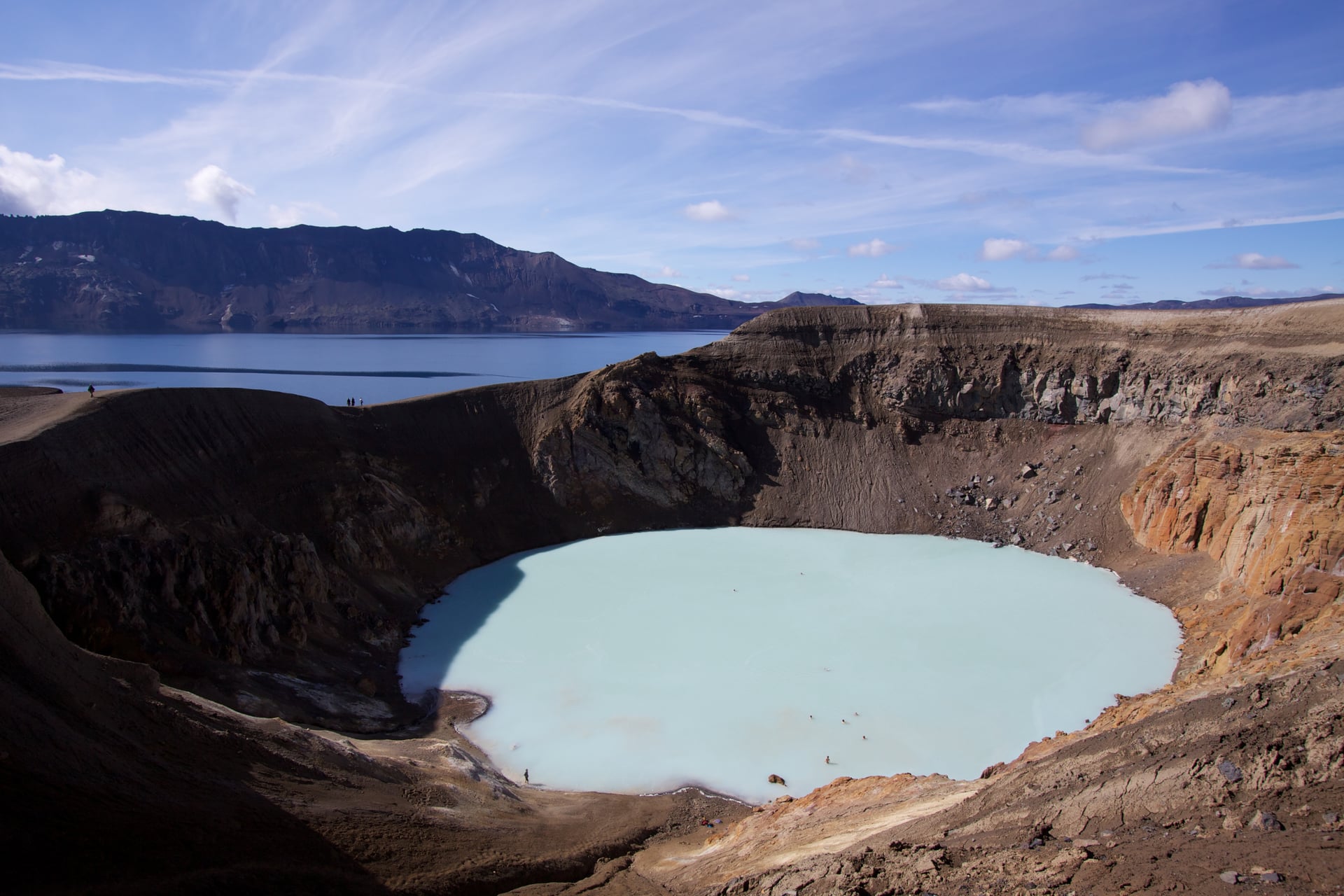
Wikimedia's structured description adds the next crucial layer. Askja is a central volcano with nested calderas located in the Highlands north of Vatnajökull, and the major 1875 eruption formed the most recent caldera and the lake Öskjuvatn. That history matters because it keeps the water from being read as merely peaceful. Öskjuvatn exists because the ground failed dramatically. The lake is beautiful, yes, but its beauty comes after collapse, not before. At Askja, calm and violence remain tightly folded together.
The neighboring crater Víti deepens that contrast in a particularly Icelandic way. It is smaller, more immediately dramatic, and easier for first-time visitors to emotionally grasp. Commons material describes it simply as the geothermal lake at the Askja caldera, and that plain description is exactly right. Víti is often the image people remember first because it is shaped, contained, and oddly intimate beside the larger severity of Askja. But the real power of the site comes from seeing both together. Öskjuvatn gives you scale and silence. Víti gives you color and nearness. One broadens the mind. The other hooks it.
Remoteness is not decoration here. It is part of the meaning. Commons summaries of Askja repeatedly emphasize that it lies in a very remote part of Iceland, on high terrain with snow even in summer and deserts in the vicinity. That is not just travel drama. It changes how the place works on the traveler. Many Icelandic highlights can be inserted into a day without changing your underlying relationship to the country. Askja usually cannot. To go there is to accept that the interior will take time, that road conditions matter, that weather matters, and that the destination cannot be separated from the exposed spaces around it.
This is why Askja belongs naturally inside a wider Highlands article while still deserving its own. The Highlands in general teach scale, fragility, and patience. Askja condenses those lessons into a particularly memorable form. The route toward it moves through lava deserts and interior roads that already begin stripping away everyday travel expectations. By the time you reach the caldera area, the journey has done part of the interpretive work for you. Askja does not emerge from comfort. It emerges from commitment.
The geological setting around Dyngjufjöll sharpens that mood further. Askja sits within a volcanic world that looks austere even by Icelandic standards: black and brown expanses, sparse vegetation, wind, distance, and the sense that color here appears only when geology insists on it. This makes the blue of Öskjuvatn and the altered tones of Víti feel almost improbable. The eye is forced to work harder in the interior, and then suddenly rewarded. That pattern is part of the emotional structure of the place.
There is also an interesting historical intelligence in how Askja has been described over time. It is often presented as one of the great interior goals for travelers willing to leave the ring of easier-known stops. That is still true, but what makes it last in memory is not bragging-right remoteness alone. It is the quality of the silence there. Askja can feel large without being theatrical, and empty without feeling blank. The caldera holds attention through restraint. You do not arrive to be entertained. You arrive to be altered slightly in how you measure distance and force.
Photographically, Askja is stronger when the images preserve some of that remoteness instead of isolating only the famous crater edges. Close frames of Víti work, of course, because the geothermal color is striking. But the richer visual story usually includes the surrounding desert logic, the slopes of Dyngjufjöll, the austerity of the ground, or the relationship between the smaller crater and the broader caldera world. Askja is one of those places where context is not background. Context is the substance.
Weather changes the reading profoundly. In clearer conditions, the caldera can feel almost spacious and lucid, with the lakes acting like clean geological statements. In lower cloud or harsher wind, the place becomes much more interior in the old sense of the word: withdrawn, difficult, and mentally farther away than the map suggests. This variability is not a flaw in the destination. It is part of its honesty. Askja should never feel fully domesticated by tourism.
Compared with Kerlingarfjöll, Askja is less colorful in the obvious rhyolite sense and more severe in its volcanic desert setting. Compared with Krafla or Leirhnjúkur, it feels less like a readable geothermal field near a district of services and more like a true interior objective. Compared with Jökulsárlón or Diamond Beach, it gives almost no easy beauty at first glance. You have to meet it on its own terms. That is precisely why the people who love Askja tend to love it with unusual conviction.
There is also a useful emotional difference between Askja and some of Iceland's more narratively crowded places. It does not need a troll story, a church legend, or an overloaded folklore wrapper to feel deep. The drama is already in the landform itself: collapse, lake, crater, heat, desert, silence. Askja is one of the places where geology is enough, and perhaps more than enough. The imagination has plenty to do without borrowing myths from elsewhere.
Askja benefits from a fuller explanation because traveler questions around it is unusually layered. People want to know what Askja actually is, how it differs from Viti, whether the road effort is worth it, what kind of traveler should prioritize it, and why it is so often described as one of Iceland's most remote highlights. The strongest way to understand it is that Askja is not simply a sight. It is one of the clearest interior experiences in Iceland, where caldera scale, volcanic history, and the psychology of distance all converge.
What stays with many travelers after Askja is not only the image of the crater lakes. It is the entire rearrangement of perception around them: the long interior approach, the sparse ground, the realization that these waters occupy the aftermath of eruption and collapse, and the feeling that Iceland's interior is never merely empty. Askja lingers because it reveals how much presence a remote landscape can have when almost everything unnecessary has been stripped away.