Iceland Travel Guides
Bjarnarfoss: The Waterfall That Watches Over Búðir
A fuller private guide to Bjarnarfoss, with its view over Búðir, volcanic cliff setting below Mælifell, local mountain-lady imagery, and the reason it feels like a threshold into southern Snæfellsnes.
GlaciGo Iceland / May 2026 / 10 min read
Bjarnarfoss is one of those Icelandic waterfalls that starts working on you before you reach it. You see it from the road, high on the mountainside above Búðir, dropping in a long white line from dark rock toward open fields and coast. That first sight matters. Some waterfalls are hidden until the last minute, and their power is surprise. Bjarnarfoss is different. It acts like a landmark, almost like a vertical signal announcing that you are entering one of the most visually layered parts of southern Snæfellsnes.
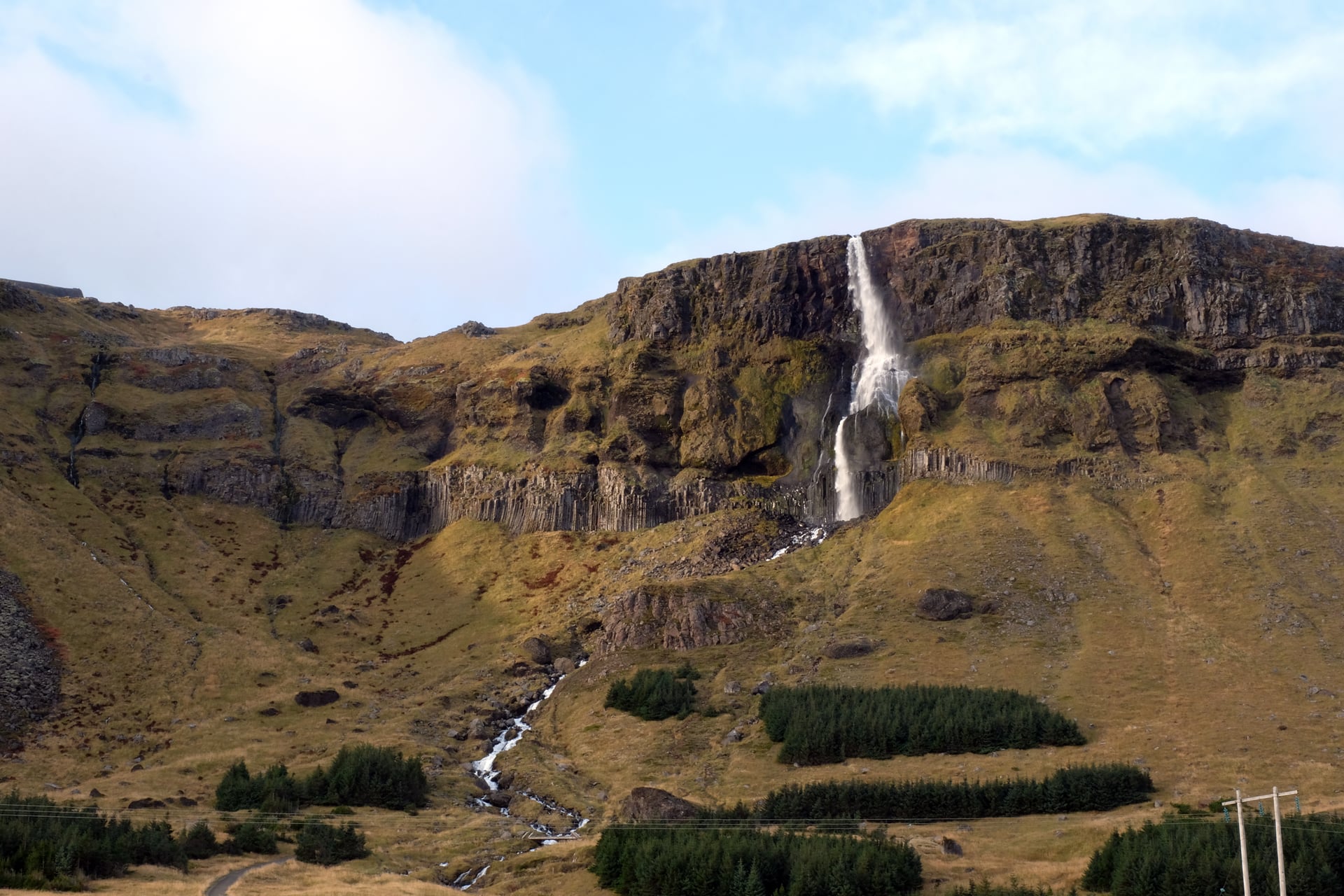
West Iceland's official description places the waterfall exactly where it belongs: above Búðir, below Mælifell, falling from the cliff edge with basalt walls around it. That geography gives Bjarnarfoss its character. The waterfall does not live in isolation. It belongs to a whole arrangement of mountain slope, old volcanic ground, church plain, and coastline. When people remember Bjarnarfoss, they often remember not only the water itself but the way it hangs over the landscape as if the mountain had opened a seam for gravity to write through.
What makes the site especially strong for travelers is that it changes scale depending on where you stand. From the road, Bjarnarfoss seems elegant and distant, part of a larger panorama that includes Búðahraun, the lowlands around Búðir, and the southern flank of Snæfellsnes. As you walk toward it, the waterfall becomes less decorative and more physical. The height starts to read differently. The sound grows. The cliff face becomes textured rather than flat. This shift from postcard to presence is one of the pleasures of the place.
West Iceland also notes something people often miss in quick stop-and-go itineraries: the slopes by the waterfall are rich in flowering vegetation. That detail matters because Bjarnarfoss is not only a study in rock and falling water. It is also one of those Snæfellsnes sites where harshness and softness sit unusually close together. Dark cliff, white water, green slope, and often a softer lowland light near the coast all meet in one frame. The result is less severe than many Icelandic waterfall settings and, in its own way, more nuanced.
The site has also been recognized for how it is cared for. West Iceland records that the resting place at Bjarnarfoss received the Icelandic Tourist Board's Environment Prize in 2018. That is not trivia. It helps explain why the stop feels more settled and legible than many roadside attractions. Iceland is full of places whose popularity strains the ground beneath them. Bjarnarfoss matters partly because the infrastructure here reflects an effort to welcome people without flattening the place into something careless.
One of the most evocative descriptions of Bjarnarfoss comes not from tourism language but from Iceland's environmental authority. In the official text on the protected coast by Stapi and Hellnar, Umhverfisstofnun describes Bjarnarfoss falling from the rocky slopes above Búðir and says that in it stands a Lady of the Mountains, with the spray forming a shawl over her head and shoulders. That image is worth carrying into the article carefully. It is not a literal claim and does not need to be treated as one. It is local landscape imagination doing what Icelandic landscape imagination often does best: giving a shape of personhood to rock, mist, and distance.
That figure of the mountain lady tells you something important about how Bjarnarfoss is experienced. This is not a waterfall that invites only measurement. Yes, people want to know where it is, how long the walk is, and whether it is worth stopping. But the site also asks for a slightly slower eye. The line of the water, the folds of the cliff, and the spray shifting in wind all make it easy to understand why the landscape was read in human terms. At Bjarnarfoss, imagination does not feel pasted onto nature from outside. It feels drawn out by the form of the place itself.
The larger Snæfellsnes setting deepens that feeling. The national park and nearby protected-area material make clear that this whole district is a conversation between volcanic history, lava, sea exposure, and unusually varied geology. West Iceland specifically notes that the basalt cliff was formed by the now extinct volcano Mælifell. That helps make Bjarnarfoss more than a pretty stream over a wall. The waterfall is part of an older volcanic architecture. Water is tracing down a structure made by fire long before most visitors can imagine the timescale involved.
This is one reason Bjarnarfoss works so well on a private itinerary. It can be treated as a quick scenic pause, but it rewards anyone willing to spend a little longer. Walk upward and look back. The view toward Búðir changes the meaning of the waterfall again. West Iceland points out that from the trail the view over Búðakirkja, Hotel Búðir, and the coastline is breathtaking. That is exactly right, but the deeper reason is compositional. Very few stops in Iceland give you such a clean conversation between one falling line of water and such a broad, low, historically charged foreground below.
That foreground matters because Búðir is not just scenic filler. It carries church history, trading history, lava-field ecology, and one of the most recognizable black church images in the country. From Bjarnarfoss, all of that sits beneath you in a way that turns the waterfall into a kind of overlook on memory as much as terrain. The stop begins to feel less like a self-contained attraction and more like a vertical entrance into the southern Snæfellsnes story.
Compared with other Snæfellsnes waterfalls, Bjarnarfoss has a distinct personality. It is not hidden and intimate like Kvernufoss, not saga-heavy in the same direct way as Rauðfeldsgjá, and not primarily about brute force or immense spray. Its strength lies in placement. It stands where road, mountain, plain, and coast all become readable at once. That makes it especially satisfying for travelers who like landscape to explain itself gradually instead of simply overwhelming them.
Photographically, Bjarnarfoss is unusually generous. From a distance, it can be framed with the mountain and lowland around it, showing how elegantly the waterfall occupies the slope. Closer in, the cliff and stream give stronger texture and vertical drama. In changing light, especially when cloud moves across Snæfellsnes quickly, the white water can seem to brighten against a darker backdrop in a way that makes the whole mountain face feel alive. This is one of the reasons the waterfall stays memorable even for people who see many more famous stops on the same trip.
For tourists, the practical appeal is simple: Bjarnarfoss is easy to reach, visually immediate, and close to major southern Snæfellsnes routes. But the more human appeal is subtler. The place gives you a sense of arrival. It feels like a threshold. Once you have seen it and looked back toward Búðir and the coast, the peninsula seems to change tone. You are no longer just driving between attractions. You are inside a more coherent landscape, one in which volcanic form, local imagination, and coastal settlement all keep answering each other.
Bjarnarfoss often catches travelers first from the road or from a photograph, then rewards a slower stop. What people really need to know is why this waterfall feels different from dozens of others and whether it justifies time on a Snaefellsnes route. The honest answer is yes, especially for travelers who care about atmosphere, viewpoint, and the layered relationship between mountain, Budir, coast, and falling water.
What stays with many visitors after Bjarnarfoss is not only the image of a waterfall, but the structure of a whole scene: white water falling from old volcanic rock, green slope at its feet, Búðir below, and the southern Snæfellsnes coast opening outward. It is a composed place, almost painterly, but it never feels artificial. Bjarnarfoss lingers because it turns orientation into emotion. You see where you are, and for a moment that feels like enough.