Iceland Travel Guides
Borgarnes: Saga Memory, Coastal Rhythm, and the Gateway Logic of West Iceland
A fuller private guide to Borgarnes, with its gateway role in West Iceland, Egils Saga memory, Settlement Centre, coastal walks, and the everyday rhythm that makes the town worth more than a quick stop.
GlaciGo Iceland / May 2026 / 10 min read
Borgarnes is one of those Icelandic towns that can be underestimated precisely because it is so useful. People pass through it on the way to Snæfellsnes, the Westfjords, Silver Circle, or North Iceland, and that gateway role can make it look like a place of logistics rather than a place of character. But Borgarnes is better than a fuel-and-coffee stop. It is one of the towns in Iceland where route logic, saga memory, coastal atmosphere, and everyday life come together in a way that feels unusually complete. If you slow down instead of only passing through, Borgarnes starts to read not as a pause between destinations but as one of West Iceland's most revealing human-scale places.
Visit West Iceland says it simply: Borgarnes lies in the middle of West Iceland, about 75 kilometers from Reykjavík city center. That location matters more than it first appears to. Borgarnes is not dramatic because it is remote. It is important because it sits where roads and regions begin to branch. From here, travelers can fan outward into Borgarfjörður, northward on the Ring Road, west toward Snæfellsnes, or farther toward the fjords. The town therefore carries a feeling of threshold. You are leaving the gravitational field of Reykjavík, but you are not yet in the deep distances. Borgarnes stands at the point where travel becomes regionally specific.
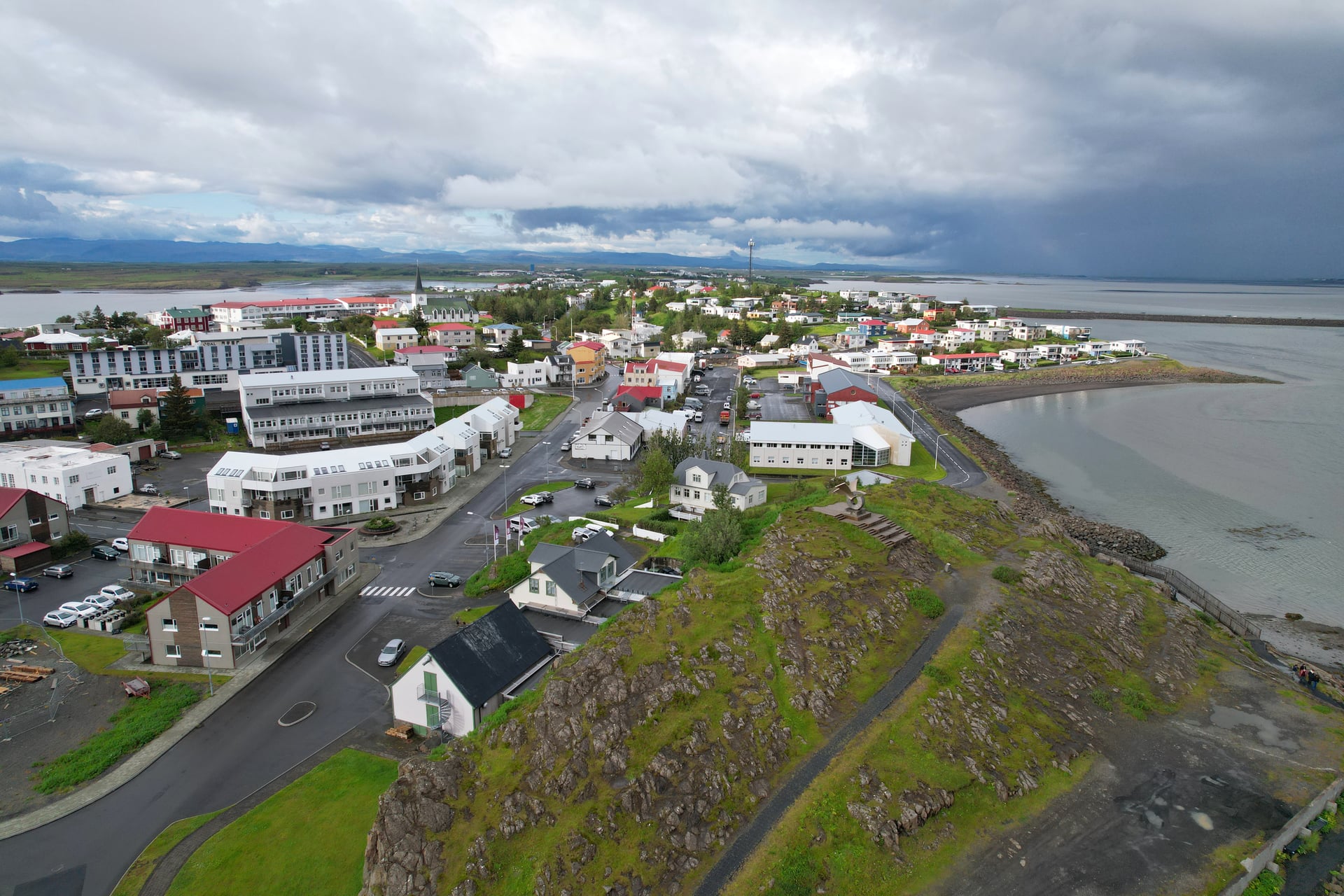
Its physical setting reinforces that role beautifully. Borgarnes sits on a peninsula at the shore of Borgarfjörður, which gives it more water, sky, and edge than many service towns of comparable size. The town is not merely beside the road; it leans into the bay. Visit West Iceland highlights the beaches, the old cove Englendingavík, the walking trail, and the views toward Hafnarfjall and even Snæfellsjökull on clear days. These are not decorative extras. They explain the mood of Borgarnes. This is a place where urban life and open landscape stay close together, where you can eat, sleep, swim, visit a museum, and still feel the bay breathing around the town.
That coastal feeling is one reason Borgarnes benefits from a fuller explanation rather than a short practical mention. traveler questions around Borgarnes usually begins with function: where to stay, whether it is a good base, whether it is worth stopping on the Ring Road. The stronger answer is yes, because Borgarnes works on two levels at once. It is efficient and it is atmospheric. It gives you access to West Iceland, but it also gives you a distinct local identity shaped by saga memory, shoreline walks, and a town scale that is lively without becoming anonymous.
The saga layer matters enormously here. The Settlement Centre's official material says the museum sits in the heartland of one of Iceland's most famous medieval tales, Egils Saga, in two of Borgarnes's oldest houses by the coast. Visit West Iceland adds that the centre recreates Iceland's earliest days and introduces visitors to one of the best-known heroes of the Icelandic sagas, Egill Skalla-Grímsson. This is not just museum marketing. It tells you something true about Borgarnes. The town is one of the easiest places in Iceland to feel the transition between saga literature and actual landscape. You are not reading a text in isolation. You are moving through a real coastal settlement where names, places, and local memory still echo that older story-world.
This becomes even more tangible in places like Skallagrímsgarður and Brákarey. Visit West Iceland notes that the public park in the center of town plays an important role in Egil's Saga, while Brákarey, connected to the mainland by a bridge, is named after Þorgerður Brák, the slave of Skalla-Grímur and nurse to Egill. These details matter because they stop Borgarnes from feeling like a neutral modern town that merely hosts a museum about the past. The town itself is entangled with the past. Its geography still speaks saga language if you know how to listen.
Brákarey is especially revealing in that respect. On the surface it is just a small island attached by a bridge. In memory, it is part of one of the most emotionally charged stories in the Egils saga tradition. That duality is very Borgarnes: ordinary town fabric on one level, old narrative undercurrent on another. The best visits here do not force those layers into spectacle. They let you notice them quietly, by walking, reading, and looking outward over the water.
The Settlement Centre deepens the town's role rather than dominating it. Official information from Landnámssetur emphasizes that the museum stands in two of Borgarnes's oldest houses, right by the coast, and is devoted both to settlement history and to Egils Saga. That is exactly the right cultural heart for a town like this. It gives visitors a way into Iceland's early history without severing that history from the town around them. You come out of the exhibition not into a generic street but into Borgarnes itself, where the harbor, the peninsula, and the named places continue the story in quieter form.
Borgarnes is also one of the few West Iceland stops that works equally well as a base and as a stopover. Visit West Iceland lists a mix of practical and low-key pleasures: Geirabakarí for breakfast, Borgarnes Swimming Pool, the local museum, beach walks, Bjössaróló playground, Einkunnir Country Park, and Hafnarfjall nearby. This breadth matters. The town does not depend on one single attraction. It functions as a lived place. That makes it valuable for travelers who are tired of destinations built entirely around one photo point or one ticketed experience. In Borgarnes, the town itself is part of the value.
The old cove Englendingavík adds another note of coastal memory. Visit West Iceland points out that the name means the Englishman's Cove. You do not need to over-explain it to feel what it contributes. Borgarnes has the kind of layered shore where names preserve trade, contact, and remembered outsiders. That is part of the town's charm. It does not present history only through formal exhibitions. Sometimes history is simply there in a place-name, a shoreline, a bridge, a church site, or an older house still doing everyday work.
The walking trail around Borgarnes is another reason the town lands so well. Visit West Iceland describes how visitors are welcomed by Hafnarfjall while also being able to admire Snæfellsjökull and the surrounding sea. This gives Borgarnes a spatial generosity that many small towns do not have. Even when you are staying in town, the wider West Iceland landscape stays visually present. That prevents the place from feeling boxed in. Borgarnes remains open, horizon-rich, and slightly windswept in a very Icelandic way.
The bridge over Borgarfjörður matters too, even if people tend to register it only practically. Visit West Iceland notes that Borgarfjarðarbrú is the second-longest bridge in Iceland and links Borgarnes to Route 1 and the surrounding road system. In travel terms that is useful information. In emotional terms it says something deeper: Borgarnes is a connector. It is a town built around movement, passage, and orientation, but without losing its own texture. Some gateway towns feel purely transitional. Borgarnes manages to keep a center while also helping everyone move onward.
That is probably why the town works so well for different kinds of travelers. Families can actually use it. Road-trippers can rest in it. History-minded travelers can read it. Photographers can work with the bay light and mountain backdrop. People heading west can use it as a final reorganization point. People coming back east can use it as a place to soften the reentry toward Reykjavík. Good towns do not only offer attractions; they offer rhythm. Borgarnes does that very well.
Borgarnes benefits from a fuller explanation because it is too often flattened into a sentence like "good overnight stop in West Iceland." That is true but insufficient. The stronger description is that Borgarnes is one of Iceland's most useful and characterful small towns: a saga-marked coastal settlement, a cultural gateway to Borgarfjordur, and a place where museum history, shoreline walking, daily services, and old place-memory meet naturally.
What many travelers remember after giving Borgarnes real time is the feeling of balance. The town is practical without being dull, historical without becoming staged, scenic without acting like a wilderness stop, and central without feeling overrun. It is one of the places in Iceland that helps you understand how travel and life fit together outside the capital. Borgarnes lingers because it quietly proves that some of the country's best places are not only the spectacular ones. Some are the towns that teach you how the rest of the landscape is meant to be entered.