Iceland Travel Guides
Brimketill: Oddný's Pool and the Atlantic Force of Reykjanes
A fuller private guide to Brimketill, with wave-carved geology, the Oddný folklore, coastal danger, and the raw Atlantic character of Reykjanes.
GlaciGo Iceland / May 2026 / 10 min read
Brimketill is one of those Icelandic places that looks simple from a distance and becomes much more interesting the longer you stay with it. At first glance it is just a wave-carved hollow in dark lava near the sea, a short stop on the Reykjanes Peninsula where people park, walk a marked path, take photographs, and move on. But that first glance misses the real force of the place. Brimketill sits at the meeting point of lava, North Atlantic wave energy, local folklore, and a very Icelandic lesson about the difference between access and invitation. You are allowed to come close enough to understand it. You are not being invited to forget what the ocean is capable of.
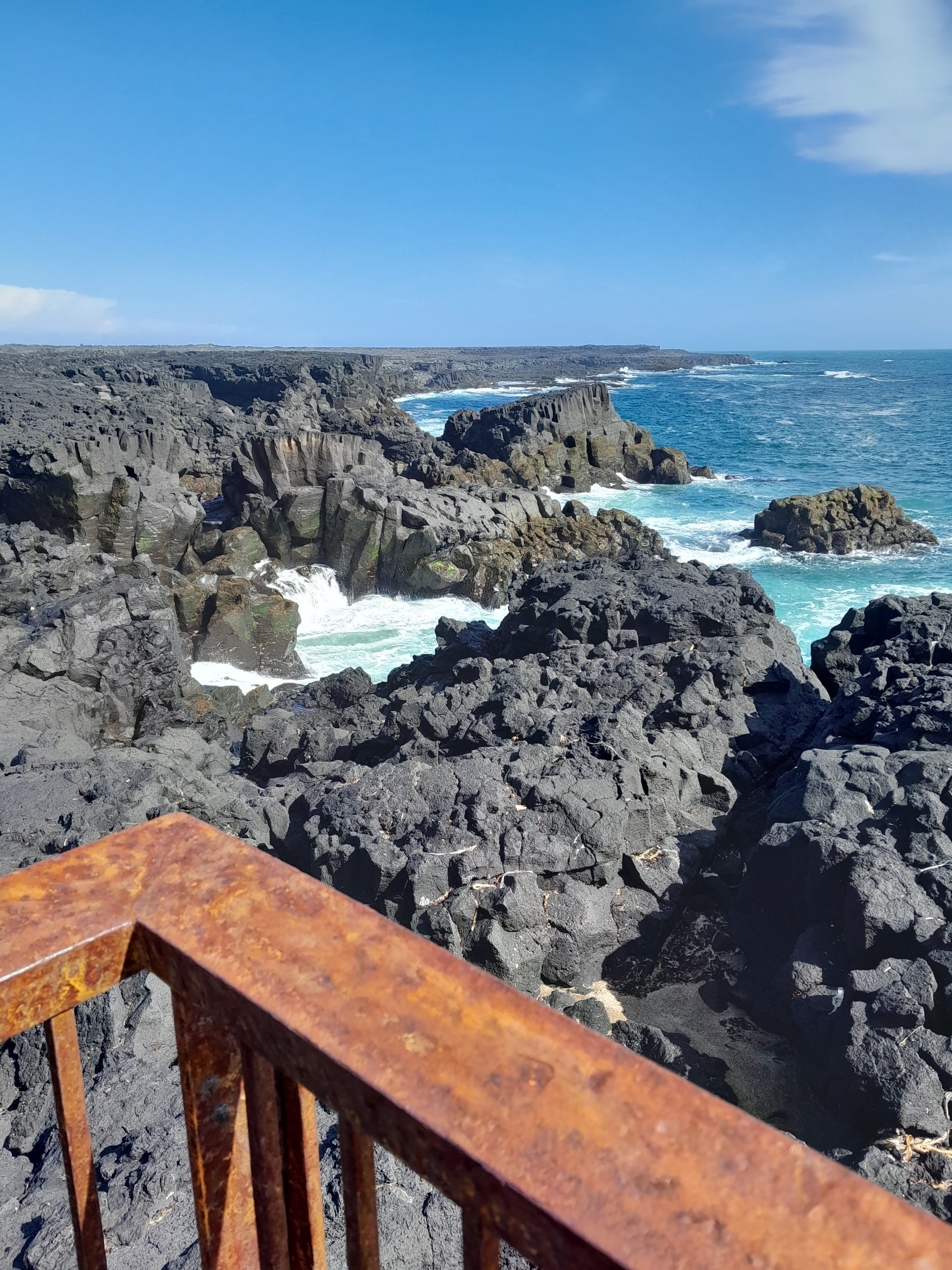
Visit Reykjanes gives the key definition plainly: Brimketill is a small, naturally carved pool created by marine erosion at the edge of a lava shore west of Grindavik. That description matters because it protects the site from a common misunderstanding. People often call it a natural pool in a way that makes it sound swimmable or spa-like. It is neither. Brimketill is not a bathing spot. It is a geological feature shaped by surf, a cauldron-like depression at the coast where the sea demonstrates its patience and violence in the same gesture.
The place has an older name in folklore too. Visit Reykjanes notes that the pool was said to be used by a giantess named Oddny, and older tradition called it Oddnýjarlaug, Oddny's pool. This gives Brimketill one of those perfect Icelandic double identities, where geology and story do not compete so much as complete each other. The waves hollowed the lava. The human imagination then gave the hollow an owner. Once you know the story, the pool stops looking merely accidental. It begins to feel inhabited, or at least claimed, by an old narrative presence that suits the coastline remarkably well.
That folklore works because the site already feels larger than human scale. The ocean around Brimketill does not move gently. Even on a relatively calm day, the black volcanic shore carries a latent violence. In rougher conditions, waves break against the rock and water surges with the kind of force that makes the pool's shape suddenly easy to understand. It was not made by one dramatic event but by repetition. Marine erosion here is not an abstract geological term. It is a visible long argument between lava and sea.
Reykjanes Geopark places Brimketill in a useful geological context by noting that the lava likely flowed here during the Reykjanes Fires between about 1210 and 1240. That detail widens the time scale beautifully. The rock edge is medieval in human terms, volcanic in geological terms, and still being worked by the ocean now. Brimketill therefore belongs to a larger Reykjanes story in which eruptions, tectonics, and coastal erosion do not form separate chapters. They remain active layers in the same landscape.
This is one reason Brimketill benefits from clear explanation. Travelers often arrive unsure whether it is a swimming place, a folklore site, a geological feature, or simply a coastal viewpoint. It is best understood as a lava-rock pool to observe from a safe distance, shaped by Atlantic force and sharpened by the Oddny story. That clarity makes the stop more satisfying and safer at the same time.
Atmosphere, in fact, is where Brimketill becomes stronger than its size suggests. Many Iceland attractions dominate through scale. Brimketill works differently. It is intimate in footprint but not in feeling. The platform and path bring you close enough to watch the shoreline and the carved basin without pretending you control the scene. The best visits often happen when there is enough swell to animate the coast but enough visibility to read the shape of the lava. Under those conditions, Brimketill feels like a study in tension: a contained form inside an uncontained environment.
There is also something satisfying about how Brimketill changes the way people read the whole Reykjanes coast. Inland geothermal areas on the peninsula tell visitors that heat is close to the surface. Brimketill tells them the sea is doing its own sculpting at the edge of that same volcanic world. It pairs naturally with Gunnuhver because the two sites express different faces of elemental pressure. At Gunnuhver, the earth vents. At Brimketill, the coast is carved. Together they make Reykjanes feel less like a list of stops and more like a peninsula under continuous formation.
Safety should be a major part of any honest Brimketill article. Visit Reykjanes is explicit that visitors should never attempt to walk down to the pool itself, especially since the sea can be extremely dangerous. This warning should not be softened into generic travel caution. The power of Brimketill is inseparable from the risk around it. The feature exists because waves strike this coast hard. Respecting the barriers and viewing infrastructure is not a bureaucratic inconvenience. It is how the place remains visitable without turning reckless curiosity into an accident.
That safety culture is also part of the site's recent history. Reykjanes Geopark announced that development at Brimketill received the Icelandic Tourist Board's Environmental Award for 2023. That is more than a nice institutional detail. It signals that Brimketill is now understood not only as a beautiful stop but as a place where access has to be designed carefully. The walkway, viewing structure, and broader management matter because they allow people to experience a fragile and dangerous edge without degrading it or misreading it.
Photographically, Brimketill can be deceptive. Because the pool itself is comparatively small, visitors sometimes try to reduce the place to one close-up image. The stronger photographs often do the opposite: they let the pool sit inside the larger coastal architecture of black lava, broken surf, horizon, and weather. A good image shows scale and exposure. It may also suggest why the Oddny story endured. The coastline does not feel empty. It feels like the kind of place where a giantess would indeed have been imagined bathing, washing, or waiting between storms.
That story of Oddny deserves a little more room because it reveals something important about Icelandic coastal folklore. The giantess is not attached to a gentle inland hot spring or a fertile farm valley. She is attached to a sea-carved basin on a hard shore. In other words, the character fits the geology. Icelandic folklore often reads like an attempt to assign personality to landforms that already feel animate. Brimketill is a fine example. The pool's shape, its difficult access, and the violence of the surf all encourage narrative. Oddny is the cultural answer to that invitation.
On a private itinerary, Brimketill works especially well as a sharpening stop. It is not where you spend half a day, and it should not be over-inflated into something it is not. Its strength is concentration. In a short visit, it can teach a traveler how to look at the Reykjanes coast: not only as scenery, but as a process. Once you have watched the waves around Brimketill, nearby cliffs, lava edges, and sea stacks start to make more sense. The coast becomes legible as work in progress.
It also fits beautifully into arrival-day or departure-day touring from Keflavik. The stop is close enough to be practical, visually distinct from inland Iceland, and emotionally immediate in a way that works well when people are adjusting to the country. Without requiring a long hike or a major detour, Brimketill gives visitors a taste of something fundamental: this island is not merely sitting in the Atlantic. It is being handled by it.
Brimketill sits in a useful middle ground between famous and misunderstood. It is popular enough to be searched by name, but strange enough that many visitors do not know what they are seeing until they stand above it. The strongest visit clarifies the lava formation, the folklore, the safety reality, and the relationship to nearby Reykjanes stops such as Gunnuhver and Reykjanesviti.
What stays in memory after Brimketill is usually not the size of the pool but the mood around it: black lava under white surf, a basin carved by persistence, the name of a giantess attached to a dangerous shore, and the sense that even a small hollow in Iceland can hold geology, story, and caution in one compact form. Brimketill is one of Reykjanes' best examples of how a modest feature can still carry a full landscape's character.