Iceland Travel Guides
Búðir: Black Church, Living Lava, and the Quiet Weight of Memory
A fuller private guide to Búðir, with Búðakirkja's layered history, Búðahraun's unusual ecology, the old trading port, the 1799 storm, and the wider memory held in this calm southern landscape.
GlaciGo Iceland / May 2026 / 10 min read
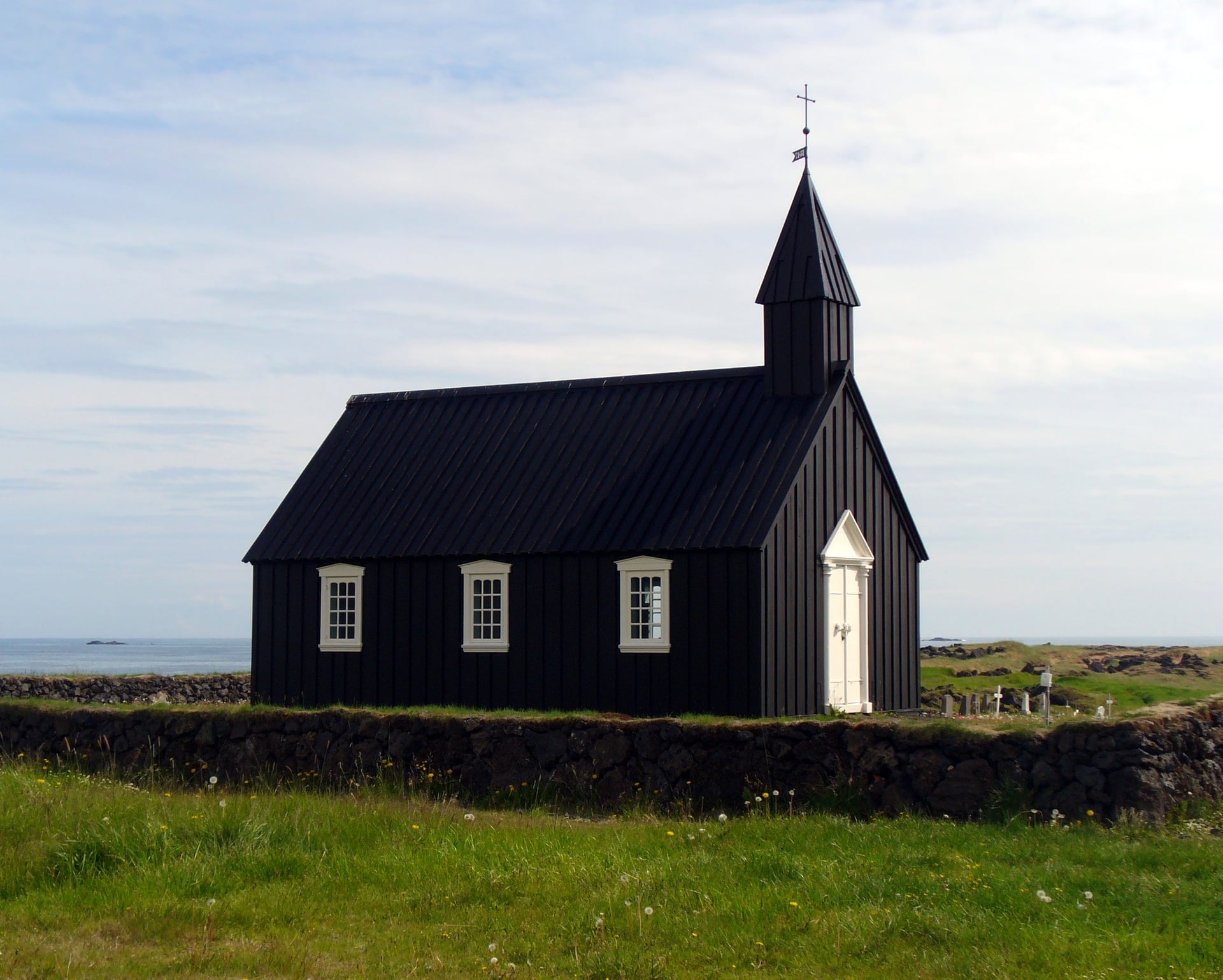
Búðir is one of those Icelandic places that the camera almost loves too quickly. A small black church, a sweep of open land, pale sand, dark lava, and the distant authority of Snæfellsjökull: the composition is so clean that many travelers assume they understand the place in a glance. But Búðir is not only a photograph, and not only a wedding-church stop. It is one of the most layered places on Snæfellsnes, where trade history, volcanic landscape, religious memory, and a surprisingly exposed human past all meet under a surface of great visual calm.
West Iceland's official description begins with the landscape itself: golden sand beaches, rugged lava field, strong vegetation, birdlife, and a commanding view of Snæfellsjökull. That list matters because Búðir is often reduced to Búðakirkja alone. In reality, the church works because the surrounding land is so distinctive. The contrast between light shore, dark lava, and black timber architecture gives Búðir much of its emotional charge. The church is not a solitary icon dropped onto neutral ground. It belongs to a highly specific southern Snæfellsnes setting.
The lava is especially important. West Iceland notes that Búðahraun is a nature reserve, and the national-park brochure explains why it matters so much: the lava field stands on the old seabed, its foundations soaked in seawater, and it supports some of the most beautiful and varied vegetation in the country. The same official source notes that around 130 plant species grow there, including 11 of Iceland's 16 fern species. That is a remarkable ecological richness for a place many visitors initially read as austere. Búðir is beautiful not only because it is open and dramatic, but because the lava is alive in a quiet, sheltered way.
This makes the mood of Búðir different from much of the harsher Snæfellsnes coast. There is more light here, more breathing room, and a gentler line between settlement and landscape. The shore is not soft in the conventional sense, but it does feel spacious. The old lava, the grass, the low horizons, and the distant glacier create a kind of southern openness that many people remember long after the church itself. Búðir is one of the places where Snæfellsnes feels almost painterly without losing geological seriousness.
The church, of course, remains central. The Environment Agency's brochure gives its history in helpful detail. Búðakirkja was first erected in 1703 by the merchant Bent Lárusson. After it decayed, it was rebuilt in 1848 by Steinunn Sveinsdóttir, supposedly after Bent requested it in a dream. In 1984, the church was moved in one piece from the old graveyard to its present foundations, then renovated to the form it was believed to have had in 1848 and re-consecrated in 1987. It is now a listed building owned by the National Museum of Iceland and cared for by the Búðir parish.
Those details save Búðakirkja from cliché. The church is often treated as an image of romance, and the official brochure itself notes that Búðir and Búðakirkja have a romantic air and are popular for weddings. All of that is true. But the building is also a document of local persistence, repair, dream, relocation, and careful conservation. It has been built, lost, rebuilt, moved, and reinterpreted. That layered life gives the church more dignity than a simple black-church postcard can hold.
Búðir itself has an even deeper history. The official park brochure describes it as an important site in the history of trade and industry in Iceland, noting that Eyrbyggja Saga suggests it already functioned as a trading port in the centuries after settlement. It also points to Frambúðir, around three kilometres south-west of the hotel, where fishing boats rowed out from early settlement times onward and where ruins of fishermen's huts, fishing structures, and merchant buildings still testify to the old economy. The place name itself is linked to these verbúðir, the huts of seasonal fishing life.
This trading and fishing history matters because Búðir can otherwise seem too elegant, too composed, too detached from labor. In fact, it played a central role in the prosperity of wider municipalities for a long time, drawing people from afar to trade. The park brochure records that around 100 people lived there in 1703, a substantial number in Icelandic terms. The westward and eastward movement of the trading center across the estuary also shows that Búðir was not static. It was a working landscape adjusting constantly to coastal realities.
Those coastal realities could be brutal. One of the strongest official details about Búðir comes from the park brochure's account of the night of 8 January 1799, when violent storms, torrential rain, thunder, lightning, and tempestuous seas drove surf as far as 1500 fathoms, about 2700 metres, inland and almost washed away the village. That is the kind of fact that changes how you stand in a place. Búðir's beauty can feel serene today, but its history includes weather so violent that the whole settlement nearly disappeared under it.
Then there is the darker human history. The same brochure recalls Axlar-Björn, the notorious murderer who lived on the nearby farm Öxl and confessed to killing nine travelers, though some believed the true number was closer to eighteen. He was thought to have placed bodies in a pond at the edge of Búðahraun called Iglutjörn. This is not the most famous story visitors bring to Búðir, but it belongs to the place, and it matters. It reminds us that the romantic calm of the present landscape sits over a past that was not only beautiful or industrious, but also harsh, exposed, and sometimes violent.
All of this makes Búðir especially satisfying on a private itinerary. It can be read from several angles without becoming repetitive. For some travelers, it is a church-and-landscape stop. For others, it is a doorway into Icelandic trade history. For others again, it is a lava-and-light experience, where Búðahraun, open shore, and the distant glacier create one of the peninsula's most balanced visual fields. The key is to let the place expand beyond its best-known image.
For travelers planning Sn?fellsnes carefully, B??ir answers several questions at once. It is a black-church stop, a B??ahraun stop, a coastal-light stop, and a small historical landscape with more weight than its calm surface suggests. B??ir is worth more than a quick photograph because it gathers ecological richness, architectural focus, commercial history, and emotional spaciousness in one of the peninsula's most complete small places.
What stays with many travelers after Búðir is a sense of quiet that has already survived a lot. The church is still there. The lava still holds its greenery. The sands still open toward the south. But once you know the history of trade, storm, rebuilding, and rumor, the quiet changes character. It no longer feels empty or merely pretty. It feels inhabited by memory. That is why Búðir lasts in the mind. It is not just lovely. It is durable.