Iceland Travel Guides
Deildartunguhver: Geothermal Power and Private West Iceland Tips
A fuller private guide to Deildartunguhver in West Iceland, with geothermal output, local domestic history, Krauma context, rare plant life, and route-planning tips.
GlaciGo Iceland / May 2026 / 9 min read
If you want to understand how geothermal energy becomes daily life in Iceland, Deildartunguhver is one of the clearest places to start. The first thing you notice is the steam and the heat. The second is that this spring is not only a spectacle. It is part of the working life of the district. In West Iceland, hot water is not an abstract natural wonder. It heats homes, supports bathing culture, shapes greenhouses, and has done so across generations.
Krauma describes Deildartunguhver in Reykholtsdalur as the most water-rich hot spring in Europe. Their figures say it produces about 180 liters of nearly 100 degree Celsius water every second. That is the kind of number people read once and then immediately forget unless they stand beside the spring and feel what it means. Up close, the force becomes physical. Steam fills the air, the water churns with a kind of constant authority, and the spring feels less like a pool than like an exposed engine in the ground.
What makes Deildartunguhver especially interesting is that it does not perform in bursts. Geysir and Strokkur shape a visitor's attention around waiting, watching, and eruption. Deildartunguhver does something almost more impressive: it never stops. Its power is steady rather than theatrical. That continuous output is part of why it matters so much in regional history and modern infrastructure.
West Iceland's tourism material and Krauma together help frame the spring properly. This is a geothermal site, a bathing culture site, and a practical resource. Visitors who only look for a dramatic photo can miss the deeper point. Deildartunguhver shows how Iceland has long lived with geothermal heat not as an occasional wonder, but as a dependable companion. That makes the stop feel more intimate than many headline attractions.
Krauma also preserves some of the local memory around the spring itself. For generations, the heat and steam were used in everyday domestic life, especially for washing and cooking. They even note that a timber pipeline once carried steam around 600 meters to the old house at Deildartunga for heating, hot showers, and steam-bath use. That image is worth holding onto. Before geothermal energy became a polished part of Iceland's national image, it was already a practical tool in ordinary homes.
The spring has a quieter ecological story too. Krauma notes that a special fern, tunguskollakambur, grows by Deildartunguhver and is not known anywhere else in the world. That detail changes the site slightly. It is not just an industrial-scale source of hot water. It is also a very specific habitat created by constant heat in a cold country, where rare life has found a way to exist at the edge of steam and mineral water.
For private travelers, Deildartunguhver is strongest when it is folded into a wider West Iceland route. Pair it with Reykholt and Snorralaug, and the day begins to connect geothermal reality with medieval history. Pair it with Krauma, and you move from raw source to controlled bathing experience. Pair it with Hraunfossar and Barnafoss, and the route starts showing the district through heat, water, lava, story, and settlement rather than through isolated stops.
That layered reading is one of the advantages of a private itinerary. A bus stop can turn Deildartunguhver into a ten-minute look and a photo. A better-paced route gives the spring a little context: why the water matters, how nearby communities used it, and why the place feels culturally different from a geyser field or a commercial spa. The stop is short, but it should not be shallow.
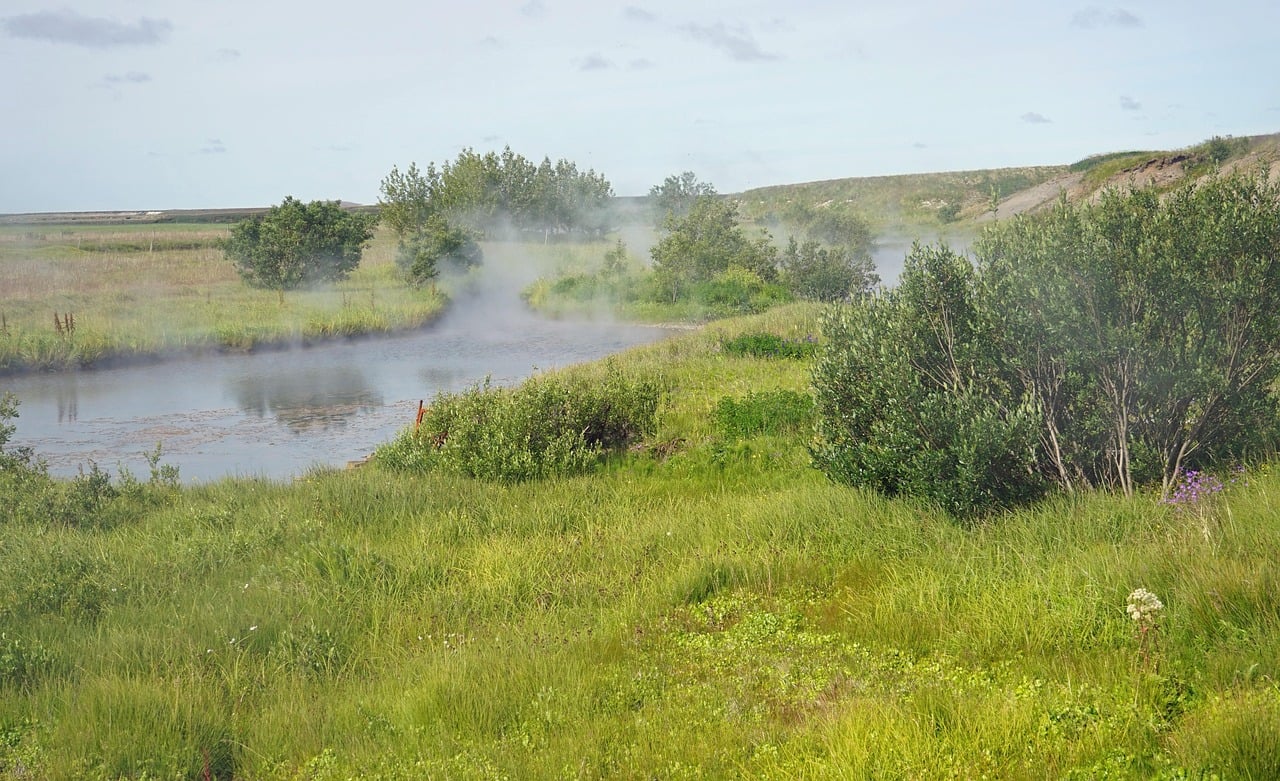
Photographers often do better here when they give up on the idea of one perfect postcard composition. Deildartunguhver is more about atmosphere and evidence than clean scenic symmetry. Steam drifting over railings, the rough texture of mineral-stained ground, boiling water close to the source, and the contrast between raw geothermal force and calm farmland nearby all tell the story more honestly. In colder weather, the steam often becomes denser and makes the site feel even more dramatic.
The safety message is simple, but it matters. The water is dangerously hot, the geothermal ground must be respected, and the barriers are not decorative. Deildartunguhver feels easy to visit because the access is straightforward, yet its ease should never be confused with harmlessness. One of the virtues of seeing it with a guide is that the explanation can stay calm and grounded while the stop remains clearly safe.
Deildartunguhver does not need borrowed folklore to become memorable. Its own reality is strong enough: one of Europe's most powerful hot springs, used across generations, still feeding a culture of warmth, bathing, and practical geothermal life in West Iceland. That makes it one of the most Icelandic stops in the region, not because it is the most beautiful in a postcard sense, but because it reveals how the country actually works.
Travelers who enjoy understanding a place as much as admiring it usually leave Deildartunguhver with a stronger memory than they expected. It is not a long stop, and it is not designed to overwhelm. What it offers instead is clarity. You see the heat. You see the steam. You understand the force. And if the route is built well, you also understand how that force has shaped homes, baths, greenhouses, and everyday life in the valley around it.