Iceland Travel Guides
Dettifoss: Force, Erosion, and the Dark Power of North Iceland
A fuller private guide to Dettifoss, with its raw power, canyon-cutting geology, river sequence with Selfoss and Hafragilsfoss, and the reason it feels more like an event than a viewpoint.
GlaciGo Iceland / May 2026 / 10 min read
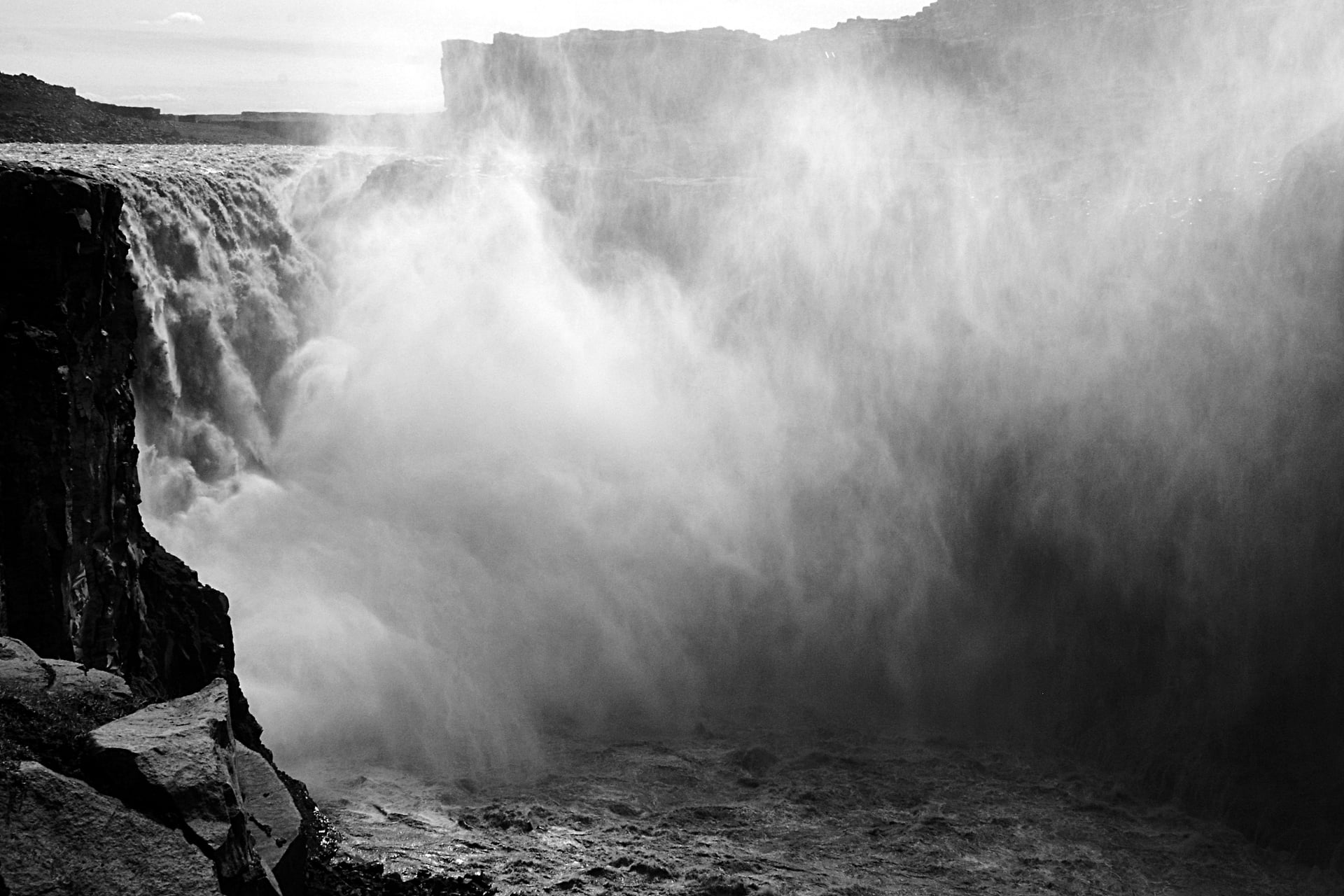
Dettifoss does not persuade gently. It arrives as force. Even before you see the waterfall clearly, you often begin to understand it through vibration, through the thickening sound in the air, through the strange bodily awareness that something large is moving nearby with more power than your eye has yet measured. This is one of the reasons Dettifoss occupies such a singular place in Iceland. It is not only beautiful, and not mainly beautiful in the conventional sense. It is severe, physical, and almost industrial in its intensity, even though the scene is entirely geological. The waterfall feels less like a picture than an event.
Vatnajökull National Park's official page makes the main claim without hesitation: Dettifoss is the most powerful waterfall in Europe. The page gives the dimensions as roughly 44 to 45 meters high and around 100 meters wide. Those numbers are impressive, but on site they are not what truly stay with people. What stays is the way the waterfall turns the whole landscape into a theater of energy. The park text says you can place your palm on a rock close to the waterfall and feel how it vibrates. That image is unusually accurate. Dettifoss is one of those places where power is not abstractly understood. It is transmitted.
Visit North Iceland places Dettifoss among the great waterfall experiences of the region and calls it the most powerful waterfall in Europe. That description is repeated so often that it can become a slogan, but it is worth rescuing from cliché. At Dettifoss, power is not only about volume and drop. It is also about context: a glacial river, a canyon system, exposed rock, and a sense that erosion is still very much underway. The waterfall does not feel settled into permanence. It feels as though it is still making the land in real time.
This active geological quality is one of the most interesting things about Dettifoss. The national park's official page explains that Iceland is geologically young, and that one sign of this youth is the many waterfalls that have not yet erased the steps in their courses. It adds that the series of waterfalls in Jökulsá á Fjöllum changes slowly over time and may even disappear eventually, because that is part of the life cycle of waterfalls. This is a remarkable frame for understanding the place. Dettifoss is not only a spectacle frozen into timelessness. It is a phase in an ongoing process of carving, retreat, and transformation.
The river itself, Jökulsá á Fjöllum, is crucial to that story. It is a glacial river with a character that feels different from the cleaner, calmer beauty some travelers expect from Icelandic water. Dettifoss often looks heavy, silted, and muscular, and that is part of its force. The color and density of the water remind you that this is not a decorative cascade. It is sediment-bearing power, dragging the memory of highland and ice-fed terrain through the canyon with it. That roughness gives the waterfall moral seriousness. It is not polished. It is working.
The wider setting of Jökulsárgljúfur matters just as much. Vatnajökull National Park describes the canyon region as stretching from Dettifoss north toward Ásbyrgi and emphasizes the extraordinary contrast of the route. Around Dettifoss, Jökulsárgljúfur narrows dramatically, and the park notes that this short northern section was created by the waterfall itself, which has been digging through the land since the end of the great outburst floods associated with ancient natural catastrophes. That historical-geological timescale matters. The canyon is not only a backdrop to the waterfall. It is one of the results of the waterfall.
This is why Dettifoss tends to feel more severe than many other iconic Icelandic falls. Goðafoss has grace. Dynjandi has breadth and procession. Gullfoss has shape and drama. Dettifoss has abrasion. It feels like the visible edge of a larger violence that has not fully calmed down. The national park page even mentions that the waterfall gradually digs its way upstream, moving southward by roughly half a meter a year. Whether a visitor remembers the exact number is less important than what it means: this is a landscape still in the act of being revised.
Above and below Dettifoss lie two other significant waterfalls, Selfoss upstream and Hafragilsfoss downstream. The official park and North Iceland materials both point them out, and that sequence matters. Dettifoss is strongest when understood not as an isolated postcard but as the central blow in a longer river argument. Selfoss offers a humbler but beautifully shaped counterpoint above, while Hafragilsfoss extends the canyon drama below. Together they make the river feel composed, but never tame.
Access is part of the experience too, and it shapes how travelers remember the place. The national park page explains that Dettifoss can be approached from both east and west. The west side is reached by paved road 862, though winter service can be limited, while the east side is via gravel road 864, which opens and closes according to conditions. This is important because the two sides do not simply duplicate each other. They create different relationships to the waterfall and the canyon. A serious article does not need to turn that into a side-by-side shopping guide, but it should acknowledge that access itself belongs to the identity of the place.
The west side, in particular, has an unusual tension between accessibility and danger. The national park trail page for the west approach describes the walk from the parking area as easy, about 1 kilometer one way, but also warns that spray from the waterfall can make the path and viewpoint very wet and slippery, especially in winter or severe frost. That mixture is exactly right for Dettifoss. The route is not an expedition, but the place should not be treated casually. There is a difference between accessible and gentle, and Dettifoss is a good lesson in that distinction.
For tourists, one of the strongest things about Dettifoss is that it can reset a traveler's scale. Iceland is full of beauty that can be read aesthetically first: symmetry, color, still water, mountain outline, soft light. Dettifoss is harder to aestheticize so neatly. It insists on mass, noise, and consequence. Many people come expecting a famous waterfall and leave feeling they have encountered something closer to geological temperament. That is why it often becomes one of the emotional anchors of a North Iceland trip, especially when paired with the Diamond Circle or the larger canyon landscape.
Photographically, Dettifoss can be surprisingly difficult, and that difficulty says something true about it. The scene often contains spray, harsh contrast, rough movement, and a scale that resists flattening into one clean frame. The best images are often the ones that admit the violence of the place rather than trying to smooth it into serenity. Dark canyon edge, churning water, mist, and human smallness can all help the picture say what the eye actually felt.
Dettifoss should not be reduced to one superlative, even though the power is real. Travelers often want to know whether it is worth the detour, which side is better, how it compares with Godafoss or Selfoss, and whether the walk is manageable. The stronger answer is that Dettifoss matters because it makes erosion, glacial force, and geological youth visible at full physical scale.
What stays with many visitors after Dettifoss is not merely awe, but a kind of respect tinged with unease. The waterfall is memorable because it does not flatter the viewer. It does not ask to be adored in a simple way. It asks to be reckoned with. Dettifoss lingers because it lets you feel that the land is still being cut, still being shaped, and still large enough to remain indifferent to your presence.