Iceland Travel Guides
Diamond Beach: The Last Bright Stage of Glacier Ice
A fuller private guide to Diamond Beach, with Fellsfjara context, iceberg drift from Jökulsárlón, tidal movement, safety, and the last bright stage of glacier ice.
GlaciGo Iceland / May 2026 / 9 min read
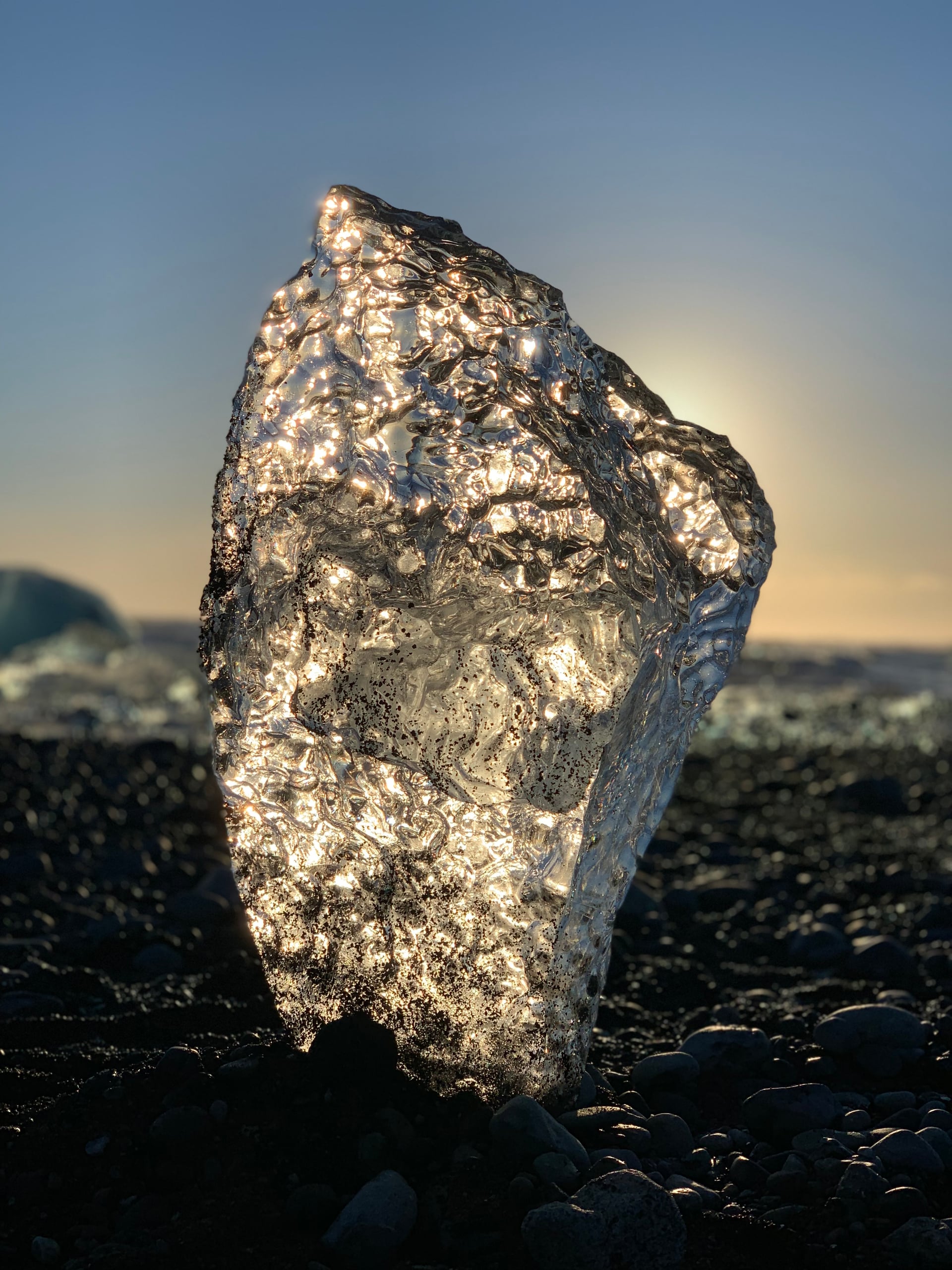
Diamond Beach is one of those names that sounds almost too polished for Iceland, as though someone in marketing got there before the landscape did. Then you stand on the black sand and see clear, blue, and white chunks of glacier lying under shifting light, and the name stops feeling artificial. It still is not the full story, though. The beach matters not because the ice looks like gemstones, but because it shows the final visible stage of a longer journey. At Diamond Beach, glacier ice is no longer held in the lagoon. It has crossed into surf, tide, sand, and impermanence.
Officially, the place is better understood through the names Fellsfjara, Eystri-Fellsfjara, and Breidamerkursandur. Visit South Iceland explains that next to Jokulsarlon there is a less-known attraction within Vatnajokull National Park called Fellsfjara, with Eystri-Fellsfjara on the eastern side of the river and Vestri-Fellsfjara on the western side. These are sandy fields where chunks of glacial ice are carried along the river Jokulsa a Breidamerkursandi toward the sea and then thrown back onto the shore by the tides. That description is exact, and it is the key to writing the place honestly. Diamond Beach is not a separate magic trick. It is a coastal process.
That process is what gives the beach its emotional force. At Jokulsarlon, the ice still floats in blue water with some dignity of scale. At Diamond Beach, the same ice becomes exposed to Atlantic rearrangement. Some pieces arrive polished and luminous. Some are rounded into forms that look sculpted by hand. Others are already collapsing into slush, riddled with bubbles, or stained with ash. The beach does not present a permanent treasure field. It presents a temporary meeting between glacier and wave, repeated over and over in different forms.
The black sand matters as much as the ice. Without it, the pieces would still be beautiful, but they would not ignite the same way in the eye. Dark volcanic sand turns every clear fragment into contrast. The beach becomes a stage designed by geology for a lesson in transience. One moment, a piece of ice glows like cut glass. A little later it has tipped over, dulled, fractured, or disappeared. This is one reason Diamond Beach is stronger in person than in photographs. The image freezes a jewel. The visit teaches you that the jewel is vanishing.
Vatnajokull National Park's Breidamerkursandur page helps widen the context. The park explains that Breidamerkursandur, the outwash plain south of Breidamerkurjokull, contains some of Iceland's most accessible glacier-formed landscapes and that the area has been changing rapidly. The fastest changes can be seen where Breidamerkurjokull calves into Jokulsarlon, but the plain as a whole is shaped by retreat, sediment, lakes, and newly exposed land. Diamond Beach belongs to that bigger moving system. It is not just a photogenic strip near the road. It is part of a changing glacial coast.
The history of Breidamerkursandur deepens that sense of change. According to the national park, the plain was once known as Breidarsandur after the farm Breida, and place names preserve evidence of habitation from Iceland's early settlement period. In the 13th century the climate cooled, glaciers advanced, and Breidamerkurjokull pushed forward until the 18th and 19th centuries. At one point, only about 250 meters separated the glacier from the sea at its shortest distance. The landscape people see today is therefore not ancient in a static sense. It is the result of dramatic change within historical time. Lakes began appearing in the 1930s as the glaciers retreated, and they have continued growing since.
That historical movement is one reason Diamond Beach should not be written as if it were simply a cute add-on to Jokulsarlon. It tells the seaward half of the same story. Ice calves from Breidamerkurjokull into the lagoon, drifts through the outlet, is reworked by tide and surf, and ends up on the sand in temporary forms. In a private itinerary, this makes the pairing with Jokulsarlon almost ideal. The lagoon shows the glacier learning to float. The beach shows the floating ice learning to disappear.
Safety also deserves direct language here. Visit South Iceland warns visitors never to crawl up on the icebergs and not to choose the ones close to the sea. It also says photographers should always keep their eyes on the ocean because waves can come unexpectedly and carry people out. That warning is not filler. Diamond Beach can look deceptively playful because the ice sits at human scale. Some chunks seem like benches, sculptures, or invitations. They are not. Ice can shift, water can surge, and the beach remains part of a live Atlantic shoreline.
This gives the place a different kind of discipline than Jokulsarlon. At the lagoon, the danger is often underestimated because the water appears calm and the ice appears accessible. At Diamond Beach, the danger comes from the seductive closeness of the objects themselves and the unpredictability of the sea. Respect is part of the aesthetic here. Good visitors do not dominate the scene. They read it.
Photographically, Diamond Beach is one of the most generous locations in Iceland, but it punishes lazy attention. The easy version is obvious: shiny ice on black sand, maybe under sunrise or low winter light. The better version comes from watching for relationships. Clear ice with trapped bubbles. A fractured edge catching cold light. A piece shaped by rolling surf rather than still-water drift. Foam curving around a berg for half a second and then vanishing. The beach is less about iconic composition than about timing.
Winter has a special reputation here for good reason. Visit South Iceland describes how the low sun can bathe the beach in magical light that reflects off the ice, making the wait in darkness worthwhile despite the cold. That is true, but the important thing is not to let winter become the only valid season in the imagination. The beach changes year-round because the ice itself changes year-round. Different tides, different wave patterns, different iceberg shapes, different melt stages. Diamond Beach is a place of constant small variation, not a fixed scene.
There is something almost philosophical about the way people respond to the site. Many travelers first approach it with excitement because the pieces of ice look precious. A little later, if they stay quiet long enough, the mood can shift. The beach becomes less about treasure and more about time. Every piece of ice represents mass that has already detached, drifted, and thinned. The beauty remains real, but it no longer feels innocent. Like Jokulsarlon, Diamond Beach is one of those places where wonder and unease can coexist without canceling each other out.
A useful Diamond Beach guide should make the relationship with Jokulsarlon clear without treating the beach as an afterthought. Travelers need to know that the ice comes from the lagoon, that the amount and shape of ice changes constantly, that sunrise and winter light can be beautiful but not guaranteed, and that the ocean deserves serious caution. With those basics understood, the beach becomes more than a spectacle. It becomes the visible last stage of glacier ice meeting the Atlantic.
What lingers after a good visit to Diamond Beach is usually not just the sparkle. It is the movement underneath the sparkle: glacier to lagoon, lagoon to river, river to sea, sea to sand, sand back to meltwater. The beach turns a vast glacial story into objects small enough to stand beside, without making the story any less serious. That is why the place works. Diamond Beach is not merely pretty. It is the last bright sentence in a longer conversation between ice and ocean.