Iceland Travel Guides
Dimmuborgir: Lava Architecture, Folklore, and the Dark Cities of Mývatn
A fuller private guide to Dimmuborgir, with its lava-lake origin, dark castle-like formations, Yule Lad folklore, conservation story, and the reason this Mývatn walk feels so narratively alive.
GlaciGo Iceland / May 2026 / 10 min read
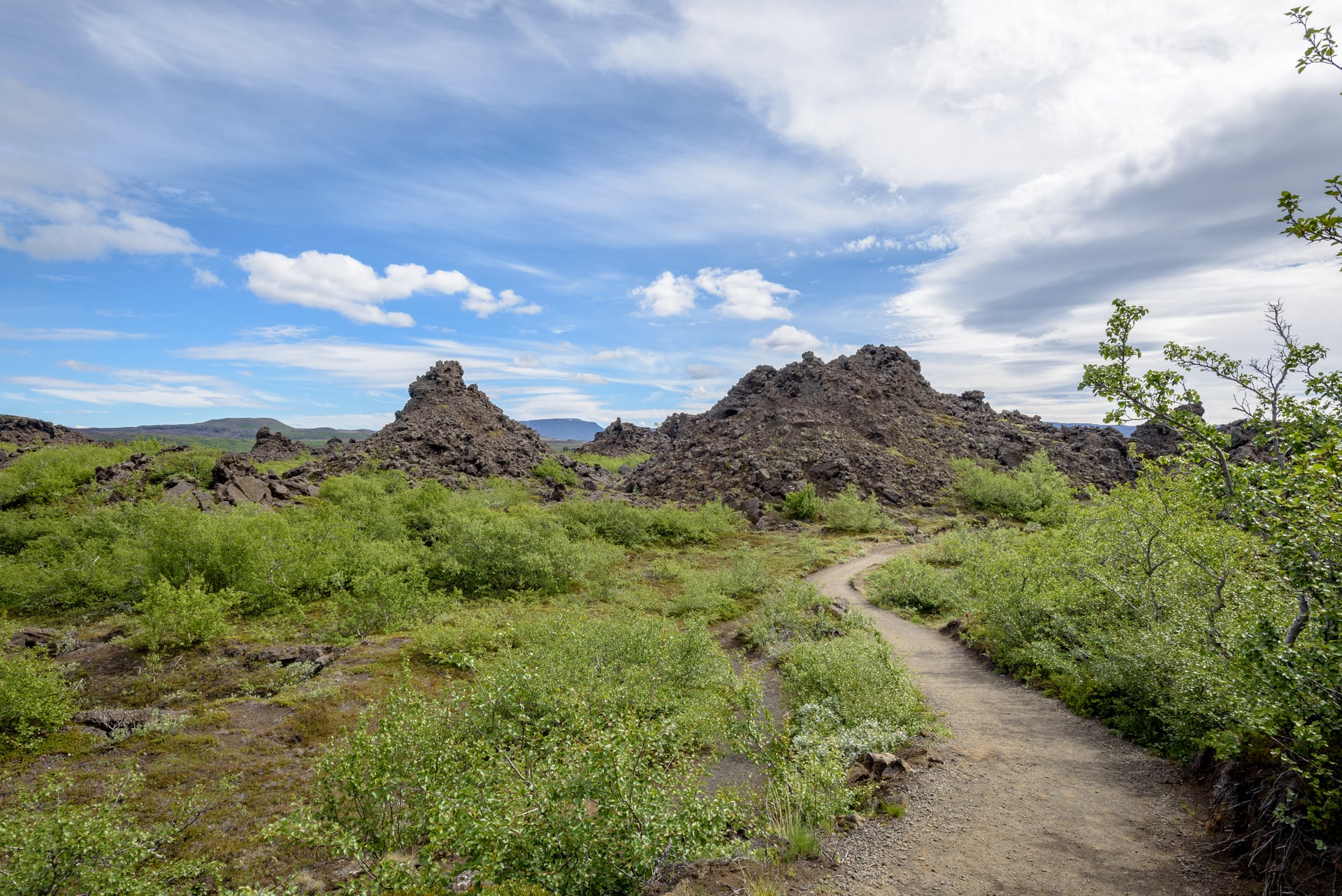
Dimmuborgir is one of those Icelandic places where geology seems to have wandered very close to myth and then decided not to leave. The name is usually translated as Dark Castles or Dark Cities, and almost everyone understands why within minutes of arriving. The lava formations rise like ruined walls, towers, gates, chambers, and alleys. The area does not look like a normal field of rock. It looks inhabited by imagination. That is the first reason Dimmuborgir stays in memory. It does not merely show strange lava. It makes people reach for story almost involuntarily.
Visit North Iceland's official page describes Dimmuborgir as a vast expanse of strangely shaped lava structures and cliffs east of Mývatn, a place whose charm does not fade in winter when the Yule Lads are said to make their home there. The Environment Agency of Iceland gives the deeper geological frame: Dimmuborgir is the remnant of an emptied lava lake formed around 2,300 years ago when lava from Lúdentsborgir and Þrengslaborgir flowed across the Mývatn district and out toward the sea. A blockage caused molten lava to pool beneath a solidifying crust, and when the molten interior drained away it left stacks, chimneys, and extraordinary hollow forms behind. This explanation matters because it keeps the site from being reduced to fantasy. The formations look supernatural, but their history is intensely material.
That material history is exactly what gives the fantasy its staying power. Dimmuborgir is not strange in a random way. The lava architecture has its own logic. The Environment Agency explains that steam rising through the molten lava likely helped cool and shape the chimneys, while the subsiding crust smeared some of them with lava as the lake emptied. In other words, Dimmuborgir is a place where process is still legible in form. The arches, chambers, and stacked structures do not merely decorate the land. They record a specific volcanic event and the unusual mechanics of a draining lava lake.
This is why Dimmuborgir deserves more than a passing mention inside a broader Mývatn article. Around the lake, volcanic forms appear in many registers: pseudocraters, explosion craters, steam fields, young lava, and geothermal caves. Dimmuborgir's personality is different. It is architectural. It invites walking, not only looking. Unlike Hverir, which strips the district down to heat and chemistry, or Leirhnjúkur, which emphasizes recency and unfinished lava, Dimmuborgir feels like a built environment accidentally made by fire. The comparison is metaphorical, of course, but it is also the right way to describe how the place acts on the imagination.
The folklore grows naturally out of that architecture. Official and semi-official North Iceland material does not hesitate to mention the Yule Lads in connection with Dimmuborgir, and this is more than seasonal branding. In Icelandic cultural memory, the lava field has long been linked to trolls, hidden beings, and uncanny presences. The darkness in the name is not only about color. It is about atmosphere. Dimmuborgir feels like the sort of place where a story about beings living half inside rock would have seemed plausible long before tourism arrived.
That mythic quality is part of what makes the site so satisfying for families, for walkers, and for anyone who likes landscapes that feel narratively charged rather than just visually dramatic. You can move among formations that genuinely resemble gates, rooms, towers, and streets. The imagination does not need much prompting. Yet because the geology is real and well explained, the site never slips into mere fantasy park territory. It remains one of the most successful combinations in Iceland: a place where scientific interpretation and folklore strengthen rather than cancel each other.
The protected status matters here too. The Environment Agency says Dimmuborgir is protected because of its unique lava formations and landscape, with a specific aim of preserving distinctive geological forms of high educational and outdoor value. That educational value should not be underestimated. Dimmuborgir is one of the easiest places in North Iceland to help people feel how volcanic landscapes can become structurally complex, not just scenic or violent. It is one thing to read that a lava lake drained. It is another to walk through the stone aftermath of that drainage and see how emptying itself can become a creative force.
The protection story also includes a human chapter that many short guides ignore. According to the Environment Agency, the landowners of nearby farms donated Dimmuborgir for care in 1942 because they understood they would not be able to protect the formations from blowing sand and smothering on their own. Soil conservation and land reclamation work have therefore played a serious role in preserving the site. This matters because Dimmuborgir is not simply a naturally perfect monument waiting unchanged for visitors. It is also a place that required stewardship. That quietly deepens the respect the area deserves.
Walking in Dimmuborgir is part of its meaning. The site is at its best when you do not hurry. The forms change as you move. What looks like a wall from one angle becomes a hollow arch from another. A cluster that first seemed chaotic suddenly reads like a passage. The lava teaches in sequence. This is one of the reasons Dimmuborgir works so well for travelers who enjoy landscapes with internal rhythm. You are not only consuming a landmark. You are tracing spatial possibilities made by ancient fire.
That spatial quality is also why the place often photographs differently from how it feels. Pictures can capture a single striking stack or a dramatic opening, but they struggle to convey the bodily act of being among the formations. Dimmuborgir is not only about silhouette. It is about movement between silhouettes. The site succeeds most deeply as an experience of wandering through volcanic architecture, where scale stays slightly unstable and imagination keeps getting involved whether you intended it or not.
Season changes the mood beautifully. In summer, the contrast between dark lava, low vegetation, and North Iceland light can make the area feel expansive and almost playful despite the ominous name. In winter, snow sharpens the forms and the association with the Yule Lads becomes easier to feel. Visit North Iceland is right to emphasize that winter does not diminish Dimmuborgir. It transforms it. The same formations that feel like black ruins in summer can feel ceremonial or storybook-dark under frost and snow.
The Mývatn district context remains important throughout. Dimmuborgir is at its strongest as one expression of the region's broader volcanic intelligence, not as an isolated roadside spectacle. It pairs naturally with Hverfjall, Grjótagjá, Hverir, and the Nature Baths because each of those places reveals a different grammar of the same district. Dimmuborgir is the grammar of shape and legend. It teaches that volcanic land can become not only active or beautiful, but also narratively habitable.
For itinerary planning, this makes Dimmuborgir one of the most versatile stops in North Iceland. It can work early in the day as an easy entry into Mývatn's lava logic, or later when travelers want a slower walk after harsher geothermal sites. It also works unusually well across ages and interests. Geology lovers can read formation processes. Photographers can work with structure and shadow. Families can enjoy the Yule Lad mythology and the sense of walking through a strange city. That combination is rare enough to be worth naming clearly.
Dimmuborgir deserves more than a quick explanation of 'dark lava formations.' Travelers want to know why it is famous, whether the folklore is part of the real experience, how it differs from other M?vatn-area stops, and whether it is worth real time rather than a quick checkmark. The answer is yes: Dimmuborgir matters because it is one of Iceland's most successful meetings between readable geology, walkable form, and mythic atmosphere rooted in the land.
What stays with many visitors after Dimmuborgir is often not a single formation but a sense of entering a place where lava stopped behaving like surface and started behaving like memory. The stone seems to remember rooms, towers, streets, and presences, even though none were ever built by human hands. That is why Dimmuborgir lingers. It is not only a lava field. It is one of the rare places where volcanic Iceland briefly feels like a dark, abandoned city that the earth made for itself.