Iceland Travel Guides
Drangsnes Hot Pots: Fjord Warmth, Village Habit, and the Quiet Ease of Strandir
A fuller private guide to Drangsnes Hot Pots, with their shoreline setting, free public access, Strandir mood, village bathing culture, and the reason they feel far more local than spa-like.
GlaciGo Iceland / May 2026 / 10 min read
Drangsnes Hot Pots are one of those Iceland stops that become much richer the moment you stop comparing them to destination spas. If you expect a large designed bathing complex, an elevated wellness ritual, or a major architected attraction, you will misunderstand them. What makes these hot pots special is almost the opposite. They are small, public, right on the shoreline in the middle of a fishing village, free to use, and woven so naturally into local life that the whole experience feels less like booking a product and more like briefly borrowing a habit. That localness is the real luxury.
Visit Westfjords introduces Drangsnes in exactly the right tone: a fishing village, pure and simple. The same official material then gives one of the best lines about the hot pots, saying that even though the new swimming pool in town is excellent, the blend-in-with-the-locals way of bathing is to dip into the small hot pools at the shore. That sentence does almost all the interpretive work a serious article needs. The hot pots are not simply scenic tubs by the sea. They are the place where the visitor can feel the village's daily rhythm most directly.
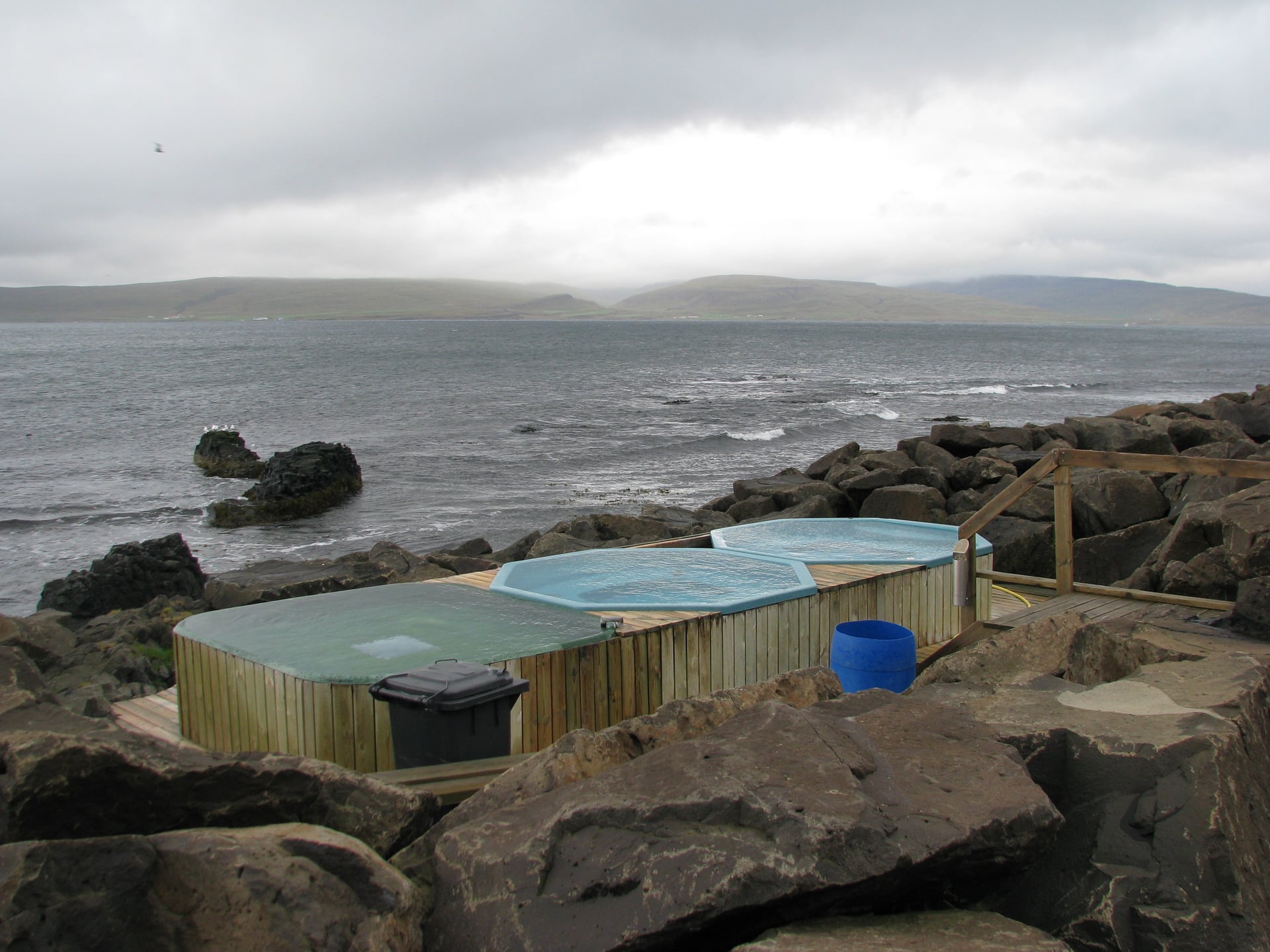
The official Drangsnes Hot Pots entry is pleasingly practical and therefore very trustworthy. It says the natural hot pools sit right along the shoreline in the middle of the village and are easily spotted from the road. That matters because it tells you something essential about the experience: there is very little theatrical build-up. You are not leaving ordinary life behind in order to enter the baths. The baths are already inside ordinary life. Cars pass. The harbor logic of the village remains nearby. The sea is close enough to keep reminding you exactly where you are.
This is one of the strongest reasons the stop benefits from being explained on its own terms rather than a passing mention inside a Strandir route. traveler questions here is very specific. People are asking whether the pots are worth a stop, whether they feel touristy, whether they are truly free and public, and what kind of mood they carry compared with Iceland's more famous geothermal sites. The fuller way to understand it is that Drangsnes Hot Pots matter because they preserve one of the cleanest versions of Icelandic bathing culture: simple, social, unpretentious, and grounded in place rather than branding.
The setting does a great deal of the emotional work. Drangsnes lies on Steingrímsfjörður in Strandir, a region of the Westfjords that often feels slightly apart even from the rest of the peninsula. The roads are long, the settlements are small, and the sea remains visually present in a steady rather than dramatic way. In that landscape, a set of shoreline hot pots feels exactly right. The bath does not interrupt the geography. It continues it. You sit in warm water while the fjord, the weather, and the village keep their normal scale around you.
Visit Westfjords' hot-pools overview makes another point worth preserving. It says the best way to meet locals and talk about everything and nothing is in the hot pots in Drangsnes. That sentence may sound charming, but it is actually quite precise. Icelandic bathing culture is social without needing ceremony. You soak, exchange small talk, fall into silence, comment on the weather, and carry on. Drangsnes Hot Pots are strong because they still allow that kind of uncurated sociability. They are not an escape from public life. They are one of its warmest forms.
This makes the stop especially different from places like Sky Lagoon, Blue Lagoon, or even some of the more rural private-feeling hot-spring destinations. In Drangsnes, there is almost nothing to hide behind. The quality of the experience comes from simplicity: hot water, cold air, a view across the fjord, and the knowledge that the baths belong to the place before they belong to tourism. For many travelers, that can become more memorable than bigger and more polished settings precisely because it feels less mediated.
The geography of Strandir deepens that effect. This is a coast where weather remains a living presence, where villages can feel both open and tucked into fjord edges, and where the idea of a warm roadside pause carries more emotional weight than it might elsewhere. A hot pot in Reykjavík can be pleasant. A hot pot on a quiet Strandir shoreline can feel restorative in a more elemental way. The region's minimalism strips the experience down to its essentials.
There is also a beautiful contrast between the hot pots and the formal swimming pool in town. Visit Westfjords mentions both, and that pairing matters because it reflects two strong strands of Icelandic bathing life. One is the structured municipal pool, built, maintained, and comfortably predictable. The other is the simpler geothermal soak that feels closer to land and village habit. Drangsnes offers both, but the shoreline pots remain the more characterful choice for travelers trying to understand what makes the village itself special.
Photographically, the hot pots are strongest when they are not oversold. They are small. They are modest. They do not need impossible claims. Their power comes from context: tubs at the edge of a northern fjord, steam rising in cool air, mountains or weather across the water, and the casual fact that people can stop and soak beside the road. Good images preserve that modesty. If the picture turns the place into a fake luxury fantasy, it loses the real charm.
There is a cultural intelligence in that modesty too. Drangsnes Hot Pots show how much of Icelandic bathing culture is not about separation from daily life but about integration with it. The idea is not that you must retreat into a sealed sanctuary to recover. The idea is that hot water can be made part of normal social and environmental existence. That is a very Icelandic answer to cold, weather, and community life, and Drangsnes still expresses it with remarkable clarity.
For road-trippers through Strandir, the pots work especially well as a recalibration stop. They are good after hours of driving, good in mixed weather, good as an evening ritual in a small village, and good as one of those places that softens the whole memory of a region. In a part of Iceland where distances can feel long and services far apart, a free hot soak by the fjord becomes more than a quirky roadside extra. It becomes part of the emotional structure of the journey.
This is also why Drangsnes Hot Pots are not well described by the word attraction alone. They are attractive, certainly. But they are stronger than that because they are habitual. You can imagine locals using them not as a rare event but as a normal piece of life. That imagination changes how the visitor sits in them. You are not simply consuming a scenic product. You are entering, briefly and respectfully, into a village custom that happened to remain accessible.
Drangsnes Hot Pots deserve a fuller guide because too many references reduce them to one line on a map: free hot tubs by the shore. While that is technically true, it leaves out the Strandir context, the social logic, the difference from larger spa culture, and the way the pots help explain Icelandic public bathing habits at their most unforced. The stronger answer is that Drangsnes Hot Pots are one of the most human geothermal stops in the country.
What stays with many visitors after Drangsnes Hot Pots is usually not the size of the tubs or any dramatic reveal. It is the ease of it all: the shoreline, the warmth, the village nearby, the wind off the fjord, and the realization that one of Iceland's most satisfying bathing experiences can arrive without spectacle. Drangsnes lingers because it proves that geothermal culture does not need to be grand to be memorable. Sometimes it is best when it is small enough to feel borrowed from everyday life.