Iceland Travel Guides
Dynjandi: The Waterfall That Feels as Large as the Westfjords
A fuller private guide to Dynjandi, with its iconic veil-like form, six-part waterfall sequence, lava-layer geology, protected setting in Arnarfjörður, and the reason it feels like the Westfjords in one view.
GlaciGo Iceland / May 2026 / 10 min read
Dynjandi is the kind of waterfall that seems to summarize a whole region before you have even found the right words for it. In the Westfjords, where roads are long, fjords are deeply cut, and scale often feels more patient than dramatic, Dynjandi rises suddenly as something close to a declaration. It does not look like a single neat column of water. It spreads, fans, and descends with a broad white force that makes it feel less like one waterfall than a whole mountainside choosing to move. That is one reason it has become the emblematic image of the Westfjords. It is not just beautiful. It feels region-sized.
Visit Westfjords calls Dynjandi the region's favourite front-page model for decades, and the phrase is better than it first sounds. Some natural landmarks become famous because they are isolated and easy to frame. Dynjandi becomes famous because it carries the visual logic of the Westfjords inside itself: steep relief, layered rock, distance, difficulty, and a kind of grandeur that feels earned rather than theatrical. When people say the Westfjords are different from the rest of Iceland, Dynjandi is one of the places that helps them mean it.
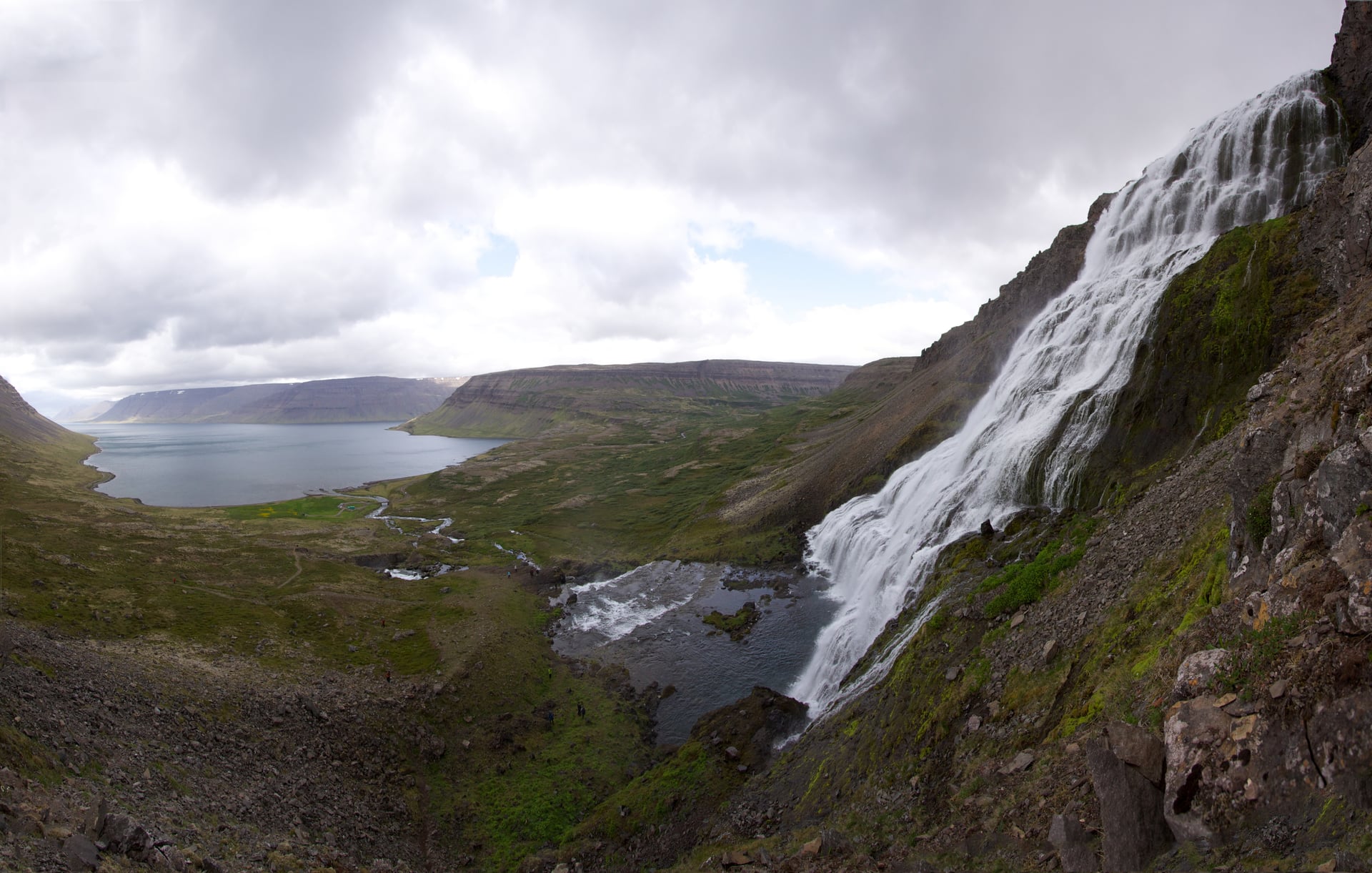
The official Westfjords description also gives one of the most useful physical details: Dynjandi cascades down approximately 100 meters, and the steps of the waterfall are formed by stratified lava layers separated by looser material that the river has carved away. That geological explanation matters because it reveals why the waterfall has such an unusual shape. Dynjandi does not simply fall. It opens. The water broadens at the top and then narrows as it drops, creating the feeling of a bridal veil, a hanging white fan, or a sheet of movement spread across rock. The form is not decorative accident. It is geology made visible through water.
This is also why the approach matters. You do not absorb Dynjandi fully from one glance in the parking area. Visit Westfjords notes that visitors should park in the designated lot and walk for about 15 minutes to reach the largest part of the waterfall. That short walk is part of the experience. Dynjandi grows on you while you move toward it. Sound accumulates. The proportions shift. What seemed like one waterfall begins to reveal itself as a whole system on the river. The body arrives at the same pace that the eye learns what it is seeing.
The same official source makes an important point that many quick summaries miss: there are six waterfalls in the Dynjandi sequence. At the top is Fjallfoss, followed by Hundafoss, Strokkur, Göngumannafoss, Hrísvaðsfoss, and Sjóarfoss. This matters because Dynjandi is not just a singular icon but a procession. The smaller falls below are not secondary clutter leading up to the 'real' one. They prepare the mind for it. They create rhythm, scale, and anticipation, and they make the climb feel like an unfolding argument in water rather than a simple arrival at a viewpoint.
That layered structure gives Dynjandi a different emotional quality from many famous Icelandic waterfalls. Gullfoss hits with force and division. Skógafoss impresses through vertical power. Seljalandsfoss invites intimacy and movement around the fall. Dynjandi is more cumulative. It is less about one explosive moment than about an upward gathering of scale. The closer you get, the more impossible it seems that the mountain can hold this much water in such a wide white sheet. The waterfall does not surprise once and end. It keeps enlarging itself.
Arnarfjörður, the fjord that holds Dynjandi, is part of this experience even when people focus on the falls alone. Umhverfisstofnun's official description places Dynjandi in the heart of Arnarfjörður and defines the protected natural monument as an area that includes not only the waterfall but the surrounding ridges, bay, valley, and sea edge. This is a helpful corrective. Dynjandi should not be imagined as a detached scenic object. It is a landscape whole. The bay below, the enclosing slopes, and the sense of fjord remoteness all contribute to why the place feels so complete.
Protection matters here too. Visit Westfjords notes that Dynjandi and its surroundings were protected as a natural monument in 1981 because they are a unique natural gem. That protection is not abstract bureaucracy. It acknowledges a truth that becomes obvious on site: the waterfall is large enough and visually strong enough that careless tourism could easily begin to flatten the experience around it. The protected status helps preserve the dignity of the approach and the coherence of the wider setting. With places this iconic, restraint is part of the beauty.
There is also something distinctly Westfjords about the relationship between effort and reward at Dynjandi. The walk itself is not extreme, but reaching the waterfall still asks for a pause in driving logic. The Westfjords are full of places that refuse the speed of checklist tourism. Dynjandi is accessible enough to be widely loved, yet remote enough that you usually feel you have come somewhere. The journey matters. The roads around Arnarfjörður, the distances between settlements, and the changing weather all contribute to the sense that the waterfall belongs to a larger arc of travel rather than standing beside a convenient urban highway.
For tourists, Dynjandi often becomes one of the emotional peaks of a Westfjords trip because it combines immediate visual impact with a deep sense of place. It is not only that the waterfall is large. It is that it feels right where it is. The water seems to fit the fjord, the rock, the remoteness, and even the slightly slowed pace of the region. That kind of fit is hard to manufacture and easy to feel. Dynjandi does not read like an attraction imported into the landscape. It reads like a natural sentence the land was always trying to say.
Photographically, Dynjandi is generous but not simple. The iconic wide view works because the waterfall spreads so beautifully across the slope, yet some of the most memorable images include the smaller falls below, the path, or the scale of people moving upward. Those details help prevent the place from turning into a pure wallpaper image. They restore the bodily experience of walking, listening, and looking back. Because the waterfall changes character as you climb, it rewards multiple kinds of framing rather than one canonical shot.
Dynjandi also belongs to the mental map of the Westfjords in a way few other places do. Travelers planning the region often orient themselves around whether they will reach it, overnight near it, or route through it on the way between fjords. This makes the waterfall not only a destination but a hinge. Places like Þingeyri, Bíldudalur, Hrafnseyri, and the roads over Dynjandisheiði all gather around its gravity. In practical itinerary terms, Dynjandi is one of the places that turns a loose regional drive into a meaningful route.
Dynjandi is not only a question of location or waterfall ranking. Travelers want to know whether the walk is worth it, what makes the shape so unusual, and why people remember it more vividly than many better-known waterfalls elsewhere in Iceland. The deeper answer is that Dynjandi works on several levels at once: geology, movement, protection, regional identity, and the pure visual pleasure of seeing water become almost architectural.
What stays with many visitors after Dynjandi is the feeling that the waterfall somehow exceeds photography without resisting it. You can capture it, but you do not quite finish it. The width, the layers, the procession of smaller falls, the fjord air, and the long white spread over old lava all continue working in memory after you leave. Dynjandi lingers because it feels less like a single stop and more like the Westfjords briefly revealing their full scale in one visible form.