Iceland Travel Guides
Dyrholaey: Sea Arch, Bird Cliffs, and South Coast Edge
A fuller private guide to Dyrholaey in South Iceland, with the sea arch, bird-reserve logic, coastal erosion, folklore, lighthouse views, and South Coast planning.
GlaciGo Iceland / May 2026 / 10 min read
Dyrholaey feels like one of those places where Iceland stops behaving like a sequence of stops and starts becoming a coastline with memory. It is not just a viewpoint above black sand. It is a headland shaped by eruptions, cliffs shaped by waves, a reserve shaped by bird life, and a landmark shaped by the old human need to name dramatic edges of land. When travelers stand there in strong wind, with the arch, the sea, the lighthouse, Reynisdrangar, and the sweep toward Vik all visible at once, the South Coast suddenly feels less like an itinerary and more like a system.
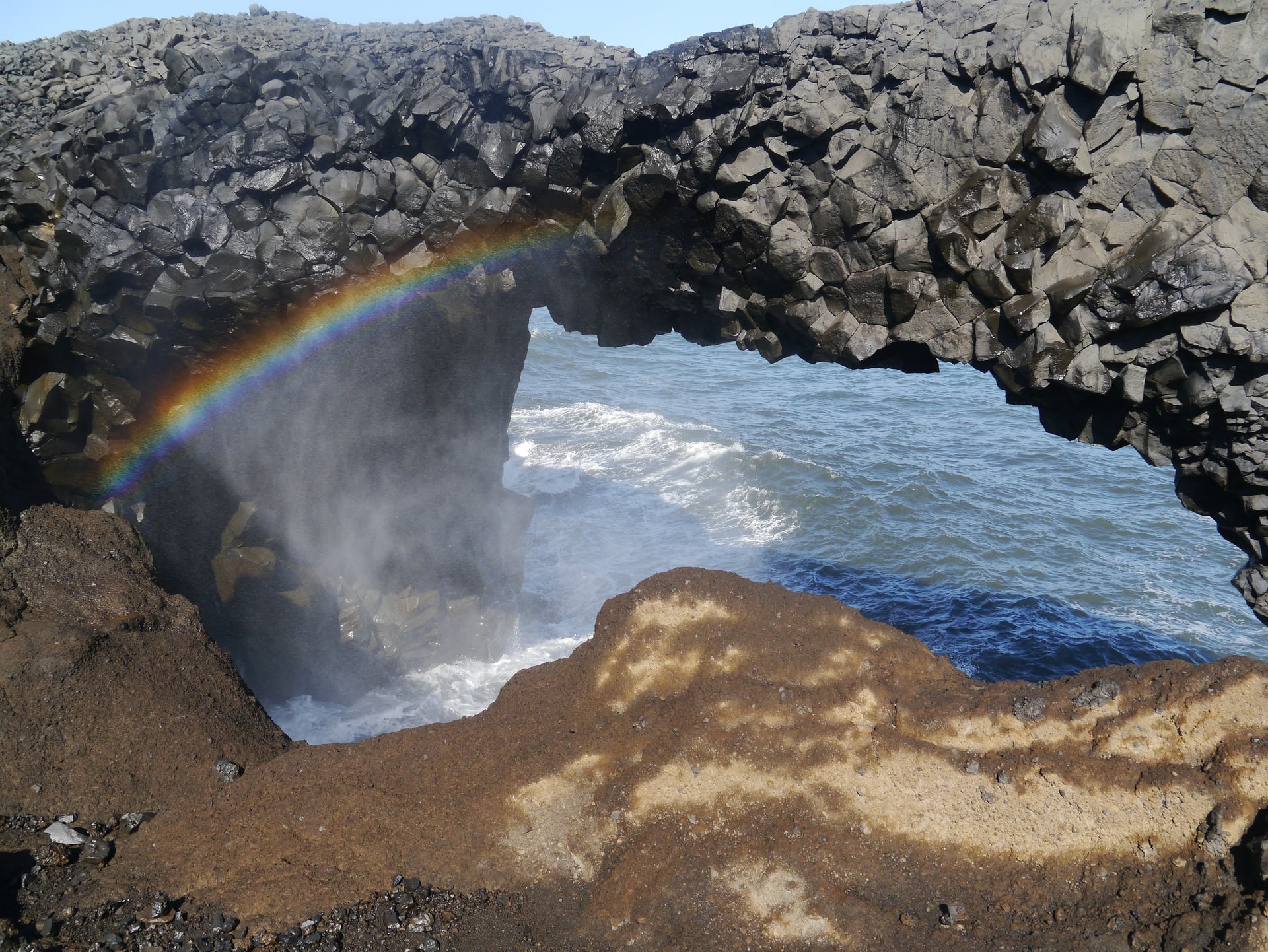
Visit South Iceland describes Dyrholaey as a 120 meter high promontory not far from Vik and explains that its name comes from the massive arch the sea has eroded through the headland. The literal sense of the name, often explained as 'door-hole island' or 'door-hole headland,' matters because it tells you how Icelanders saw the place before it became a universal photo stop. The arch is not a decorative extra. It is the defining feature, the reason the place was named the way it was.
The same source adds a detail that sounds almost too theatrical to be true: when the sea is calm, large boats can pass through the arch. That gives the formation scale in a way ordinary travel language often fails to do. This is not a modest gap in the rock. It is a sea-carved opening large enough to change how the whole headland is read. The arch turns Dyrholaey from a cliff into an event.
Geologically, Dyrholaey is even richer than the arch alone suggests. Visit South Iceland says the headland is thought to have formed in an underwater volcanic eruption late in the glacial period, while the Katla UNESCO Global Geopark material sharpens the picture by describing palagonite tuff, cube-jointed lava, and lava flows. Since formation, both glaciers and marine erosion have continued to shape it, reduce it, and create the arches and sea stacks on its southern side. That layered story is exactly why Dyrholaey feels so sculptural. Fire built it, ice modified it, and the sea kept editing.
The geopark guide adds one of the most interesting historical-geographic details: until the 1918 eruption of Katla, Dyrholaey was the southernmost point of mainland Iceland. That does not sound dramatic until you remember how much the South Coast has been altered by volcanic floods, sediment movement, and shoreline change. In Iceland, even statements about where the land ends are not always permanent. Dyrholaey carries that instability in its own history.
That is one reason the site feels so alive to thoughtful travelers. It is not a fixed monument standing outside time. It is an exposed piece of coast still being interpreted by weather, erosion, wildlife management, and memory. A visit there can feel different hour by hour. Cloud changes the color of the sea. Wind changes how safe or precarious the ledges feel. Bird season changes the emotional center of the place. Few South Coast stops are so dependent on conditions, and few reward that dependence so well.
Bird life is one of the reasons people come, and it should be treated seriously rather than as an incidental bonus. Visit South Iceland's puffin guidance says Dyrholaey is one of the classic and easily accessible places to see puffins nesting on the cliffs, usually from roughly mid May through August. The main Dyrholaey page also mentions abundant bird life, especially puffins and eider ducks. That seasonal rhythm matters because it changes the character of the headland. In summer, the place can feel busy with life and movement at the cliff edge. Outside the nesting season, the geology and exposure dominate more strongly.
The protected status is therefore not bureaucratic clutter around a tourist attraction; it is central to the meaning of the place. Visit South Iceland notes that Dyrholaey is a nature reserve and explains that some areas close seasonally or year-round to protect wildlife and sensitive natural features. That is exactly the kind of information a good private article should respect. The reserve is not there to make travel less convenient. It is there because a popular headland with nesting birds and fragile coastal formations needs boundaries if it is to remain itself.
The hiking-trail information reinforces that practical reality. The official trail page lists wind gusts and rockfall among the hazards and notes that the route is open in all seasons but not illuminated, with restrooms and rangers available. That makes Dyrholaey feel like what it really is: accessible, yes, but never fully domesticated. The right traveler experiences this as part of the appeal. You are not stepping into a manicured overlook. You are stepping onto a windy edge where the landscape still has the upper hand.
The views from above deserve their reputation, but they are stronger when understood relationally. From Dyrholaey you can connect black sand, surf, Reynisfjara, Reynisdrangar, Vik, the offshore islands, and in ideal conditions even Vestmannaeyjar and Surtsey to the southwest. The headland becomes a reading room for the whole region. It helps the South Coast make spatial sense. Beaches and stacks that seem isolated from the road suddenly lock into one coherent shoreline.
Visit South Iceland also preserves the older sailor's name 'Portland' for the promontory, and that small detail is worth keeping. It reminds the reader that Dyrholaey was not only a scenic object for modern tourism. It was a navigational landmark, a known shape from the sea, and therefore part of the maritime mental map of the coast. In a district where landing conditions were historically difficult and dangerous, recognizable promontories mattered.
Then there are the legends, and Dyrholaey has the right kind of folklore for a coast like this. The main South Iceland page repeats the well-known story that Reynisdrangar formed when two trolls tried to drag a three-masted ship ashore and were turned to stone at daybreak. It also mentions a local tale of a monster once living in one of the caves before disappearing after a landslide more than a century ago. These stories should not be used as cheap mystical garnish. They matter because they show how Icelanders historically interpreted coastal risk, strange rock forms, and cave-ridden headlands through narrative.
That storytelling layer gives Dyrholaey a wider human texture than a simple scenic overlook. Cliffs like this attract myth because they already feel liminal. They are boundaries between sea and land, bird and human territory, visibility and fog, solid rock and constant erosion. Folklore does not make the place dramatic; it emerges from drama already present in the terrain.
For photography, Dyrholaey is almost too generous. The arch, the lighthouse, the black beach, the stacks, the puffins, the sea light, the cloud shadows: all of it tempts the camera. But the place is at its strongest when the image chooses one governing idea. Sometimes that is scale. Sometimes it is bird life. Sometimes it is the clean geometry of the lighthouse against weather. Sometimes it is the way the arch explains the very name of the headland. Trying to include everything at once can flatten the experience into generic beauty.
For private travelers, Dyrholaey is best used not as a quick add-on after Reynisfjara but as a distinct coastal chapter. Reynisfjara gives you the beach from below, basalt columns, wave danger, and the sea at eye level. Dyrholaey gives you height, reserve logic, bird cliffs, long views, and the sense of looking across the whole system. The two stops complement each other, but they should not be written as if they were interchangeable.
What makes Dyrholaey linger in memory is not only that it is beautiful. It is that it feels decisive. The wind is usually stronger there, the edges clearer, the coastline more legible, and the relationship between geology and wildlife more obvious. On the right South Coast itinerary, Dyrholaey becomes the place where the shore reveals its full structure. It is less a viewpoint than a threshold: a volcanic headland worn by the sea, guarded by birds, storied by locals, and still standing at the edge of mainland Iceland with the confidence of a place that has been teaching people how to look for a long time.