Iceland Travel Guides
Fjaðrárgljúfur: Reading Time in a South Iceland Canyon
A fuller private guide to Fjaðrárgljúfur in South Iceland, with canyon geology, Ice Age formation, regional context, and the fragile beauty of protected paths.
GlaciGo Iceland / May 2026 / 10 min read
Fjaðrárgljúfur has a way of making people quieter than they expected. Not because it is empty of drama, but because its drama is elongated rather than explosive. The canyon does not strike like a single waterfall or a black-sand surf line. It unfolds. You arrive, walk a little, and begin to understand that the landscape has been thinking in curves for a very long time. The river is modest compared with the scale of the gorge, the moss softens the violence of the rock, and the path keeps giving you new angles instead of one grand reveal. It is one of those South Iceland places that rewards patience more than speed.
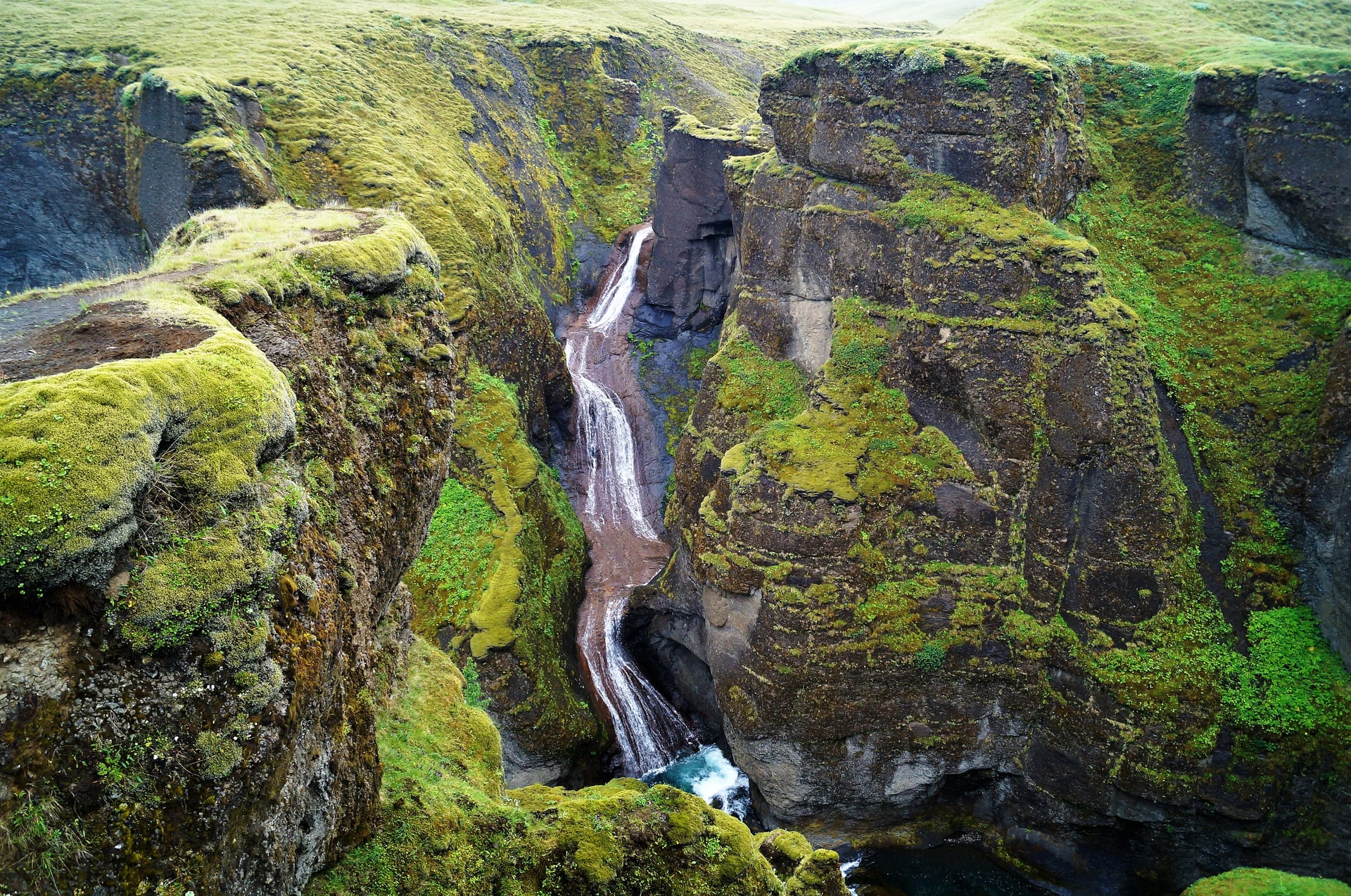
Visit South Iceland describes Fjaðrárgljúfur as a magnificent canyon about one hundred meters deep and about two kilometers long, with steep walls and a narrow, somewhat serpentine form. That serpentine quality is part of what makes it memorable. The canyon does not behave like a straight incision. It bends, withholds, and redirects the eye. From above, the shape feels almost written rather than broken, as if the water had been composing a script into palagonite rather than merely cutting through it.
The official geology is worth slowing down for. Visit South Iceland explains that the bedrock in Fjaðrárgljúfur is mostly palagonite from cold periods of the Ice Age and is thought to be about two million years old. The canyon itself, however, is believed to have formed at the end of the last Ice Age, around nine thousand years ago. That difference in timescale matters. The rock is much older than the gorge carved into it. What visitors are seeing is not one event but multiple layers of time: ancient palagonite, glacial retreat, sediment, runoff, and then the long refining work of river erosion.
The official formation story is unusually vivid. When the glacier retreated, a lake formed in the valley behind a hard, resistant rock. Runoff from that lake flowed where the canyon is today. Glacial rivers from the ice edge carried heavy sediment into the lake, and the outflow dug down through rock and then through the palagonite below. Because the initial cascade was so large, it had the power to excavate the canyon deeply. Later, as the lake gradually filled with sediment, the river weakened and began to cut through the layers it had previously left behind. Visit South Iceland notes that fluvial terraces on both sides of the valley still indicate the original height and location of that lake. In other words, the canyon is not just scenic form. It is a readable archive of retreat, force, slowing, and change.
That is one of the reasons Fjaðrárgljúfur feels different from many famous stops on the South Coast. It does not depend on a single object like a waterfall lip, a glacier tongue, or a sea arch. Instead, the whole place is the attraction: walls, bends, ledges, river, terraces, moss, and the rhythm of viewpoints along the rim. The best visit is usually not the fastest one. It is the one where you let the gorge teach you how it was made, step by step, curve by curve.
The river Fjaðrá contributes to that feeling of disproportion in the most beautiful way. Visit South Iceland says the river has its source in Geirlandshraun and falls off the heath edge into the canyon before reaching the Skaftá. The river has changed a great deal over time, which again reminds visitors that the present stream is only the latest chapter in a much larger hydrological story. Standing beside the rim, many people instinctively ask how such a comparatively gentle river could belong to such a large canyon. The answer is that they are looking at different moments of the same system compressed into one view.
A private visit works especially well here because Fjaðrárgljúfur benefits from pacing. On a hurried schedule it can be reduced to a lookout and a few photographs. On a better itinerary, it becomes a walking conversation between geology and mood. You notice how the path alternates between openness and enclosure. You notice the way moss softens the canyon's severity without domesticating it. You notice that the gorge can feel intimate even while dropping dramatically away below you. Some places in Iceland are about impact. Fjaðrárgljúfur is more about sustained attention.
It also sits inside a richer regional context than many quick itineraries acknowledge. Visit South Iceland's page for Kirkjubæjarklaustur describes the district as a place where saga meets lava, with roads leading toward Eldgjá, Laki, Vatnajökull's western approaches, and other major geosites. Near the Ring Road, Fjaðrárgljúfur is one of the area's most accessible geological experiences, but it makes more sense when understood as part of this larger volcanic and historical district rather than as an isolated canyon detached from everything around it.
That nearby human center matters. Kirkjubæjarklaustur, often shortened to Klaustur, is not just a convenient services stop. Visit South Iceland frames it as the only population center in the district and a gateway into landscapes where church history, lava, pseudocraters, waterfalls, and national-park routes all intersect. Approaching Fjaðrárgljúfur from that context changes the emotional scale of the visit. The canyon stops being merely an impressive roadside detour and becomes part of a region where geology has always shaped movement, settlement, and memory.
There is also an environmental lesson built into the experience, and it deserves to be stated directly. Fjaðrárgljúfur is widely loved precisely because it looks soft enough to wander through casually, yet the landscape is fragile. Visit South Iceland has previously shared official closure notices and reopening guidance tied to muddy conditions, damaged vegetation, and the need for visitors to stay on designated paths. That history matters. It means the article should not romanticize freedom of movement here. Respect is part of the place now. A good visitor understands that fragile beauty sometimes requires boundaries.
That fragility has a surprisingly human effect on the atmosphere. Fences, marked paths, and designated viewpoints could have made the place feel overmanaged. Instead, when approached with the right mindset, they sharpen attention. You stop trying to conquer the canyon and start learning how to look at it. That change is healthy, especially in a landscape that became globally visible so quickly. Fjaðrárgljúfur is strongest when it is not consumed like a backdrop, but encountered as a protected formation still vulnerable to pressure.
Photographically, the canyon is more subtle than people assume. The obvious wide shot works, of course: winding gorge, dark walls, ribbon of water, moss and sky. But the place often becomes more powerful when you let scale do quieter work. A turn in the river. A vertical slice of wall. The moment one viewpoint gives you three curves instead of one. In duller weather, the greens deepen and the palagonite surfaces take on more texture; in brighter conditions, the line of the river can become the governing element. Fjaðrárgljúfur does not need theatrical weather to succeed.
There is no widely repeated folklore attached to Fjaðrárgljúfur in the way there is to Reynisdrangar or Skogafoss, and that absence is interesting in itself. Not every Icelandic place has to be translated into trolls or hidden people to feel storied. Here the story is more geological than legendary, and more meditative than theatrical. The canyon invites a different kind of imagination: not who was turned to stone, but what sequence of water, sediment, retreat, and patience could have made such a shape. For many travelers, that quieter mystery is more durable than a borrowed myth would be.
For travelers moving east from Vík or west from Skaftafell, Fjaðrárgljúfur also plays a useful structural role in the day. It changes the rhythm. After long road sections and large-scale glacier or coast views, the canyon brings focus back to walking and observation. It narrows the field in a good way. Instead of taking in a whole horizon, you begin tracing a single gorge. Instead of spectacle at a distance, you read erosion at medium range. That modulation is one reason the stop often stays in memory longer than expected.
Fja?r?rglj?fur answers several real traveler questions at once: where it is, whether it is worth stopping between V?k and Skaftafell, how it was formed, whether access is easy, and why visitors are asked to remain on marked paths. A strong visit here is not about overexcitement. It is about observing the canyon carefully while respecting the fragile ground that makes the view possible.
What stays with most people after Fjaðrárgljúfur is not only the size of the canyon, but the way time feels visible inside it. Two million-year-old palagonite. A canyon carved around nine thousand years ago. A river still moving through it. Trails that now need protection because so many people want to see it. Ancient rock, post-glacial water, modern tourism, one narrow gorge. That layering is the real depth of Fjaðrárgljúfur. The canyon is dramatic, yes, but its deeper gift is that it lets visitors feel geology not as abstraction, but as a slow, legible presence under their feet.