Iceland Travel Guides
Fjallsárlón: The Quieter Intimacy of Glacier Water
A fuller private guide to Fjallsárlón, with glacier-lagoon proximity, Breiðamerkursandur context, quieter pacing, and the intimate edge of Fjallsjökull.
GlaciGo Iceland / May 2026 / 9 min read
Fjallsarlon is what happens when a glacial lagoon keeps its voice low. It does not announce itself in quite the same way as Jokulsarlon. There is less spectacle at first glance, less traffic in the imagination, fewer people arriving with a fully preloaded mental picture. That is precisely why many travelers end up loving it. Fjallsarlon offers something rarer on an increasingly photographed South Coast: a sense that the glacier is still close enough to set the emotional temperature of the place directly.
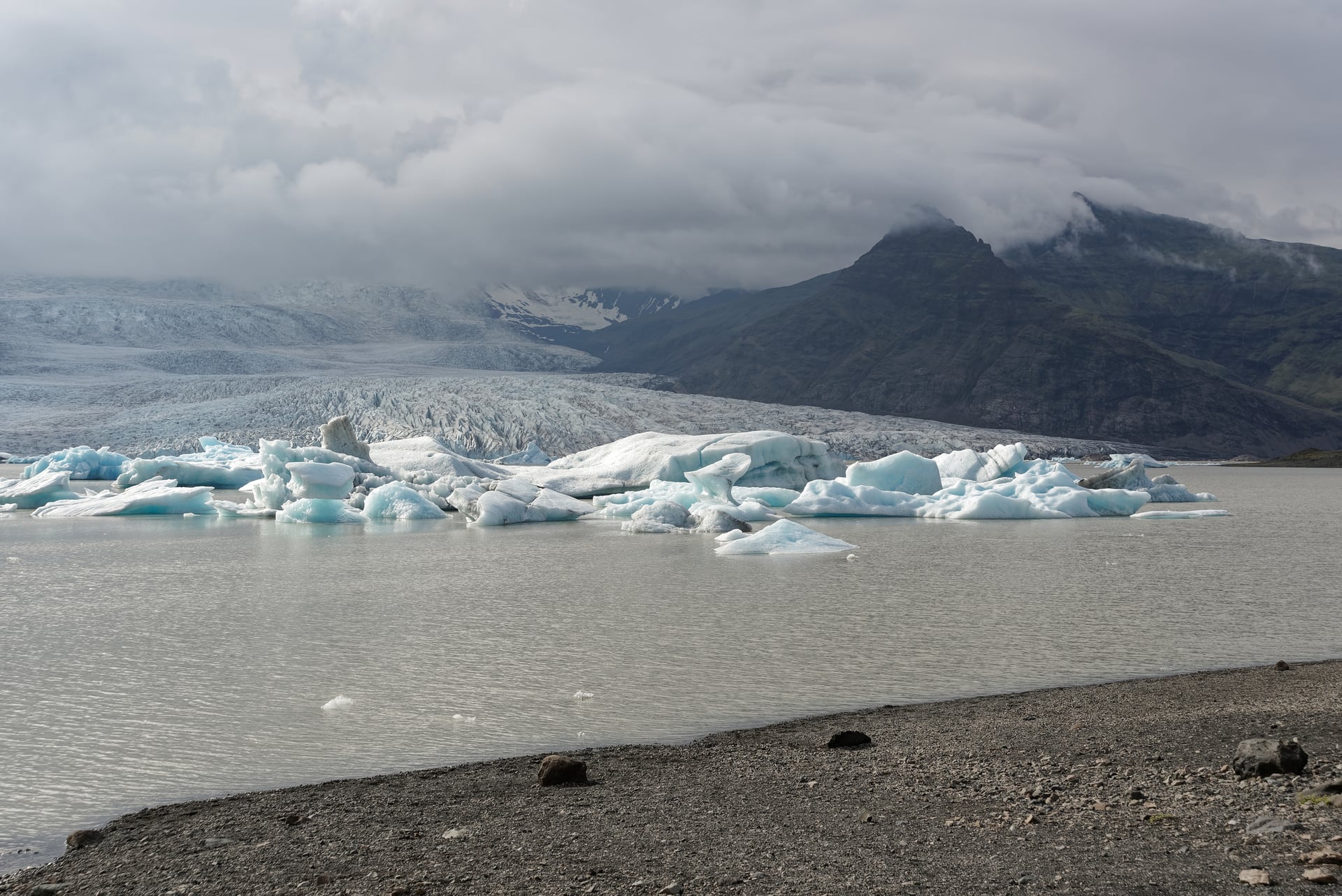
Visit South Iceland describes Fjallsarlon as a scenic glacial lagoon located around 10 kilometers west of Jokulsarlon, largely within Vatnajokull National Park. The official description highlights the steep glacier tongue of Fjallsjokull coming all the way into the lagoon and frames the place as peaceful, photogenic, and comparatively untouched. That phrase about the glacier tongue matters. Fjallsarlon is not just another blue lagoon with floating ice. Its character comes from proximity. The glacier feels physically present, not distant background.
That closeness changes everything about the mood. At Jokulsarlon, you often read the system outward: calving glacier, broad lagoon, outlet, beach, sea. At Fjallsarlon, the reading begins much nearer the ice front. The lagoon feels more enclosed, more gathered in around the glacier and the surrounding moraines. The eye does not drift outward toward a large public spectacle so much as settle into one concentrated relationship between water, floating ice, and the descending mass of Fjallsjokull.
This distinction matters because it prevents lazy duplication in both travel writing and itinerary planning. Fjallsarlon is not the 'smaller Jokulsarlon' in any useful sense. It offers a different emotional scale. Where Jokulsarlon often impresses through movement and system, Fjallsarlon works through intimacy and nearness. It is one of the best places in southeast Iceland to feel what a glacial lagoon means before the story widens into the ocean-bound drama of drifting ice.
The wider Breidamerkursandur context from Vatnajokull National Park helps explain that relationship. The park describes Breidamerkursandur as an outwash plain south of Breidamerkurjokull where some of Iceland's most accessible glacier-shaped landscapes can be studied, especially because the terrain is changing rapidly as glaciers retreat. It notes that lakes began to appear in the 1930s as the glaciers withdrew, and that Jokulsarlon, Breidarlon, and Fjallsarlon are among the largest of these lakes. In other words, Fjallsarlon belongs to the same retreat story as the more famous lagoon nearby, but it expresses that story in a quieter register.
That quietness is part of its value. Travelers often say they want 'something less touristy,' but what they usually mean is that they want a place where their own attention can settle before the crowd tells them how to feel. Fjallsarlon can do that. The glacier front, the lagoon, and the surrounding mountain forms create a self-contained visual field. It becomes easier to notice textures in the ice, the shape of moraines, the tonal shifts in the water, and the weather as it moves across the glacier face. The place teaches a slower style of looking.
There is also a strong geographical clarity to Fjallsarlon. Visit South Iceland places it at the southern edge of Vatnajokull, and the national park trail information connects it to the wider Breidarmork hiking area. One official route runs between Fjallsarlon and Jokulsarlon over 15 kilometers, which is a useful reminder that these sites belong to one glacial landscape rather than existing as isolated attractions beside the road. Even if most travelers do not walk that full route, knowing it exists changes how the map is felt. Fjallsarlon becomes part of a traversable terrain, not just a viewpoint.
Private travelers are often especially well served by that feeling. A guided or thoughtfully paced stop at Fjallsarlon can work as a counterweight to more iconic, busier highlights. This is not because it is superior in some simplistic way, but because itineraries need modulation. After the strong public image of places like Diamond Beach or Jokulsarlon, Fjallsarlon can restore something more inward. The lagoon is still dramatic, but its drama is not loud. It draws you closer rather than spreading itself wide.
The glacier itself gives the lagoon its authority. Fjallsjokull does not sit politely at a distance. It descends into the water and makes the whole site feel active, immediate, and unfinished. Icebergs here are not only pretty fragments drifting in abstract blue. They remain legibly tied to the source that produced them. That connection sharpens the visitor's understanding of calving in a way that is sometimes easier to miss at larger or more dispersed glacial lagoons.
Photographically, Fjallsarlon rewards compositional discipline. The temptation is to make it all about scale, but the better images often emerge from balancing three elements: the glacier tongue, the floating ice, and the dark structural forms of the surrounding land. It can be one of the strongest places in Iceland for a frame that feels complete without becoming overcrowded. The scene has enough complexity to be rich, but enough restraint to remain readable.
Season and weather matter here in subtle ways. In softer light, the lagoon can seem almost meditative, especially when the glacier surface recedes into pale mist and the icebergs pick up quiet tonal variation rather than dramatic sparkle. In harsher light or stronger wind, the place feels more exposed and severe, and the glacier reads less like a backdrop and more like a wall. Because the site is naturally calmer in reputation than Jokulsarlon, these smaller shifts in mood become more noticeable. Fjallsarlon is not a one-expression destination.
There is also a contemporary layer worth noting. Visit South Iceland recently highlighted new floating experiences on the lagoon in an update published on April 27, 2026, describing Fjallsarlon as the first place in Iceland to offer guided ice floating among drifting icebergs. Even if not every traveler wants that activity, the framing is revealing: Fjallsarlon is being presented not as a place for speed or spectacle, but as a slower, more immersive glacial encounter. That matches the landscape's temperament rather well.
Fjallsarlon is worth treating on its own terms because travelers usually arrive with very specific questions: whether it is calmer than Jokulsarlon, whether both lagoons are worth seeing, what the glacier looks like from here, and how boat access changes the experience. The answer is not that Fjallsarlon is better or lesser. It is quieter, closer, and more intimate, which gives it a different place in a private southeast Iceland route.
What lingers after a good visit is usually a feeling of nearness. Not just nearness to ice, but nearness to process. You can sense the glacier's edge, the lagoon forming at its foot, the retreat that made the water possible, and the evolving plain beyond it. Fjallsarlon does not need to overwhelm in order to matter. It succeeds by letting the glacier remain personal-sized in the mind, even while everything about it is geologically immense.