Iceland Travel Guides
Garður Lighthouse: Two Towers, Birdlight, and the Open Coast of Reykjanes
A fuller private guide to Garður Lighthouse, with the two Garðskagi lighthouses, birdlife, sunsets, and the calmer northern edge of Reykjanes.
GlaciGo Iceland / May 2026 / 10 min read
Garður Lighthouse is one of those Icelandic places where the experience is shaped as much by space and light as by the structure people came to see. Travelers often arrive expecting a single lighthouse stop and discover something gentler and more layered: two lighthouses at Garðskagi, a low shoreline, a sense of openness in every direction, seabirds riding the wind, and a stretch of Reykjanes that feels less volcanic in mood than the peninsula's harsher southern edge. If Reykjanesviti is about exposure and maritime severity, Garður is about horizon, patience, and the quiet authority of a coast that has spent a long time guiding both ships and migrating birds.
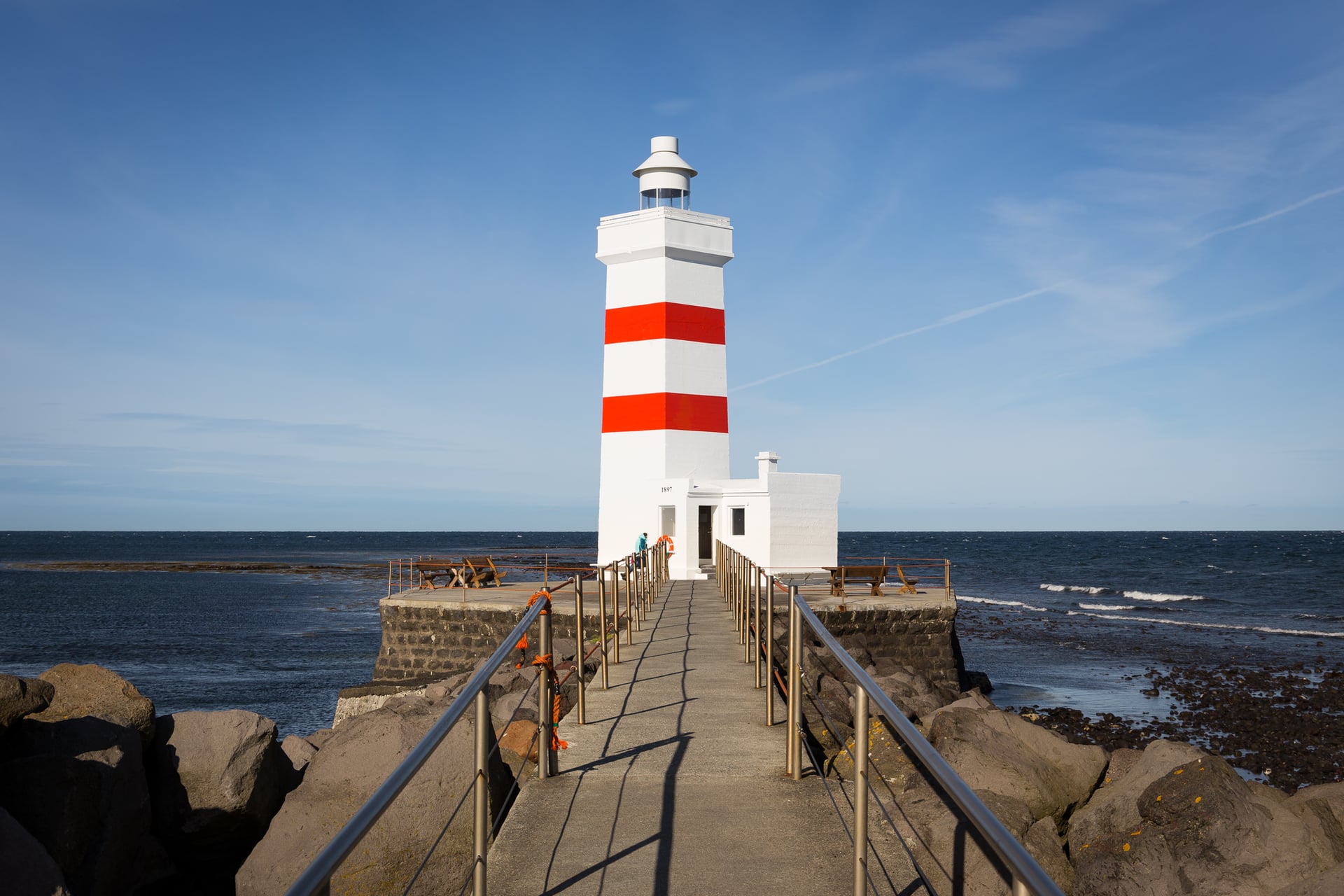
The first thing worth getting right is that Garðskagi is really a two-lighthouse place. Visit Reykjanes' official Garðskagi material presents the site as a northern point of the peninsula known for two lighthouses, a beach, and famous sunsets. That detail matters because it immediately gives the stop a different identity from other Icelandic lighthouse visits. You are not looking at one tower alone, but at a small coastal district where old and new standing near each other create a visual conversation about continuity, adaptation, and the practical realities of life by the sea.
The old lighthouse gives the place much of its character. The official Old Lighthouse page at Garðskagi describes it as part of the heritage museum there, and even that spare framing is enough to suggest the right mood. Older lighthouse structures in Iceland rarely feel ornamental when encountered in context. They feel like tools that have aged into memory. At Garðskagi, the old tower works exactly that way. It anchors the site historically and emotionally, helping the coastline feel inhabited by long-term attention rather than by sightseeing alone.
The newer lighthouse changes the composition rather than canceling the older one. Official Reykjanes tourist-guide material describes the newer Garðskagi lighthouse as the tallest lighthouse in Iceland. That is a useful fact, but its real significance lies in what it does to the place visually. The newer tower gives Garðskagi a vertical emphasis, while the older one preserves intimacy and proportion. Together they create one of the most readable lighthouse landscapes in the country: one coast, two eras of maritime signaling, and a broad sky doing half the aesthetic work.
Garðskagi is also inseparable from birdlife. Visit Reykjanes' Garður - Kalmanstjörn birding-trails page makes clear that the wider area is one of the peninsula's rewarding bird zones, especially from spring to autumn. It mentions seabirds such as Manx shearwaters, storm petrels, skuas, puffins, and others offshore, while also emphasizing shoreline walks and the way the area can produce unexpected sightings. This is important because Garður Lighthouse should not be treated only as a static architecture stop. It sits inside a living coastal ecology. The lighthouses are part of a birding landscape as much as a heritage one.
That bird dimension changes the emotional quality of the visit. At many lighthouse sites, visitors mostly look at the structure and then beyond it to the sea. At Garðskagi, the motion of birds often becomes part of the scene itself. Even when you are not a serious birder, the area teaches your eye to move differently: tower, horizon, surf line, ponds, distant flock, changing cloud. The result is softer than Reykjanestá, less explosive than Gunnuhver, and less narratively loaded than Grindavík. Garður's strength is not that it overwhelms you. It is that it steadies you.
This is where Garður Lighthouse becomes more than a nice detour from Keflavík. Because it sits on the northwestern side of Reykjanes, the area catches a different mood from the more volcanically theatrical parts of the peninsula. The coastline is still volcanic, still Atlantic, still exposed, but the atmosphere often feels calmer and cleaner in line and color. Sand, grass, stone, white towers, and open sea replace steam plumes and fissure drama. That makes Garðskagi especially valuable on an itinerary that needs contrast rather than repetition.
Photographically, the site is generous in ways that can look deceptively simple. A single lighthouse against sky is almost too easy; the challenge is to notice what makes Garður distinct. Sometimes it is the relationship between the two towers. Sometimes it is bird movement breaking the stillness. Sometimes it is the low, pale light that makes the white lighthouse surfaces glow while the sea stays steel-blue. And sometimes it is the honesty of the setting itself: this is not a grand cliff-edge monument but a flat, useful coast made beautiful by proportion and weather.
Sunsets are part of the Garðskagi reputation for good reason. Visit Reykjanes highlights them explicitly, and the topography explains why. The coast opens the west and north in ways that give the evening sky room to behave theatrically without the land competing too hard. Yet even here, the best experience is not just waiting for a red sky. It is watching the whole district slowly simplify as the light lowers: towers darkening, sea flattening into sheen, birds tracing the last visible lines over the shore.
There is also an understated cultural lesson in the place. Many visitors to Iceland learn quickly to recognize the country's more dramatic expressions of geology: lava flows, geothermal fields, black beaches, crater rims. Garður Lighthouse teaches a different kind of reading. It shows how Icelandic coasts are also built out of guidance, surveillance, patience, weather judgment, and long attention to movement across the sea. Lighthouses are part of the country's practical intelligence, and Garðskagi makes that intelligence feel unusually graceful.
For private touring, Garður works especially well on arrival days, departure days, and quieter Reykjanes loops. It is close enough to Keflavík to be practical, but not so close that it feels like mere filler. Because the stop is relatively gentle, it can also pair beautifully with busier or harsher peninsula sites. A route that includes Blue Lagoon or Fagradalsfjall benefits from a place like Garður, which returns the day to sea light, birdlife, and slower looking. It helps the itinerary breathe.
Gardur Lighthouse deserves precision because people look for the place in several ways: by Gardur, by Gardskagi, by sunsets, by birdwatching, by photography, and by the unusual presence of two lighthouses together. A broad Reykjanes overview can easily blur that identity. The point of this stop is its exactness: low coast, open sky, bird movement, two towers, and the particular feeling of the peninsula thinning into sea light.
What stays with most people after Garður is not one dramatic revelation but a total feeling: two towers sharing one shoreline, birds crossing sea light, a coast shaped for looking outward, and the sense that some Icelandic places do not need spectacle to be memorable. Garður Lighthouse is one of the peninsula's clearest reminders that guidance, weather, and patience can be as moving as fire.