Iceland Travel Guides
Geldingadalir: The Valley Where Reykjanes Began Again
A fuller private guide to Geldingadalir, with the 19 March 2021 eruption start, six-month timeline, valley-specific hazard logic, and why this was the first decisive chapter of Reykjanes' new volcanic era.
GlaciGo Iceland / May 2026 / 10 min read
Geldingadalir is where the Reykjanes volcanic story of the 2020s first became undeniable to the wider world. Before March 2021, the peninsula had already been living through months of seismic unrest, scientific monitoring, rumors of possible eruption, and the half-familiar Icelandic tension between waiting and not quite knowing. Then, on 19 March 2021, magma finally reached the surface in Geldingadalur. The place went from being a valley name known mainly to specialists and locals into one of the most watched volcanic sites in Europe. That transformation alone is enough to justify a focused guide. Geldingadalir was not just scenery around the first eruption. It was the basin that received the event and gave the new volcanic era its first recognizable stage.
The Icelandic Meteorological Office's first official notice remains the clearest anchor for the story. At around 20:45 UTC on 19 March 2021, a volcanic eruption began at Geldingadalur, close to Fagradalsfjall on the Reykjanes Peninsula. The IMO noted that the site was in a valley about 4.7 kilometers inland from the southern coast and about 10 kilometers northeast of Grindavík, and that the eruptive fissure was around 200 meters long in the opening phase. Those numbers matter not because they are dramatic in themselves, but because they show how modest the eruption first appeared. It did not begin with a towering ash cloud or catastrophic destruction. It began almost quietly, in a valley.
That quiet beginning shaped everything that followed. The six-month retrospective published by the IMO later described how magma reached the surface silently through a fissure opening in Geldingadalur, offering a spectacular sight while also surprising scientists because seismic activity had actually decreased before the eruption onset. This detail is part of what made the 2021 event so fascinating. Geldingadalir was not only photogenic. It became a case study in how volcanic systems can still upset expectations even under dense modern monitoring.
Visit Reykjanes reinforces the other crucial part of the story: duration. Its eruption-site overview states that the eruption was steady in Geldingadalir for about six months, attracting numerous visitors and being officially declared over in December 2021 after having been quiet since September. That timescale changed the public relationship to the place. If the eruption had lasted a day or two, Geldingadalir might have remained a spectacular but brief headline. Because it lasted for months, the valley became something else: a destination, a laboratory, a repeating subject of live feeds and weather forecasts, and a place where people could return and find it changed again.
This is why Geldingadalir deserves to be separated from the broader Fagradalsfjall label when we write carefully. Fagradalsfjall is the district story. Geldingadalir is the opening valley story. It was the first contained basin in which ordinary people, journalists, scientists, guides, photographers, and hikers all learned how this new volcanic chapter looked at human scale. The name carries the emotional charge of first contact. Later places like Meradalir and Litli-Hrútur mattered enormously, but Geldingadalir was where the world first adjusted its eyes.
The valley itself mattered physically, not just symbolically. A valley shapes how lava accumulates, how spectators approach, how gases settle, and how photographs frame the event. The IMO's early warnings were direct that lethal volcanic gases, many heavier than air, could accumulate in low-lying areas, especially in calm conditions. This is essential to keep visible in any good article. The same topography that made Geldingadalir such a readable volcanic theater also made it hazardous. Beauty and risk were tied to the same basin.
That risk never erased the unusual accessibility of the site; in fact, it was part of the reason the place became so globally legible. The six-month IMO retrospective notes that the location and relative ease of access allowed a wide range of instruments to be installed for monitoring the eruption and its hazards, from cameras and gas sensors to temperature probes. In other words, Geldingadalir was not only easy enough for hikers to reach compared with many volcanic sites; it was also reachable enough to become one of the most densely observed eruptions in Icelandic history. That combination is rare.
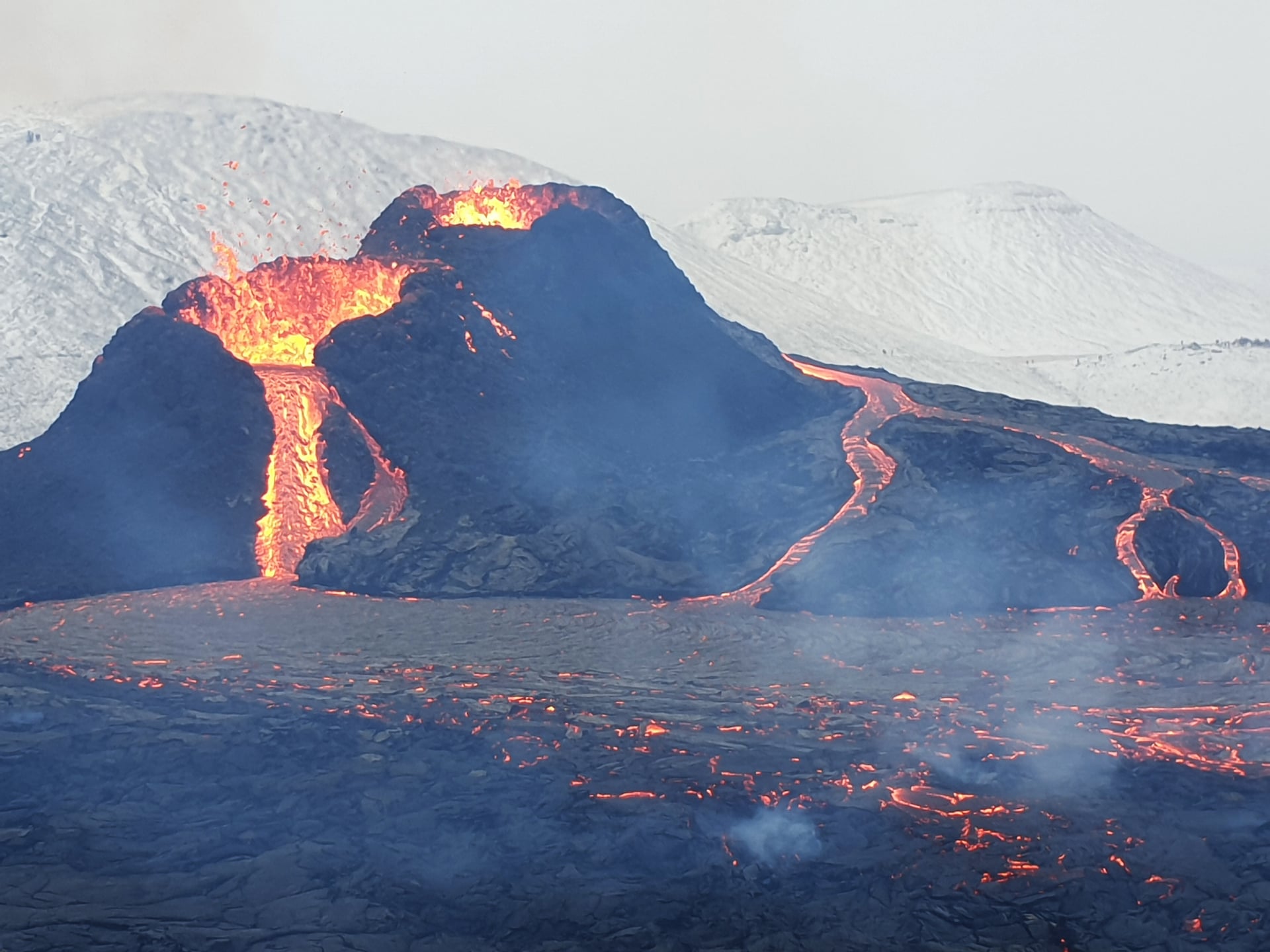
The eruption's evolution also changed the valley's character over time. The IMO review explains that the activity went through multiple phases: initially constant lava from one crater, then the emergence of more craters, then a period of strong lava fountaining, then intermittent pauses, and later more intra-crater activity with lateral drainage that promoted lava ponding in Geldingadalir. This sequence matters because it turns the valley into more than a fixed location pin. Geldingadalir was a changing container. What visitors saw there in late March was not identical to what they saw in May, July, or September.
Culturally, Geldingadalir became one of the places where Iceland's volcanic identity moved from national familiarity to global real-time spectatorship. Livestreams, drone footage, social media clips, guided volcano walks, official updates, gas maps, and aerial imagery all converged there. People who had never thought seriously about Reykjanes suddenly learned the name of a valley because it was where lava was moving that week. That is a remarkable thing. Valleys do not usually become famous overnight. Geldingadalir did because the earth used it to announce a new phase.
There is also something profoundly Icelandic about how modest the first visual scale was compared with the magnitude of the cultural effect. Geldingadalir did not need a giant Plinian column to alter the imagination of the peninsula. A relatively small effusive fissure eruption in the right place, at the right moment, under intense scientific and public attention, was enough. The valley shows how volcanic significance is not measured only by violence. Sometimes it is measured by legibility: by how clearly a landscape allows people to witness geologic process unfolding.
Photographically, Geldingadalir gave the world some of the defining images of Iceland in 2021: fresh black lava, orange fountains, cooling crust, long lines of hikers moving toward a glow, and later broader lava fields that looked as if they had appeared between one visit and the next. Yet the strongest photographs were not always the most explosive ones. Because the eruption lasted so long, the visual story expanded beyond novelty. It became about repetition, return, change, and the strange normalization of seeing active lava in a valley that had only recently been another piece of quiet Reykjanes topography.
The article also needs to be clear about what Geldingadalir is not. It is not the whole of Fagradalsfjall. It is not the same as Meradalir. It is not a generic 'Iceland volcano' tag. And it is not a place that should be remembered only through crowd photos or social-media virality. Its real significance is more structural than that. Geldingadalir is the first valley of the new Reykjanes eruptions. It is the site where the 2021 event rooted itself, where monitoring and tourism met each other most visibly, and where the public learned that the peninsula had truly entered a new volcanic chapter.
For private travelers now, Geldingadalir is best treated as a story-rich volcanic landscape rather than a promise of live lava. Even when the eruption is long over, the name still matters because it marks the beginning of a sequence that changed how people understand Reykjanes. A well-guided visit can explain why the first site mattered so much, how the valley's shape affected both visibility and hazard, and why the memory of Geldingadalir still stands at the center of the 2021 eruption narrative.
the case for a focused guide is strong. People search not only for Fagradalsfjall but specifically for Geldingadalir because they remember that the 2021 eruption is sometimes even called the Geldingadalir eruption. They want dates, significance, location, and context. The strongest way to understand it is straightforward: Geldingadalir was the valley where the 19 March 2021 eruption began, the place where Reykjanes' long volcanic quiet ended in public view, and the first basin through which this modern Icelandic eruption era became visible to the world.
What stays with Geldingadalir is the power of firstness. Meradalir may have proved the sequence would continue. Later sites may have widened or complicated the story. But Geldingadalir remains the place where the sentence began.