Iceland Travel Guides
GeoSea: Warm Seawater, Bay Light, and Húsavík's Ocean Edge
A fuller private guide to GeoSea, with its geothermal seawater, Húsavík setting, cliffside view over Skjálfandi Bay, and the reason it feels so different from Iceland's other bathing stops.
GlaciGo Iceland / May 2026 / 10 min read
GeoSea is one of the clearest examples in Iceland of how a bathing place can feel luxurious without losing its local soul. At first glance, many travelers register it through the obvious hooks: warm mineral-rich seawater, a cliffside setting above Skjálfandi Bay, views that can include whales in the bay and northern lights in winter, and the bright lighthouse of Húsavík nearby. All of that is real. But GeoSea becomes more interesting when you read it less as a generic premium spa and more as a Húsavík place. It belongs to a fishing town, to a whale-watching bay, to a northern edge of Iceland where weather, sea, and local bathing culture still feel close to everyday life. That is what gives the experience its depth.
The official GeoSea site describes the baths as a rare union of mineral-rich seawater and heat from the earth's core. It also emphasizes the western-facing cliffside above Skjálfandi Bay and the line northward toward the Arctic Circle. That wording is more than marketing flourish. It helps explain why GeoSea feels different from Iceland's better-known inland or lava-field lagoons. This is not a bath set against generalized scenery. It is a bath defined by sea presence. The horizon matters. The bay matters. The wind and the quality of northern light matter. Even when the water is calm, the whole place still feels in dialogue with the ocean below.
Visit North Iceland adds the longer story that gives the place its legitimacy. For centuries, geothermal heat north of Húsavík was known to local residents and used for bathing and washing. Drilling for hot water at Húsavíkurhöfði in the mid-twentieth century revealed something even more distinctive: hot seawater, too mineral-rich to be suitable for heating houses. That small factual turn is the beginning of GeoSea's identity. The water was not discovered as part of a tourism dream. It was encountered through ordinary local utility logic and turned out to be unsuitable for one use but unexpectedly valuable for another. The baths that exist now are modern, but the roots of the experience are practical, local, and older than the architecture around them.
GeoSea's own history page sharpens that story in a way worth preserving. Instead of letting the hot seawater go to waste, an old cheese barrel was installed at Húsavíkurhöfði, where locals could enjoy bathing in the water. This is one of those Icelandic details that immediately humanizes a place. Before elegant sea baths and panoramic edges, there was simply a useful improvised bathing point. The official site also notes that people suffering from skin conditions such as psoriasis found relief in the water. That should be handled with care, but it does underscore a long local trust in the seawater itself. GeoSea did not invent the water's reputation. It inherited it.
This inheritance is part of why the place feels grounded rather than staged. Many travelers come to Húsavík first for whale watching, for the small-town harbor atmosphere, or because the town sits naturally on a Diamond Circle route. GeoSea works so well because it adds a different register without breaking that rhythm. A day at sea watching humpbacks or minke whales in Skjálfandi Bay is outward, cold, mobile, and wind-exposed. GeoSea answers with warmth, stillness, and horizon from a fixed point. The experiences speak to one another. You are still in the same bay, still in Húsavík, still in the same northern weather system, but now your body is processing it differently.
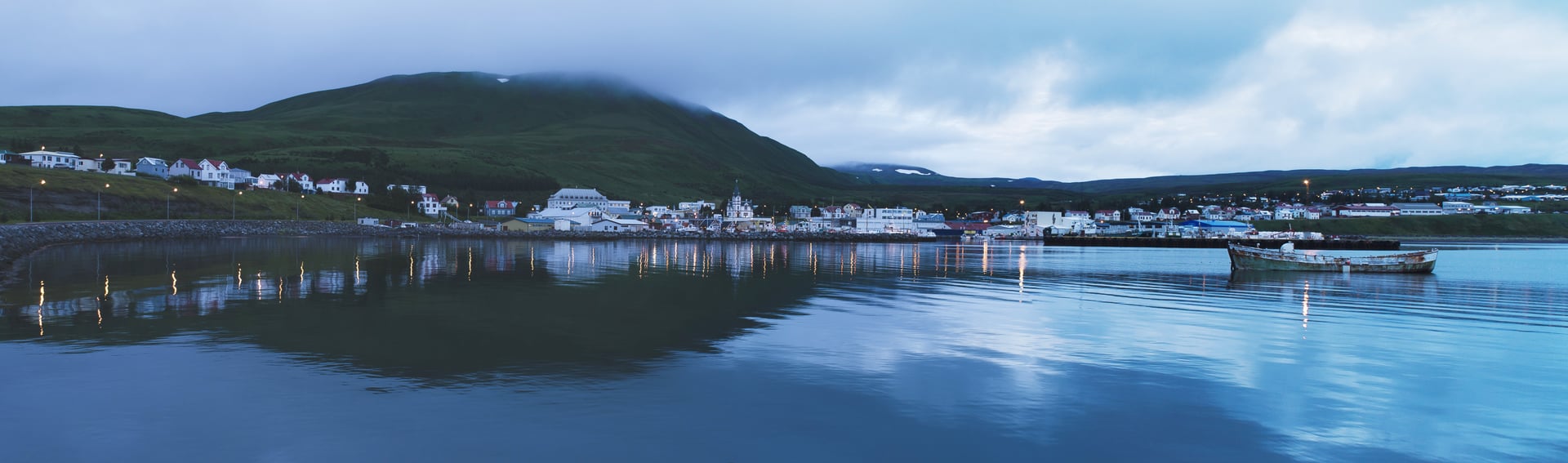
The official location page adds another detail that matters more than it may seem: GeoSea sits at the base of the bright yellow Húsavíkurviti lighthouse on the northern edge of town. This is not an incidental landmark. The lighthouse reinforces the maritime logic of the whole experience. Bathing here does not feel detached from Húsavík's seafaring identity. It feels perched right inside it, just translated into another form. You are not escaping the town's character. You are entering one of its gentler expressions.
The water itself is central to why GeoSea benefits from being explained on its own terms rather than a brief mention inside a general Husavik guide. GeoSea is not just geothermally heated freshwater with a sea view. It is geothermal seawater, and the official site leans hard into that distinction. It notes the water comes from two drillholes, one by the old cheese barrel site and one by Husavik harbor. It also explains there is no need for cleaning agents or heavy treatment systems because the steady flow of water through and over the pools keeps the bath within health regulations. That creates a subtly different mental atmosphere from many spas. The water feels in motion, not frozen into a sealed decorative concept.
This is also why the baths can feel more elemental than polished even while being very comfortable. GeoSea's terms note that the water can be cloudy and not transparent because of its high mineral content. That is an important truth to include because it keeps expectations honest and helps distinguish the place from the glassier blue-image spa language many visitors bring to Iceland. GeoSea is attractive, yes, but not because it imitates purity through artificial visual perfection. Its beauty is more northern and more truthful. It is about tone, air, surface, mineral density, and the meeting of warm water with open sea weather.
The cultural setting of Húsavík deepens everything. Visit North Iceland describes Húsavík as the largest town in Northeast Iceland and a center of commerce and services, while related regional materials also keep circling back to its older identity as one of Iceland's earliest settlement sites and a deeply maritime town. This matters because GeoSea's emotional tone is different from what it would be outside Húsavík. In a capital-area suburb, the baths would read as lifestyle. In Húsavík they read as continuation: a modern bath on a headland above a working bay, beside a lighthouse, in a place where the sea still organizes everyday meaning.
GeoSea's official homepage also says the baths serve in some sense as a cultural center, a place where locals meet to talk through the day's happenings in a practice deeply ingrained in Icelandic life. That is exactly the right note. The strongest Icelandic bathing places are rarely only wellness destinations. They are social spaces, civic spaces, and weather spaces. People go there not just to recover but to remain part of the local world while recovering. GeoSea succeeds because it lets international visitors brush against that rhythm instead of being isolated from it.
Photographically, the baths are unusually powerful because the surrounding frame does so much of the work. The bay, the mountains beyond, the harbor logic of Húsavík, the lighthouse, and the changing sky can make the exact same pool feel entirely different hour by hour. In clearer summer light, GeoSea can look airy and expansive, almost deceptively calm. At sunset, the western exposure becomes one of its greatest strengths. In winter, the darkness and steam can give the place a more concentrated, almost watchful atmosphere. If northern lights appear, the whole cliffside logic suddenly feels inevitable. Even without them, the baths remain deeply visual because the horizon never stops participating.
From an itinerary perspective, GeoSea is one of the smartest additions in North Iceland for travelers who do not want their bathing stop to feel disconnected from the rest of the route. It pairs naturally with Húsavík itself, whale watching, a quieter overnight in town, or a Diamond Circle day that needs one strong human-scale ending. It is less ideal as a rushed checkbox, because the place works best when you let the bay, the light, and your own body settle a little. This is not a site that should be consumed in the same mood as a fast roadside photo stop. Its value is in decompression.
Compared with Forest Lagoon or Myvatn Nature Baths, GeoSea holds its own by having the clearest ocean identity of the three. Forest Lagoon is about wooded shelter and a fjord-facing urban pause near Akureyri. Myvatn Nature Baths are rooted in the volcanic intelligence of the Myvatn district. GeoSea is the maritime bath: salt, bay, cliff, lighthouse, Husavik, and the northern sea horizon. That distinction is important as well as for honest travel writing. People searching specifically for GeoSea usually want to know not only whether it is good, but whether it is meaningfully different. The answer is absolutely yes.
There is also a beautiful contradiction at the heart of the place. Húsavík is often approached through movement: boats departing, birds crossing the bay, weather rolling in, itineraries branching toward Ásbyrgi or Dettifoss or back toward Goðafoss. GeoSea is about choosing stillness in a town defined by maritime motion. That contrast gives it real power. The sea remains present, but you no longer have to move with it. You can watch it from warmth instead.
GeoSea benefits from a fuller explanation because traveler questions around it is highly specific and not interchangeable with general Husavik or North Iceland bathing queries. travelers want to know what makes geothermal seawater different, whether the experience feels local or touristy, how strongly it belongs to a Husavik trip, and whether the view is truly central or just decorative. The fuller way to understand it is that GeoSea works because the view, the water, and the town's maritime identity are inseparable. It is not a bath with a background. It is a bathing experience made legible by its exact place.
What stays with many visitors after GeoSea is often not one single visual detail, though the cliff edge and Skjálfandi Bay are hard to forget. It is the feeling of having met North Iceland in a softer but still very truthful form: seawater holding heat from underground, a lighthouse above, a harbor town behind, and the bay spread out in front like something still alive and working. GeoSea lingers because it allows comfort without severing the connection to weather, place, and local history. That balance is rare, and in Húsavík it feels exactly right.