Iceland Travel Guides
Gerðuberg Cliffs: Basalt Order and the Calm Side of West Iceland
A fuller private guide to Gerðuberg Cliffs, with their geometric basalt columns, Hnappadalur setting, quiet visual power, and role as one of West Iceland's most contemplative short stops.
GlaciGo Iceland / May 2026 / 10 min read
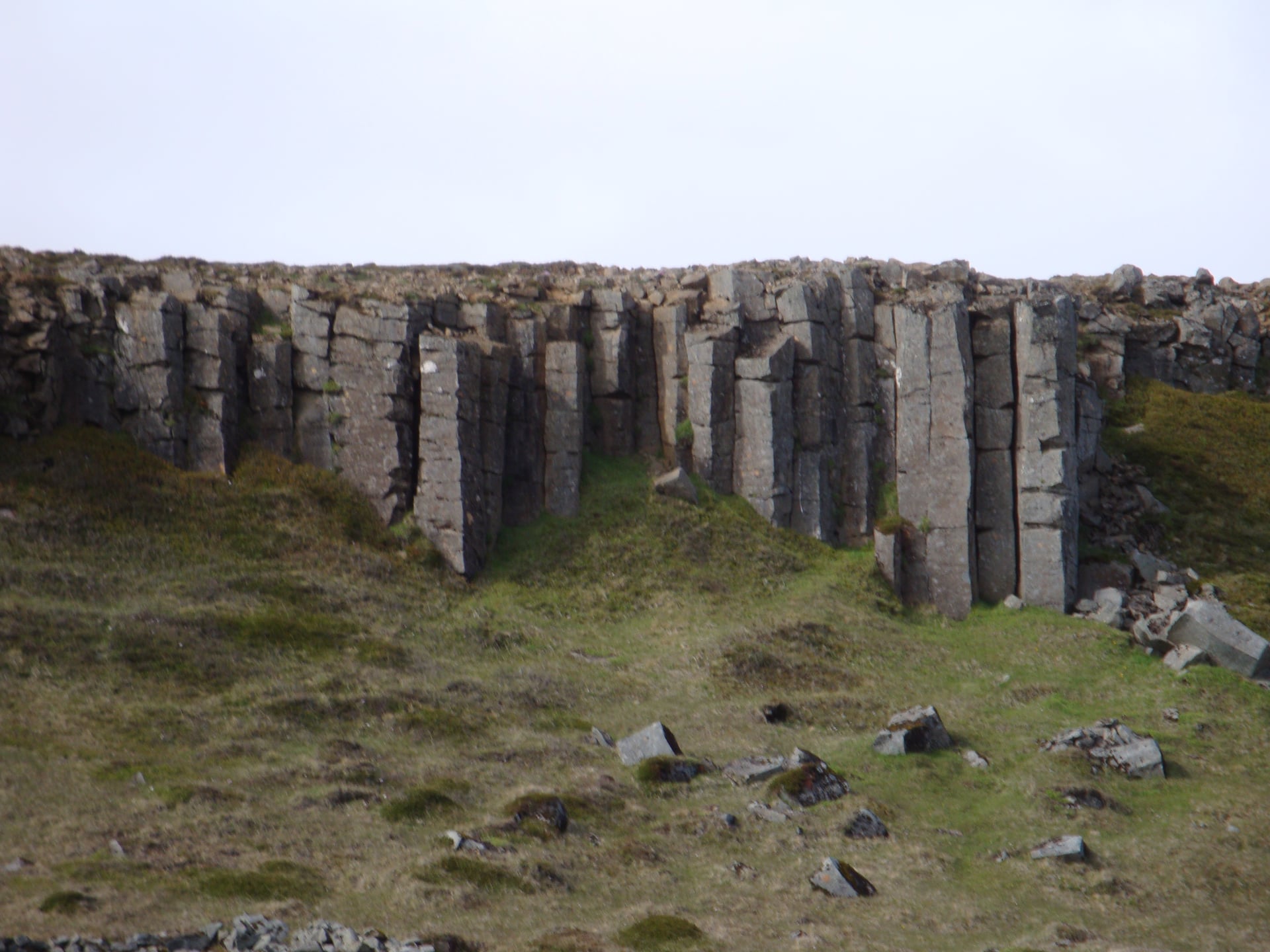
Gerðuberg Cliffs are one of those Iceland places that feel almost too orderly to be natural when you first stand in front of them. A long wall of basalt rises from the slope in tight vertical columns, so regular that people instinctively start searching for a hidden architect. And yet that slight disbelief is exactly the point. Gerðuberg is beautiful not because it is wild in a chaotic way, but because it shows how volcanic landscape can become disciplined, geometric, and unexpectedly calm. In a country full of motion, spray, collapse, steam, and rough edges, Gerðuberg feels like a moment when the land decided to line itself up.
West Iceland's tourism material describes the basalt columns at Gerðuberg as forming a long wall of hexagonal rock, and that is the essential first impression. The cliff does not behave like a mountain or a canyon. It behaves almost like a constructed facade. But what makes the stop stronger than a quick visual curiosity is the way this regularity sits inside a much softer surrounding landscape. The columns stand on the edge of Hnappadalur and on the southern side of Snæfellsnes, where fields, lowland space, and road movement remain part of the experience. The result is a contrast between human-scale countryside and a cliff that looks as if geometry itself has surfaced out of the earth.
That contrast is one reason Gerduberg benefits from a fuller explanation instead of a short mention in a Snaefellsnes checklist. traveler questions here is deceptively simple. People usually want to know whether it is worth stopping, how long it takes, and whether there is anything more to it than photographing basalt columns. The fuller way to understand it is yes. Gerduberg is one of the most satisfying short stops in West Iceland precisely because it is so concentrated. You do not need a long hike or a huge detour to encounter something geologically strange, visually memorable, and emotionally quieter than many of Iceland's more famous sights.
It also works beautifully as an introduction to the logic of basalt in Iceland. The Environment Agency's protected-area explanation for Dverghamrar, another official columnar basalt site, describes how such columns form when a lava flow cools, contracts, and finally splits into usually pentagonal or hexagonal pillars that stand perpendicular to the cooling surface. Gerðuberg is not the same site, but the same volcanic grammar helps explain why its columns feel both elegant and inevitable. What looks designed is in fact the result of lava cooling with unusual clarity and discipline. This is an inference from the general geology of Icelandic columnar basalt, but it fits what Gerðuberg so visibly presents.
That geological legibility matters because Gerðuberg does not need much interpretation structure to communicate its subject. Many natural attractions in Iceland depend on a big reveal, a guide, or a large landscape explanation. Gerðuberg communicates very quickly. You look at the wall and understand, almost instantly, that something precise has happened here. Then, if you stay longer, the place begins to deepen. The columns are not all identical. The line is not perfect in the mechanical sense. Light changes the wall. Distance changes the rhythm. The stop becomes less about counting symmetry and more about learning how nature gets close to order without ever becoming sterile.
The setting on the way into or out of Snæfellsnes gives the place a practical elegance too. Gerðuberg often appears in itineraries alongside Búðir, Ytri Tunga, Rauðfeldsgjá, Arnarstapi, and the larger circuit of the peninsula. But it does not behave like a giant destination demanding a whole chapter of the day. It behaves more like a clarifying pause. After driving, you stop, step out, look up, walk a little, and let your eyes adjust from open road to vertical pattern. Good road-trip stops are not only scenic. They reset attention. Gerðuberg does that exceptionally well.
This makes the stop especially valuable for travelers who are beginning to feel visually overloaded in Iceland. Waterfalls, black beaches, lava fields, fjords, and cliffs can eventually blur together if a route has too many high-drama episodes in a row. Gerðuberg offers a different kind of beauty. It is measured, architectural, contemplative. The cliff invites observation more than adrenaline. That change of register is not a weakness. It is part of what makes the stop memorable.
Photographically, Gerðuberg rewards simplicity. The strongest frames usually come from respecting the graphic force of the columns rather than trying to overcomplicate the scene. A person at the base can help communicate scale. Side light can pull out depth and irregularity. A wider frame can show how the wall rises out of ordinary grassland rather than out of some mythic wilderness. The place is a lesson in restraint. You do not need dramatic weather or a heroic composition to make it work. The wall already carries enough visual intelligence.
At the same time, Gerðuberg is not only about photography. In person, one of its strongest qualities is bodily scale. The columns are large enough to feel impressive and close enough to feel approachable. You can stand under them and sense their height without being swallowed by them. That proportion is important. Some Iceland landscapes overwhelm. Gerðuberg converses. It feels large, but still readable. That makes it especially good for travelers who enjoy geology when it can be encountered directly rather than only admired from a distant lookout.
There is also a subtle relationship between Gerðuberg and the broader cultural atmosphere of Snæfellsnes. This peninsula is often described as 'Iceland in miniature' because so many landscape types gather there in condensed form. Gerðuberg supports that idea, but it also complicates it. It reminds you that Snæfellsnes is not only about dramatic headlands and famous churches and mountains. It is also a place of structure, lava memory, and inland textures that can be just as compelling as the coast. The peninsula becomes richer when Gerðuberg is included, because it prevents the route from being read only through ocean spectacle.
The cliffs also sit near a region of old place-memory and farm country, which gives them a groundedness I find especially appealing. Gerðuberg is not hidden away in some access-controlled wilderness. It belongs to a lived West Iceland landscape of roads, fields, and routes. That means the extraordinary sits right beside the ordinary. In Iceland, that pairing often produces the most durable travel memories. The land does not always announce itself with giant fanfare. Sometimes it simply places a highly improbable wall of basalt beside a rural road and lets the traveler decide whether to notice.
For families or mixed-pace groups, this is another real strength. Gerðuberg does not demand technical skill, advanced fitness, or half a day. It offers genuine geological reward in a short, manageable form. That makes it useful in itineraries where not every stop can be a hike, a boat, or a long activity. It is one of those places that adds quality without adding strain. In route-building terms, that is incredibly valuable.
Gerduberg benefits from being explained on its own terms because too many summaries flatten it into a sentence like 'basalt columns on Snaefellsnes.' That phrase is accurate, but it misses the emotional and visual specificity of the place. The better description is that Gerduberg is one of West Iceland's most elegant basalt stops: a long wall of geometric columns that offers a quieter, more contemplative way to understand the volcanic intelligence of the landscape.
What stays with many visitors after Gerðuberg is not motion but stillness. You remember the repetition, the confidence of the rock, the way the cliff seemed almost to have been arranged, and the relief of standing before something so visually clear after so many messier wonders. Gerðuberg lingers because it proves that Iceland is not only a country of force. It is also a country of form. And sometimes form is exactly what makes a landscape unforgettable.