Iceland Travel Guides
Gígjagjá: The Cave Behind Iceland's Yoda Silhouette
A fuller private guide to Gígjagjá, with its real Icelandic name, Hjörleifshöfði geology, settlement memory, local folklore, and why Yoda Cave is more than a social-media stop.
GlaciGo Iceland / May 2026 / 10 min read
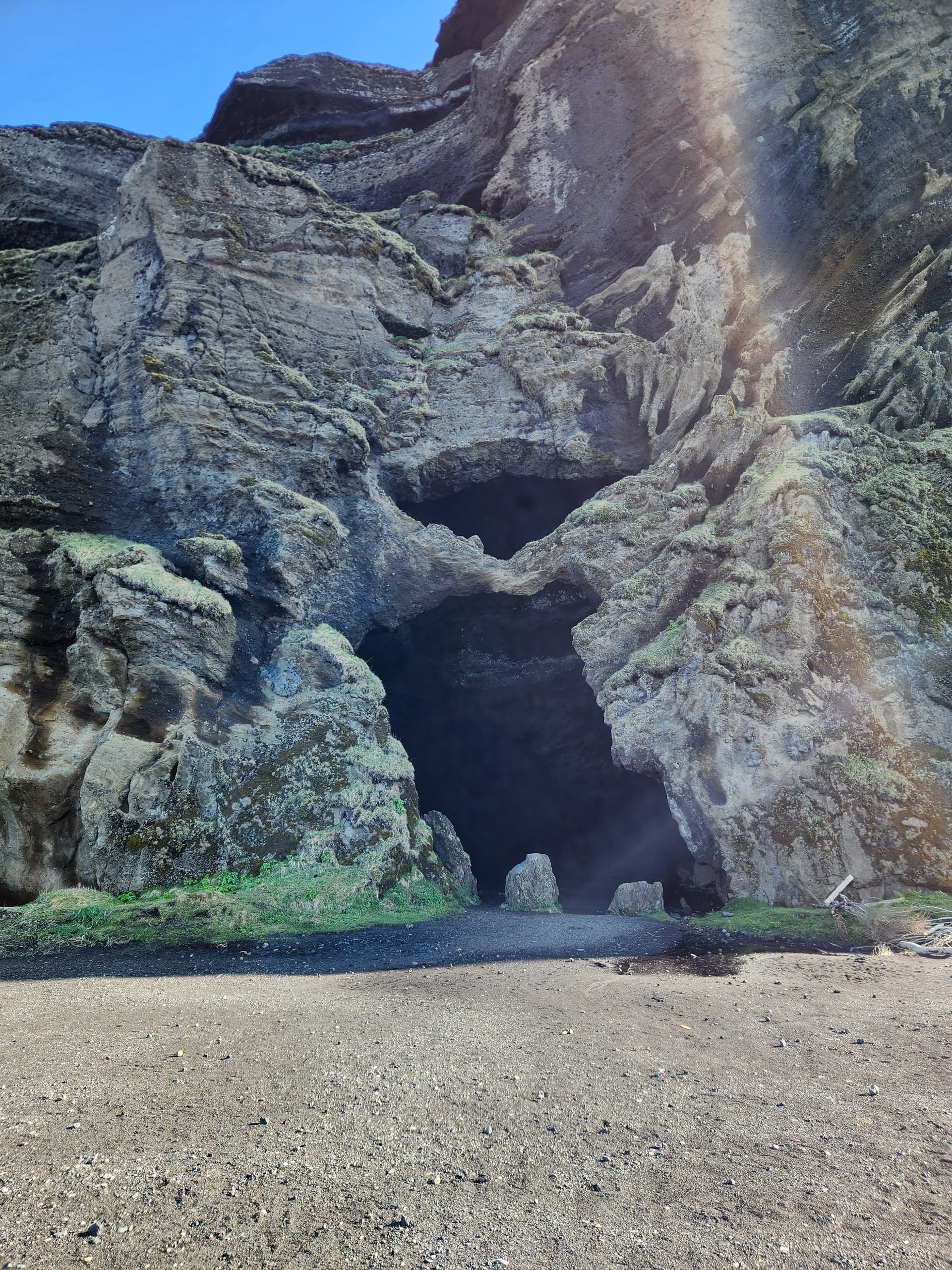
Gígjagjá is one of those Icelandic places that suffers a little from being too photographable. The cave has become widely known online as Yoda Cave because, from the right interior angle, its opening resembles the outline of Yoda's head. The nickname is catchy, easy to remember, and not entirely unfair. But if an article stops there, it misses what makes the place worth visiting. Gígjagjá is not interesting only because a cave mouth resembles a film character. It matters because it sits inside one of the South Coast's most layered landscapes: Hjörleifshöfði, a former island, a tuya on Mýrdalssandur, a place tied to early settlement memory, Katla's repeated outwash, and the long human habit of reading stories into strange forms.
The first thing to get right is the name. Viking Park, which manages the area around Hjörleifshöfði and presents local interpretation there, explains clearly that the original Icelandic name is Gígjagjá. The same source also preserves a local story behind that name, linking it to a sea monster woman under a spell. That small piece of folklore matters more than the imported nickname because it reminds us the cave was narratively alive long before Star Wars tourism found it. The Yoda comparison is modern, visual, and global. Gígjagjá is older, stranger, and more local.
Viking Park also confirms the popular association that most travelers now know: when you stand inside the cave, the outline of the opening resembles Yoda, and the cave was featured in the opening scene of Rogue One. That is useful to acknowledge because many visitors do arrive through that route of recognition. But it should not dominate the article. Film exposure can explain why a place became famous; it does not explain the deeper reason a place holds up once you are there in person.
To understand that deeper reason, you have to widen the frame from the cave to Hjörleifshöfði itself. Visit South Iceland describes Hjörleifshöfði as a 220-meter tuya on the southwest side of Mýrdalssandur, formed when lava erupted through thick ice during the last cold period of the Ice Age. That geological origin already changes the mood of the visit. You are not approaching a random seaside cave. You are entering the side of a steep-sided volcanic landform that once stood as an island and later became surrounded by black sands created through repeated glacial runs from Katla.
That former-island identity gives the whole site unusual emotional force. Visit South Iceland notes that Hjörleifshöfði was probably once an island in the sea and later became landlocked during settlement times, with a fjord called Kerlingarfjörður reaching in beside it. Even if you come only for the cave, the headland still carries that old island logic. It stands apart. It rises alone from sand. It feels detached in a way that is difficult to fake. Gígjagjá inherits that atmosphere. The cave is not merely tucked into a hillside; it belongs to a headland whose entire shape suggests separation, survival, and memory.
History deepens the place even further. Visit South Iceland connects Hjörleifshöfði to Hjörleifur Hróðmarsson, the early settler whose story is woven into Iceland's settlement narratives. According to the tradition summarized there, Hjörleifur was killed by Irish slaves, who fled with the women to the Westman Islands, where Ingólfur later found and killed them. A burial mound on Hjörleifshöfði is associated with him. Whether a visitor comes for saga history or not, this background changes the imaginative register of the site. The cave sits in a landscape where geology, naming, and settlement legend all overlap.
There is another kind of historical presence too: habitation. Visit South Iceland notes that Hjörleifshöfði remained inhabited until 1936 and that the farm had to be moved after Katla's 1721 eruption destroyed the earlier site. That detail matters because it keeps the headland from becoming a pure wilderness fantasy. People lived here, adapted here, lost ground here, and rebuilt here. When modern visitors walk toward Gígjagjá across the black sands, they are moving through a space that has been both mythic and practical for centuries.
What the cave itself offers is a powerful lesson in scale and framing. Outside, the South Coast often overwhelms with width: sandurs, surf, glacier systems, sky. Inside Gígjagjá, the visual logic reverses. The cave narrows the world into one shaped aperture. Instead of facing a panoramic sprawl, you stand in darkness and look outward through a silhouette. That reversal is part of why the place photographs so well, but it also explains why it feels memorable even without a camera. The cave edits the landscape. It turns a huge region into one expressive edge of light.
This is also why the Yoda nickname, while superficial in one sense, is not entirely empty. Humans are pattern-seeking animals. We look at openings, cliffs, and clouds and read faces, beasts, and beings into them. Icelandic folklore has always done this, whether through trolls, hidden people, sea creatures, or named rocks and mountains. Modern pop culture is simply another layer of that same impulse. The problem is not that people call it Yoda Cave. The problem is when they forget that Iceland already had older habits of imaginative seeing long before the franchise reference arrived.
The best way to experience Gígjagjá, then, is not as a quick novelty stop but as one moment inside the broader Hjörleifshöfði landscape. Viking Park's local interpretation highlights the cave, the headland, and the old ruins together. That is exactly right. The cave becomes stronger when approached as part of a place that includes volcanic form, early settlement memory, black-sand isolation, and the remains of lived human effort. Seen this way, the cave is not separate from Hjörleifshöfði. It is one of the most photogenic expressions of what the whole headland is already saying.
Compared with Sólheimasandur Plane Wreck, Gígjagjá offers a much older and less accidental drama. Compared with Reynisfjara, it is smaller, more enclosed, and more inward-looking. Compared with Þakgil, it is less about shelter in the camping sense and more about shape and headland presence. These differences matter because they keep the article from collapsing into generic South Coast language. Gígjagjá is not about grandeur alone. It is about framing, naming, and the strange intimacy of standing inside rock while the black-sand world opens in front of you.
There is also something healthy in resisting overstatement here. Gígjagjá is not one of Iceland's largest caves, nor one of its most geologically complex accessible interiors. It does not need to be. Its power comes from precision. The opening is unusually expressive. The surrounding promontory is geologically and historically thick with meaning. The walk across the sands helps prepare the eye. And the cave gives back a very distilled kind of wonder: not the wonder of size, but the wonder of one shape doing more than it should.
For tourists, this makes the site especially rewarding on days when you want one place to hold several Icelandic themes at once. You get the South Coast's black sands. You get Katla-country geology. You get settlement memory. You get a local folktale. And yes, you get the film-reference silhouette too. The site works because those layers do not cancel each other out. They stack.
Gigjagja benefits from careful explanation precisely because traveler questions is split. Some people search for Yoda Cave. Others search for Gigjagja. Some want the movie connection. Others want the real Icelandic name and location. A strong guide needs to answer both without letting the nickname take over. The best way to understand it is simple: Gigjagja is the original name, Yoda Cave is the popular modern nickname, and the place is worth visiting because the landscape around the cave is much richer than the meme version suggests.
What many travelers remember afterward is not only the outline itself, but the feeling of standing inside a dark volcanic opening and looking out over a world shaped by ice, flood, ash, legend, and time. That is the real achievement of Gígjagjá. It takes a place that could have remained a clever image and turns it back into landscape, history, and story.