Iceland Travel Guides
Glaumbær Turf House: Architecture of Survival and the Memory of Old Iceland
A fuller private guide to Glaumbær Turf House, with its thousand-year farm mound, corridor-style turf architecture, preservation story, saga echoes, and role in understanding old Icelandic life.
GlaciGo Iceland / May 2026 / 10 min read
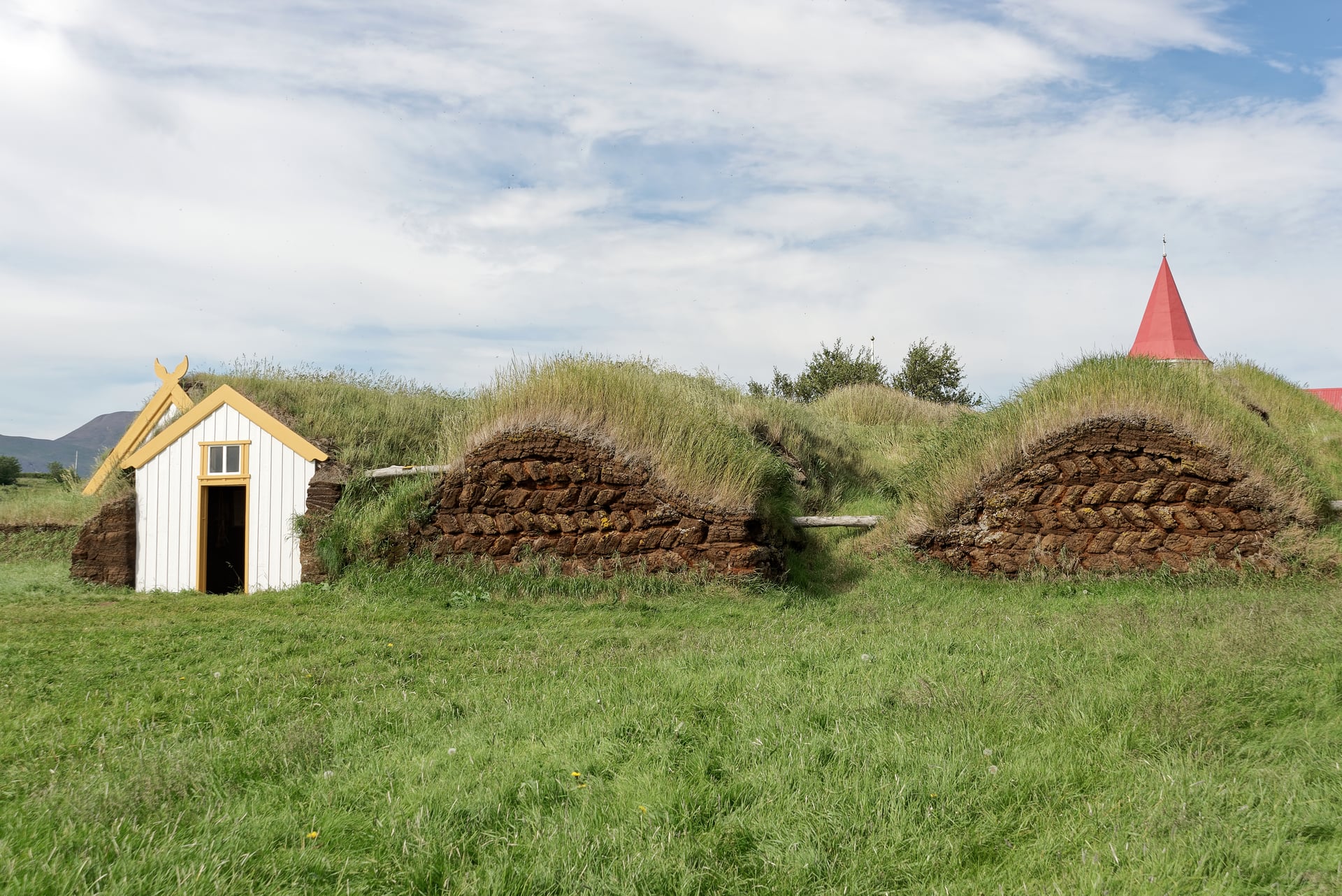
Glaumbær Turf House is one of those places in Iceland where architecture stops feeling like style and starts feeling like survival made visible. From the outside, the farm looks almost as if it has risen out of the earth rather than been placed upon it. Grass-covered roofs melt into the landscape, dark timber fronts face the yard, and the whole complex sits with an intelligence that is older than tourism and more practical than romance. People often arrive expecting something quaint. What they leave with, if they really pay attention, is a much sharper understanding of how Icelanders once lived with climate, scarcity, and long winters.
The Skagafjörður Heritage Museum describes Glaumbær not simply as a picturesque farm but as a protected historic building that likely stood on the same farm mound for about a thousand years. That single fact changes the emotional scale of the place immediately. You are not walking through a decorative reconstruction placed in an approximate landscape. You are entering a site layered by centuries of habitation, adaptation, rebuilding, and memory. The farm changed in size, age, and internal arrangement over time, but the continuity of the place itself matters just as much as the preserved rooms that visitors see today.
That continuity reaches back into saga-age memory. The museum states that, according to the sagas, Snorri Þorfinnsson, son of Þorfinnur Karlsefni and Guðríður Þorbjarnardóttir, built the first church at Glaumbær around the year 1000. The exact location of the church remains unknown, but archaeological remains of 11th-century buildings were found east of the farm mound in 2002. This is exactly the kind of historical layering that makes Glaumbær richer than a simple heritage stop. The place is not just about the nineteenth century preserved for visitors. It also carries much older echoes of settlement, Christianization, and family memory connected to some of the most resonant names in the Icelandic story.
The architecture itself is the real teacher. The museum's official explanation says Glaumbær is a corridor-style turf farmhouse of the largest kind, made up of thirteen interconnected buildings and covering roughly 730 square meters. Six front houses face the farmyard with their gables, while the back houses are linked by an interior passage running all the way to the baðstofa, the communal living room. That description is precise, but walking it in person is what makes it unforgettable. You begin to understand that the house was not planned as a monument. It was planned as a working organism: a connected interior world designed to reduce exposure, preserve warmth, organize labor, and let people move through winter without repeatedly stepping into hostile weather.
The building materials tell the same story even more strongly. Because there was little stone available on the land, turf became the primary material, and the museum says turf-cutting conditions in the area were excellent. It goes so far as to suggest that perhaps nowhere else in the world was turf used so extensively in a building of this size. That is not a cute detail. It is a revelation about Icelandic resourcefulness. Glaumbær was built from what the land could actually provide: turf for insulation and walls, driftwood and imported timber for framing and interior paneling. In a country where durable building materials were limited, architecture had to become an act of negotiation with the landscape rather than conquest over it.
This is one reason Glaumbaer benefits from being explained on its own terms rather than a passing mention in a regional route. traveler questions here is not only about opening hours, tickets, or whether the place is worth the detour from the Ring Road. People are also looking for a way to understand what a turf house really means. The stronger answer is that Glaumbaer helps decode a whole vanished daily world: heat, light, privacy, status, storage, family structure, labor, and the physical intimacy of life inside walls that were part earth and part craft.
The museum's main exhibition, Life in Turf Houses in the 19th Century, is itself a clue to the best way of reading the site. Glaumbær is not strongest when treated as an isolated artifact. It is strongest when treated as a lived environment. Rooms were not only rooms; they were parts of a seasonal system. Passageways were not charming corridors; they were climate logic. The baðstofa was not just a communal room; it was the emotional and social center of the home. The kitchen, pantry, yard-facing fronts, and back-house sequence all express a domestic order built around necessity, hierarchy, and shared endurance.
That lived quality becomes even more poignant when you learn about the preservation story. The museum notes that a decisive moment came in 1938, when Mark Watson donated money toward conservation. Glaumbær was formally declared protected in 1947, and that same year the last residents moved out. In 1948 the Skagafjörður Heritage Museum was founded, and in 1952 the main exhibition opened in the old farmhouse. This timeline matters because it captures a very Icelandic threshold between use and memory. Glaumbær did not move directly from timeless tradition into abstract heritage. It passed through a modern moment when people recognized that an entire mode of living was disappearing and made a conscious decision to preserve it before it vanished completely.
That transition from home to museum is part of what gives the place its emotional charge. You can feel that Glaumbær is preserved, but it does not feel sterile. It still carries the density of actual use. Low doorways, connected rooms, dim interiors, and compact volumes remind the visitor that Icelandic rural life was not built around spaciousness. It was built around containment, adaptation, and making domestic life possible in a harsh environment. The result is not luxurious, but it is deeply intelligent.
North Iceland's official tourist guide describes Glaumbær very briefly as a turf farm with two timber houses, part of the Skagafjörður Heritage Museum. That short description is useful because it points beyond the most photographed element. Many visitors focus only on the turf frontages, but the site as a whole is broader than that. The timber houses add another layer to the story, showing the shift from older building traditions toward newer domestic forms. Glaumbær therefore works not only as a preserved old house, but as a compact lesson in transition: how one architectural world gave way, slowly and unevenly, to another.
The broader Skagafjörður setting also matters. This is a farming district with deep horse culture, church history, saga memory, and one of the strongest rural identities in Iceland. Glaumbær sits within that richer northern landscape rather than floating above it as a museum object. The surrounding valley helps the house make sense. You can see why such a farm belonged here, why turf mattered, why storage and internal connectivity mattered, and why preserving this site tells a bigger story than simply saving one attractive building.
Photographically, Glaumbær is often reduced to the iconic grass-roofed facade, and to be fair, that facade is extraordinary. But in person the more powerful experience is spatial rather than purely visual. The low passages, the turn from yard to interior, the sense of moving through a structure that was built by accumulation rather than by modern symmetrical planning, all create a much richer memory than one exterior frame can hold. It is one of those heritage sites where the photograph gets people there, but the interior sequence is what gives the place weight.
There is a cultural humility built into Glaumbær that many travelers find unexpectedly moving. The house is ingenious, but it is not trying to impress in the modern sense. Its beauty comes from fit: fit to weather, fit to materials, fit to the household, fit to the land. That can be surprisingly affecting because so much contemporary travel trains us to look for bigness, spectacle, or novelty. Glaumbær asks for a different kind of respect. It asks you to notice competence, continuity, and the quiet dignity of people building carefully within limits.
For itinerary planning, Glaumbær works beautifully on a North Iceland or ring-road route through Skagafjörður, especially when paired with other historical sites such as Víðimýrarkirkja or Hólar. It also balances nature-heavy travel extremely well. After waterfalls, canyons, geothermal fields, and mountain roads, a place like Glaumbær recalibrates the journey. It reminds travelers that Iceland is not only lava, water, and weather. It is also household history, craftsmanship, and the long problem of making a life in this landscape.
Glaumbaer benefits from a fuller explanation because too many summaries flatten it into a single phrase like "traditional turf house museum." That is technically true, but it leaves out the thousand-year continuity of the site, the protected-building history, the saga connections, the corridor-style plan, the conservation story, and the larger cultural meaning of turf architecture in Iceland. The better description is that Glaumbaer is one of the country's clearest and most human ways to understand how Iceland once sounded, felt, and functioned indoors.
What stays with many visitors after Glaumbær is not simply the image of grass roofs against the northern light. It is the realization that this was a complete domestic world built with extraordinary intelligence from modest means. Glaumbær lingers because it makes the past legible without overdramatizing it. The place does not need theatrical reconstruction. The house itself is enough. It holds warmth, labor, memory, and adaptation inside its walls, and that makes it one of North Iceland's most rewarding cultural stops.