Iceland Travel Guides
Goðafoss: Water, Memory, and the Quiet Authority of North Iceland
A fuller private guide to Goðafoss, with its elegant horseshoe form, Diamond Circle access, connection to Iceland's conversion story, and the reason this waterfall feels historically as well as visually complete.
GlaciGo Iceland / May 2026 / 10 min read
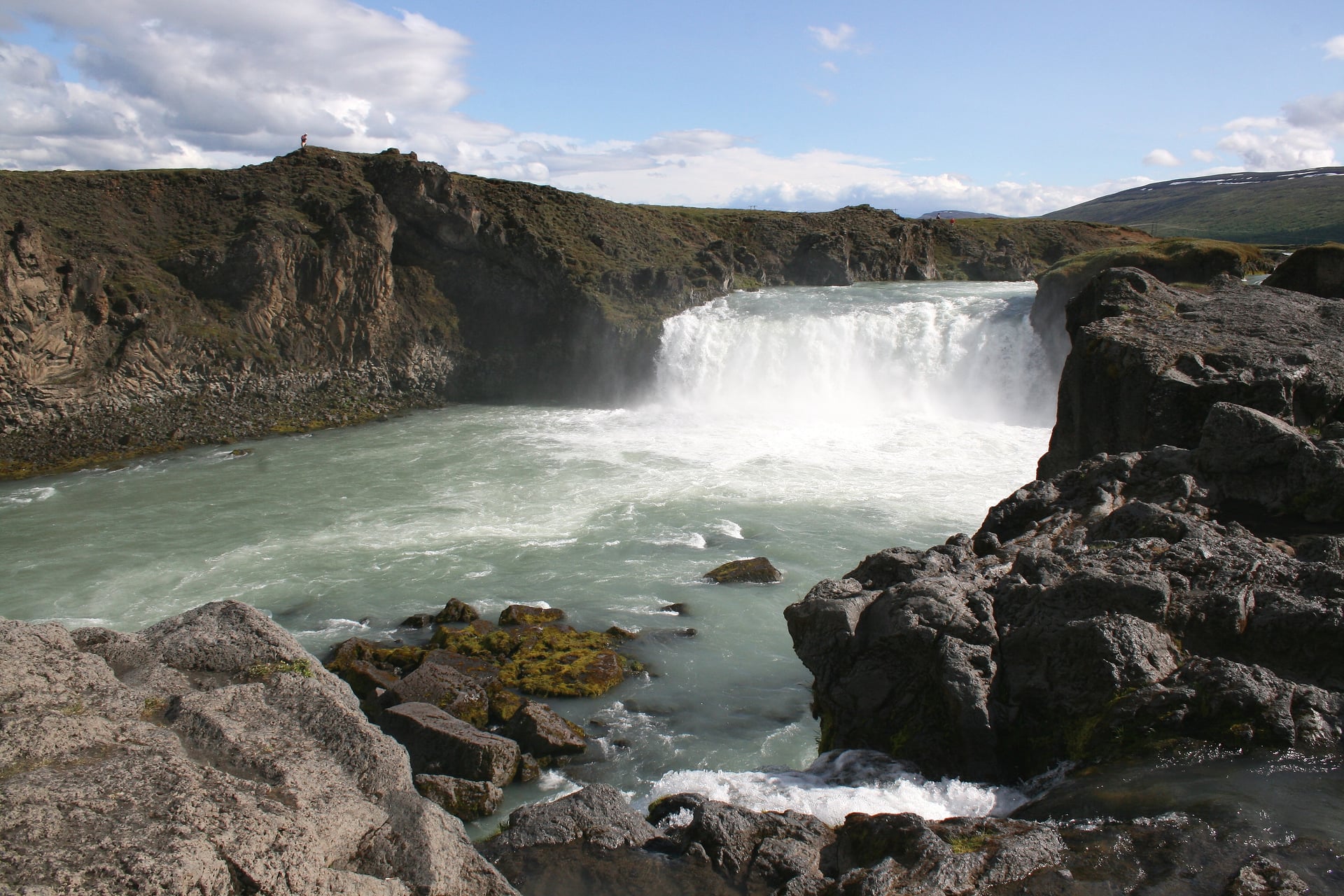
Goðafoss is one of those Icelandic waterfalls whose fame rests on more than appearance, though the appearance would be enough for many places. It is broad rather than towering, open rather than hidden, easy to reach yet difficult to dismiss. The water of Skjálfandafljót curves and breaks over a horseshoe-shaped edge with a composure that feels almost ceremonial. That word matters. Goðafoss does not usually overwhelm in the same way as the loudest or tallest waterfalls in Iceland. It carries a different kind of force: visual balance, historical resonance, and a sense that nature and national memory have been tied together here for a very long time.
Visit North Iceland's official page gives the essential physical outline clearly. The river falls about 12 meters over a width of 30 meters, and the Ring Road passes directly by, with parking on both sides and paved paths to viewing platforms. That accessibility is part of why Goðafoss matters so much in real itineraries. Some iconic sites in Iceland require detours, gravel roads, or a substantial time commitment. Goðafoss sits close enough to the main route that many travelers first assume it might be merely convenient. In practice, the opposite often happens. Because the waterfall is so easy to reach, people arrive with modest expectations and then find a place with far more presence than convenience alone can explain.
A lot of that presence comes from shape. Goðafoss does not descend in one stern vertical line. It opens in a curve, which gives the waterfall an unusual generosity. Water seems to gather itself and then spread across the dark edge rather than simply plunge. The effect is especially strong from the better viewpoints, where the whole crescent becomes legible at once. This is why the waterfall often feels photographically satisfying even in poor weather. It has a completeness of form. The eye understands it quickly, but the feeling of it lasts longer.
Yet form alone is not the reason Goðafoss has such a secure place in Icelandic imagination. Visit North Iceland repeatedly links the waterfall to the conversion of Iceland to Christianity around the year 1000. The official tourism story says that the lawspeaker Þorgeir Ljósvetningagoði, after deciding that Christianity would become the country's official religion, threw the idols of the old Norse gods into the waterfall. This is the tradition from which the name is usually explained: goð meaning gods, and foss meaning waterfall. For a serious article, the important thing is not to flatten this into mere legend or to overstate it as if every detail were beyond discussion. The deeper truth is that Goðafoss has become one of the places where Iceland remembers a moment of civilizational turning.
That turning matters because the conversion story is not really about dramatic personal piety alone. It is about peace, compromise, and the difficult work of keeping a young commonwealth together under external pressure and internal division. Visit North Iceland emphasizes that Þorgeir made his decision as pressure grew from other European countries, especially Norway, and that keeping the peace was central. This gives Goðafoss a subtler historical mood than many travelers expect. The waterfall is associated not only with gods and dramatic gesture, but with a legal-political attempt to prevent fracture. That makes the site feel more Icelandic in a deep sense: consensus, law, and landscape held unusually close together.
This is one reason the waterfall often stays in memory differently from other stops on the Diamond Circle. Dettifoss may hit harder through raw power. Mývatn may offer more varied geological forms. But Goðafoss has a compactness of meaning that is hard to beat. It is scenic, yes, but also narratively complete. River, road, history, and form all arrive together. You do not need a long hike or a complicated explanation in order to feel that something important gathers here.
The river itself also matters. Goðafoss lies on Skjálfandafljót, one of North Iceland's defining rivers, and the official North Iceland material places other major waterfall experiences on the same system farther south, including Aldeyjarfoss. That wider river context is useful because it reminds visitors that Goðafoss is not an isolated decorative fall created only for roadside admiration. It belongs to a much larger fluvial and volcanic landscape, one in which glacial water, lava country, and northern distances all continue to shape what is visible at this single, accessible bend.
Accessibility has improved significantly in recent years, and Visit North Iceland explicitly notes the new paved hiking trails, nature trails, and viewing platforms. This matters not just as practical information, but as part of the site's emotional structure. Goðafoss is one of the waterfalls where people of different ages and mobility levels can still encounter something major without that encounter being thinned out into triviality. The infrastructure does not replace the landscape. It helps more people meet it. That is worth saying clearly, because easy access and genuine beauty do not always coexist this well.
For tourists, one of the most interesting things about Goðafoss is that it can be entered from more than one mood. If you are doing a larger North Iceland route, it can work as a hinge between Akureyri, Húsavík, and Mývatn. If you are on the Ring Road, it becomes one of the most graceful breaks in the drive. If you are thinking historically, it becomes a site of memory. If you are simply tired and in need of a short walk to a place that immediately feels worth the stop, it delivers that too. Very few landmarks carry all of those functions so comfortably.
The surrounding atmosphere also deserves attention. Goðafoss is more open than many canyon-bound or cliff-hidden waterfalls, which gives it a broader northern sky and a stronger conversation with changing light. In summer the white water can feel especially bright against softer greens and dark rock. In colder seasons the edges harden, mist sharpens, and the scene can become almost austere. Visit North Iceland even highlights Goðafoss as a particularly accessible northern-lights location, which fits the place surprisingly well. The waterfall has enough visual clarity that it can hold celestial drama without being visually swallowed by it.
Photographically, the site benefits from this openness. The best images are often not the closest ones. They are the ones that preserve the arc of the water and the broad, calm confidence of the fall within its river course. Too tight a frame can reduce Goðafoss to detail. A fuller frame lets the shape breathe, which is where much of the beauty lives. Because the fall is not extremely tall, its grandeur is compositional rather than merely monumental.
Goðafoss also deserves to be understood as part of North Iceland's own identity rather than simply as a smaller stop compared with the bigger waterfall legends of the south. Visit North Iceland places it among the region's top destinations and along the Diamond Circle, and that positioning makes sense. The waterfall reflects something essential about the north: strong but not always loud, deeply storied without becoming overperformed, and easy to love while still rewarding more thoughtful attention.
Godafoss answers several visitor questions at once: whether it is worth stopping for when Iceland has so many waterfalls, whether the Christianity story is central or secondary, how accessible the paths feel, and what makes it distinct from larger falls. Its strength is combination. It is beautiful on sight, historically resonant, route-friendly, and emotionally balanced, which can be more memorable than scale alone.
What stays with many visitors after Goðafoss is a sense of poise. The waterfall feels complete without feeling showy. It is rich in story without turning into a lesson. It is accessible without becoming ordinary. Goðafoss lingers because it offers one of Iceland's cleanest meetings between landscape form and cultural memory, and does so with a quiet confidence that feels entirely earned.