Iceland Travel Guides
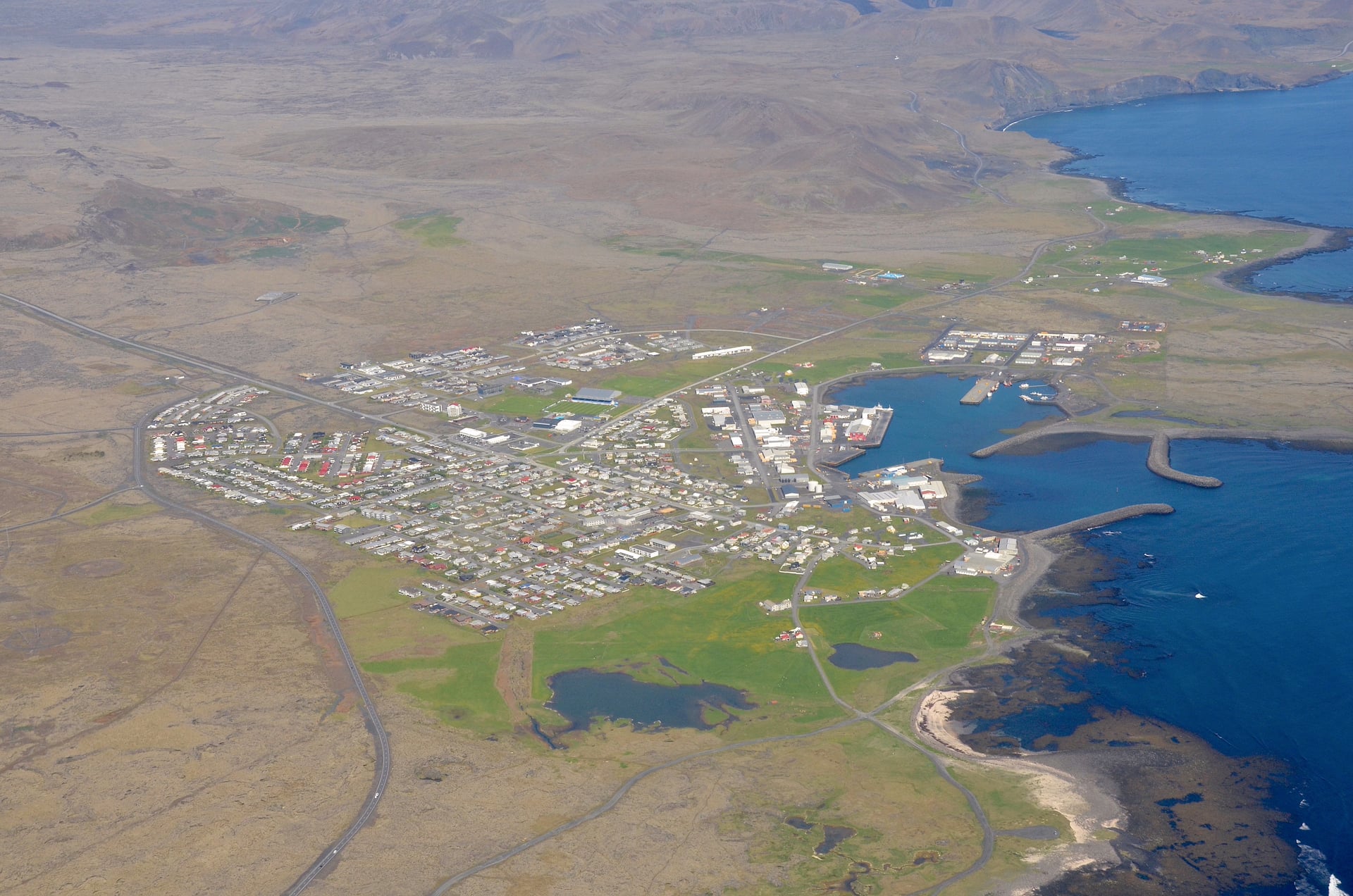
Grindavík: Harbor Memory, Volcanic Reality, and a Town Returning
A fuller private guide to Grindavík, with harbor history, saltfish culture, the turning point of 10 November 2023, reopening on 21 October 2024, and the town's ongoing return to ordinary life.
GlaciGo Iceland / May 2026 / 11 min read
Grindavik is one of the Icelandic towns whose name changed meaning for many international travelers in a very short time. For a long while, people who knew it at all tended to know it through fishing, salt cod, the harbor, the Blue Lagoon nearby, or the broader Reykjanes Peninsula. Then the events that unfolded from November 2023 onward pushed the town into a much harder global frame: evacuation, earth cracks, protective barriers, and repeated questions about whether ordinary life could continue at all. A useful article has to hold both identities together. Grindavik is not only a town affected by volcanic unrest. It is also a real fishing community with a longer memory than the headlines.
The official English page from Grindavik itself begins with that older identity. It describes Grindavik as a fishing town on the south coast of the Reykjanes Peninsula whose life has evolved around fishing since the time of settlement, around 934. The same municipal page emphasizes the town's importance in fish-related industry and notes its strong connection to saltfish production. Even if some of the numbers on older tourism pages belong to a pre-2023 moment, the underlying truth remains essential: Grindavik is not a place that became meaningful only because of a volcanic emergency. The sea built its character long before the recent eruptions altered its daily rhythm.
That maritime identity becomes especially tangible through Kvikan, the House of Culture and Natural Resources, which Visit Reykjanes presents as Grindavik's cultural house. On the second floor is the exhibition 'Saltfish in the history of the nation,' a fitting theme for a town whose harbor economy helped shape livelihoods for generations. This matters for how visitors should think about Grindavik. If you reduce the town to a stop near Blue Lagoon or to a dramatic news location near lava barriers, you miss the deeper structure of the place. Grindavik has always been a working harbor town first, and a visitor who understands that will read the streets, shoreline, and local institutions differently.
The harbor itself supports that reading. Official local material from Grindavik and maritime references both make clear that Grindavik has long ranked among Iceland's more active landing ports. That is not trivial context. On the Reykjanes Peninsula, where landscapes are often described through geology alone, Grindavik reminds you that labor, export, fish processing, and harbor logistics are just as much part of the regional story as lava and steam. The town is one of the places where Iceland's relationship with the North Atlantic is economic and daily, not only scenic.
And yet it would be dishonest to write about Grindavik in 2026 as though nothing had happened. The Icelandic Meteorological Office's later research summary on ultra-rapid dike formation points back to 10 November 2023, when the town was initially evacuated as a major magmatic intrusion formed beneath the area. That date matters. It marks the moment when Grindavik ceased, in the eyes of many outsiders, to be simply a harbor town and became a symbol of life on an active peninsula. The speed and seriousness of that transformation still shape how the place is felt now.
The official Visit Reykjanes page for Grindavik municipality gives the next important date: the town reopened to the public on 21 October 2024 following an ongoing risk assessment and a range of safety measures, including mapping, geological surveys, geophysical measurements, inspections, and the fencing or filling of crevices. That reopening should be understood neither as a neat ending nor as a dramatic all-clear. It is better understood as a managed reopening in a town where risk continues to be evaluated continuously. That nuance is important for travelers, and also for tone. Grindavik is not frozen in disaster, but it is not appropriately described as if the last few years were a temporary footnote either.
Recent town updates add another layer to that picture. A municipal update from 28 March 2026 reported increasing numbers of staff and businesses operating in Grindavik. That may sound administrative, but emotionally it means something larger: return, adaptation, and insistence. Towns do not resume life all at once or symbolically. They do it through work shifts, reopened kitchens, maintenance, schools, harbor activity, cultural rooms, and people deciding that routines are worth rebuilding. Grindavik's recent story is therefore not only about hazard. It is also about stubborn civic continuation.
This is one reason Grindavik should be treated as a town in its own right rather than as an accessory to Blue Lagoon, Fagradalsfjall, or eruption maps. Travelers need to understand what the town meant before the evacuation, what controlled access and gradual return mean now, and how to think ethically about a community that became globally recognizable through stress. The right tone is specific and restrained, never spectacle-hungry.
Photographically, Grindavik rewards a different kind of attention from the nearby geosites. The strongest images are often not of the most dramatic defenses or the most obviously damaged areas, but of the quieter continuities that show what the town is made of: fishing vessels, harbor geometry, low industrial buildings against lava ground, weather over the bay, street signs, the cultural house, or the relationship between ordinary town structure and extraordinary surrounding landscape. Grindavik photographs best when it still feels inhabited, worked, and specific.
Food and cod culture are part of that specificity. Visit Reykjanes' listing for Salthusid describes it as the first restaurant in Iceland specializing in codfish and notes how central cod once was to the national economy. Even though individual businesses have experienced closures, relocations, or uncertain reopening timelines since late 2023, the broader truth remains: in Grindavik, fish is not branding pasted onto tourism after the fact. It is the historical substance of the town. That matters for how a visitor should eat there, read there, and think there.
For private travelers, Grindavik can be one of the most rewarding stops on Reykjanes precisely because it introduces human scale into a peninsula often narrated through processes larger than people. Seltun gives geothermal chemistry. Gunnuhver gives coastal steam. Reykjanesviti gives maritime exposure. Fagradalsfjall gives eruptive time. Grindavik gives community. It is where those forces meet a harbor town that has had to negotiate both livelihood and uncertainty in public view. That human dimension can transform an otherwise purely geologic day into something fuller.
A careful article should also make room for emotional complexity. Some travelers may hesitate to visit out of respect, uncertainty, or confusion about current conditions. That hesitation is understandable. But there is a difference between respectful caution and treating a living town as permanently off-limits in the imagination. Official regional pages now speak in terms of controlled access, ongoing monitoring, and gradual return. The right posture for visitors is not voyeurism, and not avoidance born of stale assumptions. It is attentiveness to current official guidance and a willingness to see Grindavik as a place where ordinary life and extraordinary geology now coexist more visibly than before.
This coexistence is also what makes Grindavik so distinctly Icelandic. Around the world there are fishing towns, volcanic towns, and tourist towns. Grindavik is all three at once, and in recent years those identities have collided more openly than anyone would have wished. Yet the collision has also made the town newly legible. You can see how infrastructure, labor, memory, and hazard fit together. You can feel what it means for a harbor town to sit on a peninsula that is geologically restless in the present tense.
From an itinerary perspective, Grindavik works best when it is not rushed or instrumentalized. It can be paired with Blue Lagoon, but should not disappear behind it. It can sit within a broader Reykjanes route, but should not be reduced to a service stop. The town deserves at least enough time for a harbor look, a cultural stop such as Kvikan when appropriate, and a more grounded sense of what the peninsula means when people actually live there. That is where the visit becomes more than transit.
Grindavik brings several visitor questions together: fishing town, Blue Lagoon neighbor, evacuation history, current access, ethical visiting, and what there is to understand beyond the recent volcanic story. A responsible guide has to answer those without pretending the town is either frozen in crisis or simply back to normal. Its present reality is more careful, more human, and more complicated than either shortcut.
What stays with people after a thoughtful look at Grindavik is often not a single dramatic scene, but a more durable impression: harbor pragmatism, cod history, black lava nearby, civic vulnerability, gradual reopening, and the realization that Iceland's most revealing places are often the ones where geology has to share space with ordinary work. Grindavik is not simply a town beside recent volcanic events. It is one of the clearest places in Iceland to see how a community keeps trying to remain itself while the ground around it changes.