Iceland Travel Guides
Grjótagjá Cave: Heat, Memory, and Intimacy Beneath Mývatn
A fuller private guide to Grjótagjá Cave, with its lava chamber, old bathing history, Krafla Fires temperature change, and the reason this small Mývatn site feels so emotionally concentrated.
GlaciGo Iceland / May 2026 / 10 min read
Grjótagjá is one of those Icelandic places where scale deceives at first glance. It is not a vast canyon, not a sweeping crater, not a major waterfall visible from far away. It is a small lava cave near Mývatn, and because of that many travelers imagine it as a quick curiosity or a minor photo stop. In reality, Grjótagjá has a disproportionate emotional pull. The cave gathers several things that Iceland does unusually well into one confined space: volcanic fissure, geothermal water, fragile beauty, recent geological change, local bathing history, and a strange intimacy that larger landscapes can never quite produce.
Visit Mývatn's official material describes Grjótagjá simply but effectively as a small cave in the Mývatn area that was once a popular bathing place for locals. That sentence already contains most of what matters. Grjótagjá is not significant because it is large. It is significant because people once used it. The cave is not merely geological scenery. It belongs to the social and bodily history of the district. You do not stand there only thinking about lava and fissures. You also think about warmth, privacy, custom, and the older Icelandic habit of living directly with geothermal places rather than treating them only as attractions.
That older habit gives the cave much of its charge. The same official Visit Mývatn text explains that geological activity during the Krafla Fires of 1975 to 1984 caused the temperature of the water in the cave's pool to rise so much that bathing has not been possible there since. This is the crucial detail that keeps Grjótagjá from becoming a sentimental fantasy about a hidden hot spring. The cave remains beautiful, but it also carries a story of loss and alteration. A place once used intimately by locals has become something you can look into but not inhabit in the same way. That distance is part of its poignancy.
And it is also what makes Grjótagjá such a strong North Iceland subject in its own right. The cave demonstrates a larger truth about the Mývatn-Krafla district: volcanism here does not belong only to ancient time. It can still change how places are used inside living memory. The Krafla Fires did not only create abstract geological facts for guidebooks. They changed bathing habits, altered water temperatures, and turned one kind of local relationship to the landscape into another. Grjótagjá feels small, but the story it tells is not small at all.
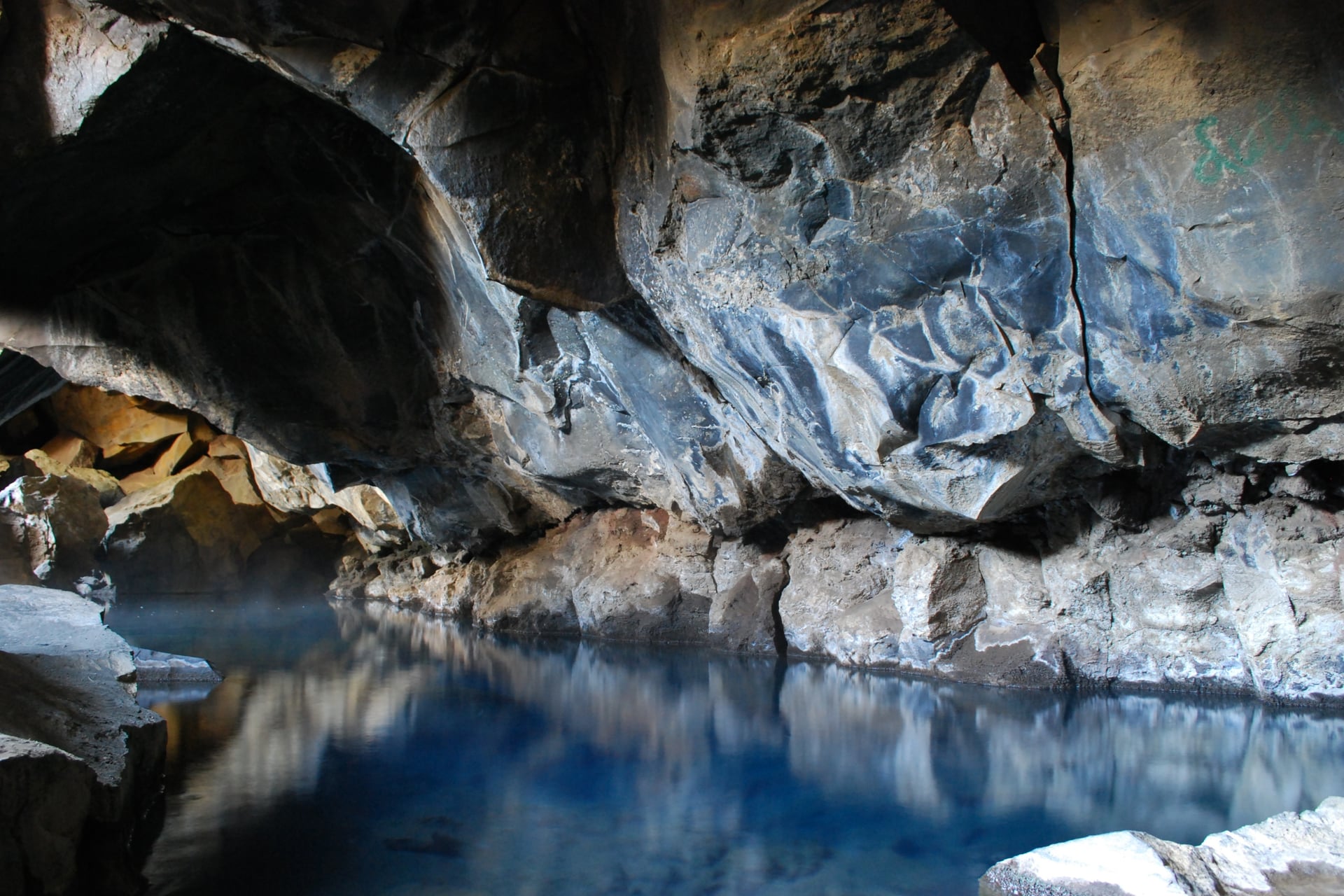
The cave's appeal also depends on contrast. Around Mývatn, so many famous stops unfold at open scale: pseudocraters, wetlands, geothermal fields, lava expanses, crater rims. Grjótagjá does the opposite. It narrows experience. You move inward. The lava walls close around the eye. The pool glows below in a way that can look almost impossible, as if the cave had hidden a piece of light underground. This spatial compression gives the site a rare kind of drama. Iceland often amazes through breadth. Grjótagjá amazes through enclosure.
That enclosure is one reason the cave has been so easy for people to romanticize. Visit Mývatn's 2026 blog article openly leans into the cave's romantic reputation, and of course many international visitors know it through the Game of Thrones scene filmed there. It would be easy to let that association flatten the place into a pop-culture stop. But the better approach is to keep the filming as one layer rather than the whole meaning. The cave was compelling long before television found it. What the camera recognized was already there: intimacy, heat, shadow, secrecy, and a volcanic world condensed into one chamber.
This is also why Grjótagjá works best when written as more than a 'can you still swim there?' question. The answer, according to the official material, is no. But the more useful question is what the cave feels like now that it can no longer be used as it once was. The answer is that it feels suspended between invitation and refusal. The water looks welcoming. The setting feels private and human-scaled. Yet the district's geothermal history has pushed the place beyond that older custom. That tension gives the cave emotional complexity.
The location of Grjótagjá within the broader Mývatn system adds even more depth. Visit Mývatn's hiking materials connect it directly to routes toward Hverfjall, Dimmuborgir, and the Nature Baths. The reserve map also frames it as one element inside a larger protected volcanic district. This matters because Grjótagjá is not an isolated oddity hidden in the middle of nowhere. It belongs to a chain of landscapes that all teach different versions of the same regional intelligence: lava and water, heat and habitability, geology and cultural use.
That regional belonging helps explain why Grjótagjá is so memorable on a private itinerary. It can function as a short stop between larger landmarks, but it often changes the emotional rhythm of the day more than its small size suggests. After open landscapes like Hverfjall or Hverir, the cave pulls attention inward. After the broader conceptual scale of Krafla or Leirhnjúkur, it gives volcanic North Iceland a human chamber. The day stops being only about grand forces and becomes briefly about how those forces once entered private bathing and local routine.
Photographically, Grjótagjá is a lesson in restraint. The site is easy to over-romanticize or to push into fantasy because the water and the rock already look theatrical. But the best images usually stay close to what is actually there: a lava fissure, a pool, darkness, and light entering carefully from above. The cave does not need exaggeration. It already contains enough mood. In fact, part of its strength lies in how unpretentious the place remains despite its fame. It is still a cave first, not a set built for admiration.
The cave also rewards honesty about limits. You are not meant to turn Grjótagjá into a full underground bathing experience. You are not meant to imagine it as a major hike. You are not even meant to expect long time on site in the same way as a full district stop. What you are given instead is concentration. A few minutes can hold a lot here if you let the place speak in its own scale. Grjótagjá does not ask for a large block of the day. It asks for attentiveness disproportionate to its size.
One of the most beautiful things about Grjótagjá is that it makes Mývatn's volcanic history feel personal. At Krafla, the scale can become systemic and expansive. At Hverir, geothermal activity becomes chemical and exposed. At Leirhnjúkur, eruption becomes crust and steam underfoot. At Grjótagjá, those same forces become chamber, pool, and memory. The region's geology stops being only landscape and becomes a story about what people could once do in a cave and why they cannot do it now.
That shift from system to chamber is why Grjotagja benefits from being explained on its own terms rather than a passing line inside a broader Myvatn guide. traveler questions here is specific. People want to know what the cave is, why it matters, whether you can bathe there, how it relates to the volcanic district, and whether it is still worth visiting if swimming is no longer possible. The fuller way to understand it is yes. Grjotagja is worth visiting because it condenses the region's most interesting tensions into a small and unforgettable space.
the cave also deserves clearer treatment because too much online content reduces it either to a Game of Thrones location or to an outdated hidden hot spring fantasy. Neither is enough. The better answer is that Grjotagja matters because it is one of North Iceland's clearest examples of geothermal intimacy altered by recent volcanic change. That gives the cave a stronger identity than either television or nostalgia alone.
What stays with many visitors after Grjótagjá is often the water itself: visible, alluring, almost impossibly calm inside dark lava walls, and yet not available in the old way. The cave lingers because it is beautiful, yes, but also because it embodies a very Icelandic truth. The earth gives warmth generously, but not always on human terms. Grjótagjá remains one of the best places in North Iceland to feel that truth up close.