Iceland Travel Guides
Gullfoss Waterfall: History, Power, and Private Touring Tips
A fuller guide to Gullfoss, with the shape and force of the Hvita River, the conservation legacy of Sigridur Tomasdottir, local gold legend, and slower private Golden Circle planning.
GlaciGo Iceland / May 2026 / 9 min read
Gullfoss does not reveal itself all at once. You hear it first. Then you notice the air changing, the dampness, the mist that seems to drift sideways when the wind catches it. Only after that does the shape of the waterfall really come into view. Even travelers who have seen a lot of Icelandic waterfalls often remember this sequence because Gullfoss feels less like a single curtain of water and more like a force that has found a way to disappear into the earth.
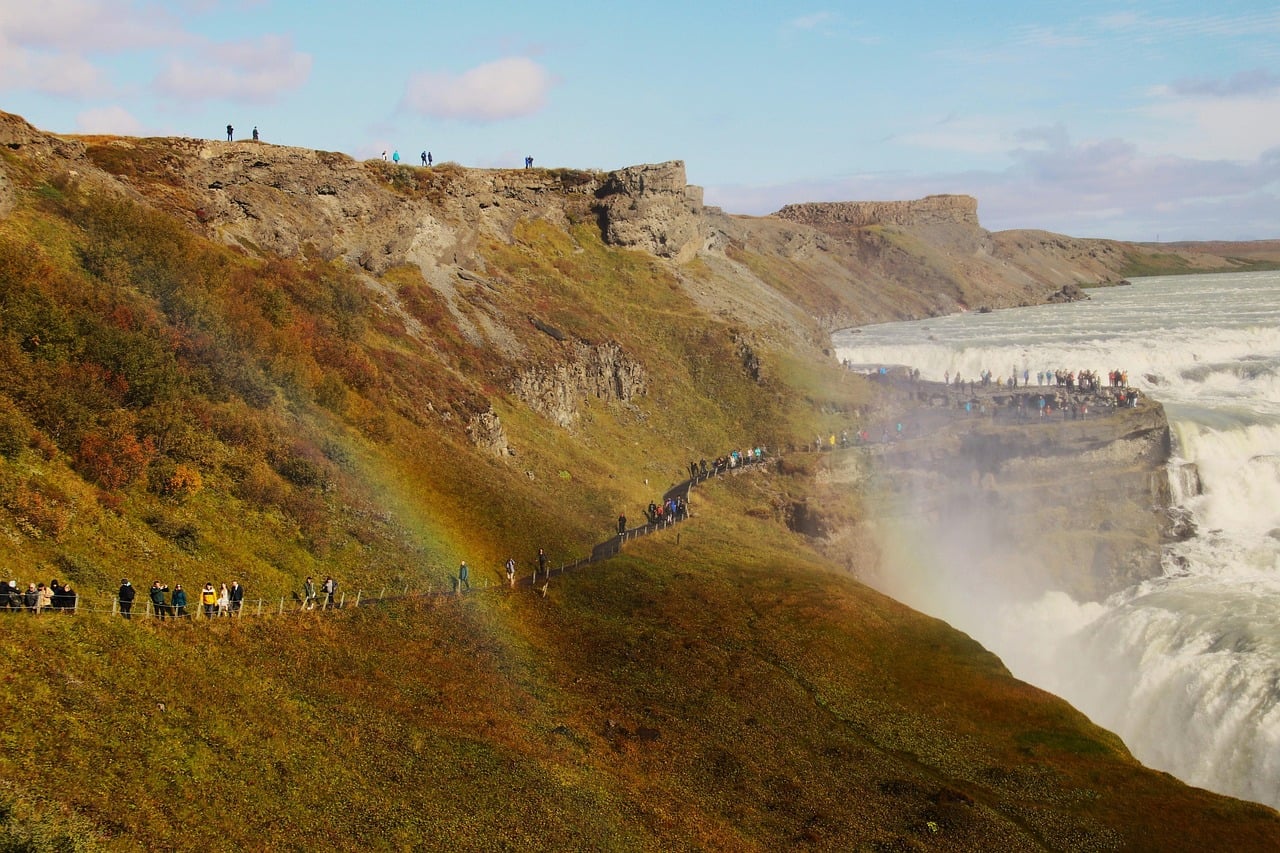
The Environment Agency of Iceland describes Gullfoss as two waterfalls on the Hvita River: an upper drop of about 11 meters and a lower drop of about 20 meters. It also lists the average water flow at around 109 cubic meters per second. These numbers matter, but mostly because they help explain the sensation of standing there. Gullfoss is not only tall. It is voluminous, directional, and strangely concealed. The canyon keeps part of the drama half-hidden until you move around it.
The site also carries one of the most important human stories on the Golden Circle. Official South Iceland material points directly to early hydroelectric plans on the Hvita and to the campaign associated with Sigridur Tomasdottir of nearby Brattholt. Her role has entered Icelandic environmental memory for good reason. Before conservation became a polished tourist phrase, Gullfoss was already teaching Iceland a hard lesson about what could be lost if beauty were treated only as usable power.
There is no need to over-dramatize that history to make it meaningful. The essential point is enough: the waterfall people admire today survived a moment when its future could not simply be taken for granted. That gives Gullfoss an ethical weight different from many scenic stops. You are not only looking at a natural wonder. You are also visiting one of the places where Iceland's instinct to protect its landscapes became visible and public.
At the same time, Gullfoss still invites story in an older way. One long-circulating local legend says that a farmer threw his gold into the falls rather than let anyone else have it, helping explain the name Golden Falls. Whether you treat that as folklore, symbolism, or simply a good Icelandic story, it suits the place. The canyon is deep enough, the spray wild enough, and the water commanding enough to make human treasure feel ridiculous beside it.
Private travelers often benefit more from Gullfoss than they expect because the site changes radically with timing. In a rushed group itinerary, it can feel like a dramatic but crowded viewpoint between Geysir and the return drive. In a slower route, it becomes one of the emotional anchors of the day. You have time to walk between levels, to notice how the angle alters the shape of the falls, and to let the sound settle in rather than bouncing off it for five minutes and leaving.
This is also where the Golden Circle's internal contrasts become very clear. Geysir is vertical heat and suspense. Gullfoss is descending glacial force. Thingvellir is an open historical rift. Gullfoss is a narrowing canyon. Good route design lets those differences breathe. Bad route design turns them into a pile of famous names. Gullfoss especially suffers when the day is overpacked, because it needs a little physical and mental space to land properly.
The weather collaborates with the waterfall more than it ruins it. On bright days, the spray often catches light and draws rainbows through the canyon, giving the place an almost ceremonial beauty. On gray days, the effect is heavier and more severe. The water goes pale, the rock darkens, and the whole scene feels carved rather than decorated. Winter can be magnificent if conditions are safe, with snow and ice adding structure to an already sculptural landscape. But winter can also close trails, and Visit South Iceland specifically advises checking conditions because the walking routes may be shut.
That practical note is not a small one. Gullfoss can look accessible from a distance, yet wind and spray can change the experience quickly. A private guide can make better decisions about how long to stay, which path is worth taking, and whether lower viewpoints are a pleasure or simply a wet battle. The stop is one of the best arguments for flexible pacing in Iceland: the same waterfall can feel almost meditative in one set of conditions and aggressively exposed in another.
Photographers have a lot to work with here if they resist taking only the obvious frame. The classic composition shows both tiers and the river diving into the canyon. But tighter work can also be excellent: sliced curtains of water, spray lifting in diagonals, visitors disappearing into scale, or a rainbow arriving for a few seconds and vanishing again. Bring a cloth for the lens. Gullfoss likes to remind cameras that water does not care what you are trying to preserve.
There is also a quieter cultural layer around Brattholt and the surrounding farmland. Gullfoss is not in an empty wilderness. It is in a lived landscape where farms, routes, weather, and memory have always mattered. That is one reason the story of Sigridur Tomasdottir feels so grounded. The waterfall was not an abstract national symbol first. It was part of somebody's actual district, and then it became part of a wider Icelandic conscience.
When people say Gullfoss is one of the great Golden Circle stops, they are not wrong. But the phrase becomes too flat if it only means famous and photogenic. Gullfoss is also a place about pressure, protection, and perspective. It teaches scale through sound, movement, and mist. It teaches history through the fight to keep it. And on a well-paced private itinerary, it often becomes the moment when a famous route suddenly feels serious, physical, and unforgettable.