Iceland Travel Guides
Hallgrímskirkja: Stone, Sound, and the Vertical Heart of Reykjavík
A fuller private guide to Hallgrímskirkja, with its memorial role, slow construction history, Icelandic geological design language, music culture, and the reason it remains far more than a tower stop in Reykjavík.
GlaciGo Iceland / May 2026 / 10 min read
Hallgrímskirkja is one of those buildings that almost everyone in Iceland recognizes before they understand. It rises above central Reykjavík so clearly that it can seem, at first glance, like a single idea made solid: a tower, a church, a skyline marker, a postcard certainty. But the building becomes much more interesting once you stop treating it as only a viewpoint or photo stop. Hallgrímskirkja is a church, a memorial, an argument about Icelandic form, a concert space, and a civic landmark that keeps participating in the daily life of the city rather than merely overlooking it.
Visit Reykjavík describes Hallgrímskirkja in a way that gets to the core quickly: it stands guard over Reykjavík, serving both as a parish church and a national sanctuary. That pairing matters. There are buildings tourists visit because they are famous, and there are buildings locals continue to use because they are alive. Hallgrímskirkja is both. It is not an empty monument that happens to be beautiful. It is a functioning Evangelical-Lutheran church whose significance comes partly from the fact that worship, music, mourning, celebration, and ordinary urban orientation all continue there at once.
The official history page of the church adds a second layer that matters just as much: Hallgrímskirkja is a memorial church dedicated to Hallgrímur Pétursson, Iceland's most influential hymn poet. This changes the building's tone immediately. The church is not only about scale and concrete. It is also about language, devotion, and the afterlife of one writer's voice in Icelandic culture. That helps explain why the place has always meant more than architecture alone. It carries literary memory inside its walls even before a visitor learns a single construction date.
And yet the architecture is unavoidable, in the best sense. The official church history explains that State Architect Guðjón Samúelsson began designing Hallgrímskirkja in 1937 and that his work drew on Icelandic models and materials, creating a national style. The church itself says the final result is reminiscent of columnar rocks, Icelandic mountains, and glaciers. This is one of those rare official descriptions that does not feel like marketing exaggeration. When you stand in front of Hallgrímskirkja, the stepped facade really does read like a translation of Icelandic geology into built form. The building feels less decorated than grown.
That geological association is one reason Hallgrímskirkja remains compelling even for travelers who are not especially interested in churches. It belongs to a wider Icelandic habit of seeing nature not just as scenery but as visual structure. The vertical ribs, the upward pull of the tower, and the stark pale surface all make sense in a country where lava columns, cliffs, snowfields, and steep weather are constant parts of perception. Hallgrímskirkja is modern, but it does not feel imported. It feels as though Reykjavík tried to imagine what its own land would look like if it became civic architecture.
The building's long construction history gives it another human dimension. According to the church's own account, the construction brief grew out of a 1929 design competition. The tower also had a technological purpose, since it was meant to be used for the upcoming era of broadcasting in Iceland. Construction began in 1945, the choir cellar was consecrated in 1948, a church hall in the tower's south wing opened in 1974, and the church itself was finally consecrated on 26 October 1986, the day before the 312th anniversary of Hallgrímur Pétursson's birth. In other words, Hallgrímskirkja was not built in one burst of certainty. It emerged across decades, through patience, changing needs, and the stubborn will to finish something larger than a single generation.
That long duration matters because it gives the church a different emotional texture from buildings that arrive quickly as complete statements. Hallgrímskirkja belongs to Reykjavík's twentieth century in a slow, layered way. It matured alongside the city rather than appearing fully formed above it. The official history also notes that the Icelandic Parliament was involved in the project, and that the state and city supported it, while two-thirds of the construction costs came from the church's own funds and private sources. So the building is not only architecturally symbolic. It is materially collective. A lot of hands, institutions, and convictions carried it upward.
The position of the church is part of its meaning too. Hallgrímskirkja stands on Skólavörðuholt, one of the higher points in central Reykjavík. That is why it behaves as a true landmark rather than a merely tall building. You do not experience it only when you arrive at the front steps. You keep encountering it between streets, above roofs, down sightlines, and at the end of walking routes. It organizes the city visually. Many travelers remember the rainbow-painted Skólavörðustígur leading toward the tower, but the deeper point is that Hallgrímskirkja gives central Reykjavík a vertical destination and a sense of gathering line.
For that reason, going up the tower is worth understanding properly. Visit Reykjavík highlights the panoramic view from above, and yes, the tower is one of the clearest ways to read the capital in one sweep: colored roofs, harbor edges, low urban spread, mountain outlines, sea light. But the real pleasure is not just that the view is beautiful. It is that Reykjavík suddenly makes spatial sense. Hallgrímskirkja is one of the few places where the city can be grasped as a whole without losing its human scale.
Inside, the mood changes. The facade can seem severe from outside, but the interior has a calmer, more resonant clarity. Light, height, and restraint do most of the work. Hallgrímskirkja's official history emphasizes that the church remains active in worship, education, and children's and youth work, and that concerts and exhibitions have also shaped its artistic life. That is important because the interior should not be read as a frozen design object. It is a room that keeps being used by sound, ritual, speech, silence, and public gathering.
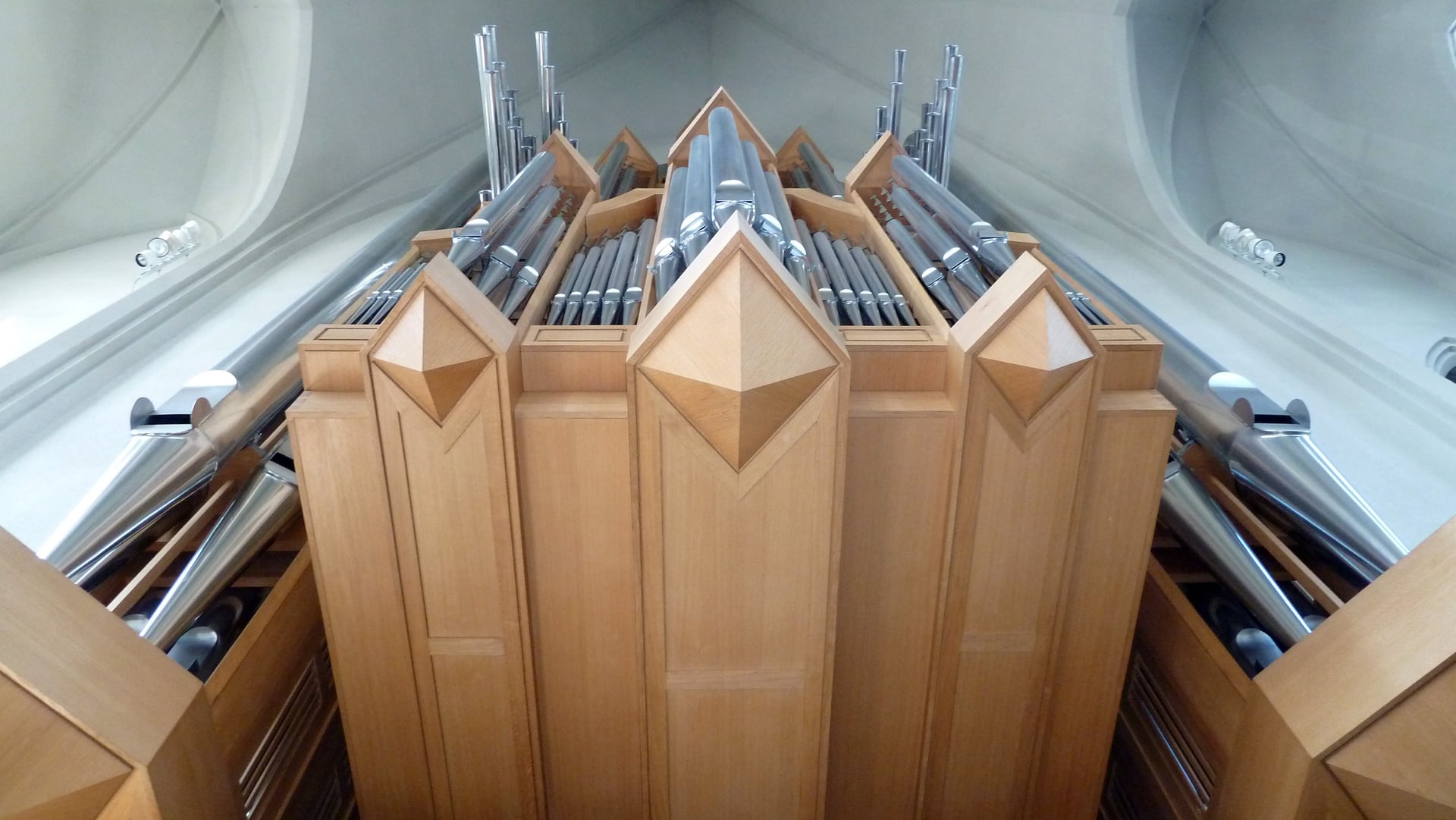
Music is one of the strongest reasons Hallgrímskirkja deserves a fuller article. The church's own organ page explains that the arrival of the Klais concert organ in 1992 marked a turning point in its musical life. Built in Bonn, the organ has 72 stops and 5,275 pipes, stands 15 meters high, and weighs about 25 tons. These are impressive numbers, but the larger point is cultural. Hallgrímskirkja is not only a place where music is hosted. It is one of the places in Iceland where music helps define the identity of the building itself. Organ concerts here are not side programming attached to a famous landmark. They are part of how the church speaks.
The same official source notes that organists from around the world seek out the instrument for concerts and recordings. That international attention matters, but so does the more intimate fact that the organ was largely financed by donations, and that people were invited to buy individual pipes. It is a beautifully Icelandic mixture of grandeur and participation. The great instrument at the west end is not only a technical marvel. It is also a public act of investment in sound, reverberation, and shared cultural ambition.
There is also something distinctly human about the way Hallgrímskirkja balances tourism with ordinary religious life. Visit Reykjavík reminds visitors that the church is active and may close without notice because of services and concerts. That detail is more than practical information. It is a healthy correction. Hallgrímskirkja is not a museum with occasional spiritual leftovers. It is a church first, even while being one of the most visited places in the country. Travelers who understand that usually experience it better. The building asks for a little more attentiveness than a simple checklist stop.
For tourists, Hallgrímskirkja often becomes the place where Reykjavík stops feeling scattered and starts feeling legible. You can approach it through design, through literature, through city walking, through music, through the tower, through faith, or through photography. That range is part of its genius. Some landmarks are overdetermined; once you have seen them, you feel done. Hallgrímskirkja remains open to several kinds of reading at once. It can be a first stop, a last stop, or a place you return to in different light and different weather and find newly convincing each time.
Hallgrimskirkja deserves more than opening hours and tower-ticket notes because travelers often want to know what the building really means: whether the architecture is tied to basalt forms, why it matters to Icelanders, whether the tower is worth it, and what makes it more than a famous church in a small capital. The fuller answer is that it condenses several Icelandic stories into one building: poetry, Protestant identity, twentieth-century nation-building, geology translated into form, and a city still gathered around a visible center.
What stays with many visitors after Hallgrímskirkja is not only the image of the facade, but the sense that Reykjavík has a building capable of holding seriousness without becoming heavy. The church is monumental, but not pompous. It is iconic, but still used. It is photogenic, but not shallow. Hallgrímskirkja lingers because it is one of those rare landmarks that genuinely deserves both the attention of tourists and the loyalty of the city beneath it.