Iceland Travel Guides
Harpa: Glass, Harbor, and Reykjavík's Modern Cultural Face
A fuller private guide to Harpa, with its long prehistory, post-crash significance, glass facade by Ólafur Eliasson, harbor setting, and the way it became Reykjavík's modern cultural living room.
GlaciGo Iceland / May 2026 / 10 min read
Harpa is one of the clearest examples of how Reykjavík presents itself to the world in the twenty-first century. If Hallgrímskirkja rises above the city like a vertical memory of stone, Harpa meets the harbor as a shimmering public face of glass, light, and cultural ambition. It is easy to reduce the building to its facade because the facade is genuinely extraordinary. But Harpa becomes more interesting when you understand that it is not only a beautiful object by the water. It is also a story about national aspiration, financial collapse, public resolve, music, conferences, and the way a city decides what kind of room it wants to offer both itself and its visitors.
Harpa's own official introduction begins with a sentence that is worth taking seriously: it is one of Reykjavík's most striking landmarks and a centre of cultural and social life in the very heart of the city. That dual role matters. Harpa is not a pure arts monument sitting outside ordinary urban life. It is a building people pass through, meet in, eat in, work in, hear music in, and use as a reference point on the harbor edge. It belongs to the city's public rhythm in a way that many famous buildings never quite manage.
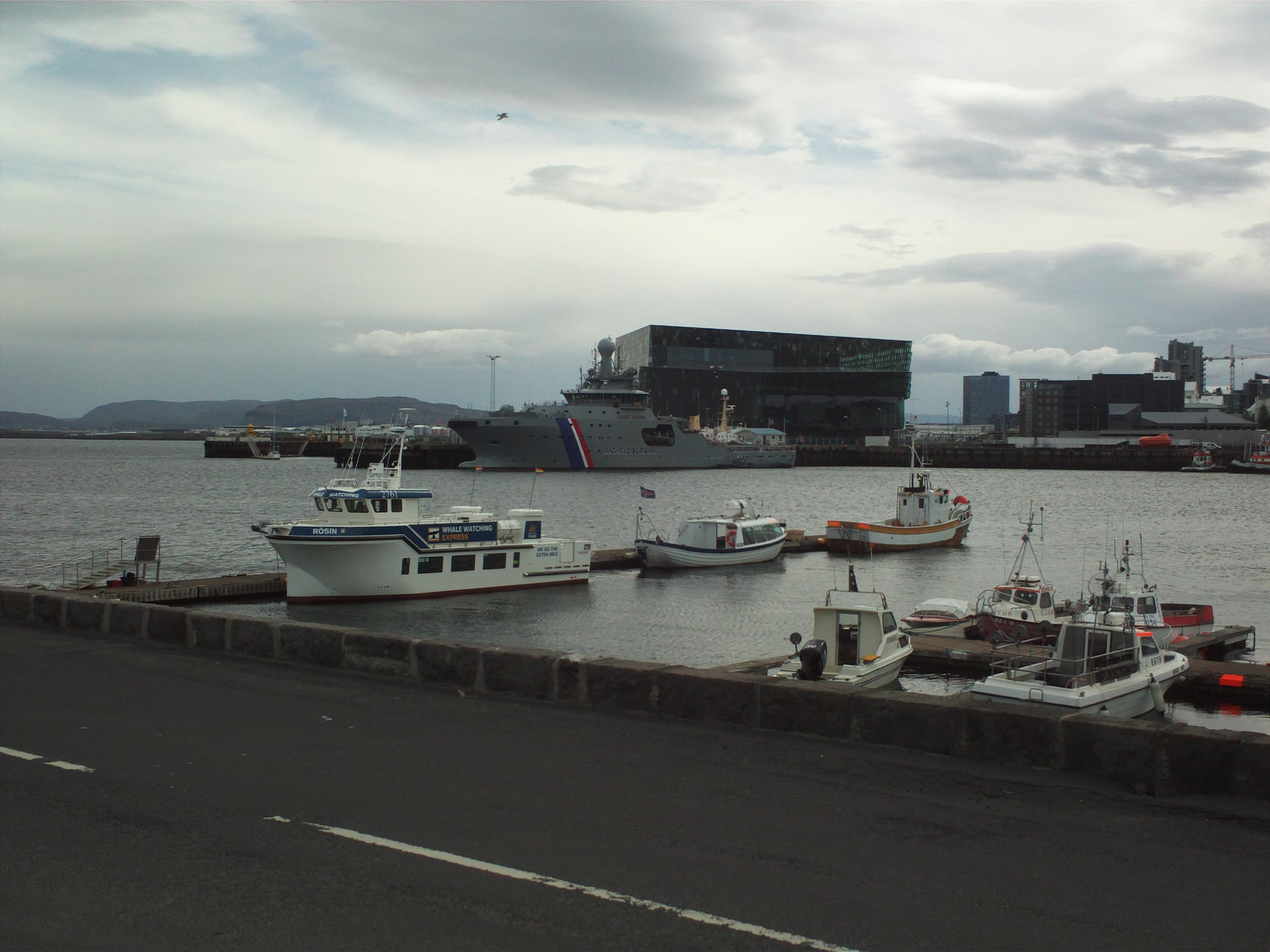
Its location is part of that success. Harpa stands at Austurbakki where central Reykjavík opens toward the sea. That position gives the building a kind of double citizenship. One face addresses the city, the other answers the harbor, the ships, the changing sky, and the light over Faxaflói. This is why Harpa feels different in different weather more than many modern cultural buildings do. It does not simply sit beside the waterfront. It keeps entering into exchange with it. In a bright hour it flashes; in gray weather it absorbs mood; at night it becomes lantern-like. The building is never quite static because Reykjavík itself is never visually still.
The design page on Harpa's official site names the principal designers as Henning Larsen Architects together with Batteríið Architects, and explains the central role of Ólafur Eliasson in the glass facade. That matters because Harpa is one of those buildings where architecture and artwork are inseparable. Eliasson said he wanted the facade to both reflect and become part of the Icelandic environment. That is the key to why the building works. Harpa does not imitate older Icelandic architecture, and it does not pretend to be geological in the direct way Hallgrímskirkja does. Instead, it participates in Icelandic light. It turns reflection itself into material.
This is also why tourists often remember Harpa less as a single photograph and more as a sequence of visual moods. The honeycomb-like south facade catches sky, ocean tones, passing clouds, and surrounding color in constantly shifting combinations. You do not only look at Harpa. You look through it, into it, and back from it toward the city. It is one of Reykjavík's best buildings for teaching visitors that the capital's beauty is not only picturesque and low-rise. It can also be contemporary, precise, and surprisingly playful.
But Harpa's story is not simply one of elegance and design confidence. Its official history page gives the deeper, more dramatic background. The dream of a real Icelandic concert hall had been alive for more than a century, with the challenge reportedly appearing in the Icelandic press as early as 1881. The formal Association for Music Halls was founded in 1983. Then, after years of planning, the state, the City of Reykjavík, and private partners moved forward; an agreement was signed in 2006, and construction began in January 2007. By October 2008, during Iceland's financial collapse, construction stopped. In March 2009 it resumed after a political decision to continue. That moment is essential to understanding Harpa. The building we see now is not only stylish. It is the visible result of a difficult national choice not to leave a cultural project half-born beside the harbor.
This gives Harpa a very different emotional weight from many other waterfront icons. In some cities, a signature concert hall signals uncomplicated prosperity. In Reykjavík, Harpa also carries the memory of fragility. It emerged into public life just after a period when Iceland's self-image had been badly shaken. The formal opening came in May 2011, with the Iceland Symphony Orchestra's first concert in Eldborg on 4 May and the official opening on 13 May. Later that August, on Culture Night, the building's facade by Ólafur Eliasson was fully introduced with a light show. That sequence matters because Harpa did not appear as a finished trophy detached from circumstance. It arrived as both cultural house and recovery symbol.
The name itself deepens the tone. Harpa's history page explains that the name was chosen from 4,156 public proposals submitted by 1,200 citizens and announced in December 2009. The word refers both to the harp and to an old Icelandic month in early spring. That is one of those naming decisions that feels almost too perfect, yet it works because the double meaning is so revealing. Harpa suggests music, yes, but also seasonality, renewal, and a cultural springtime. In the context of the post-crisis years, that resonance is unusually powerful.
Inside, Harpa becomes more than a facade lesson. It is home to residents that matter to Iceland's cultural life, including the Iceland Symphony Orchestra and the Reykjavík Big Band. Visit Reykjavík also presents Harpa not only as an architectural attraction but as one of the best concert and conference facilities in Northern Europe. Those institutional layers matter because they protect the building from becoming merely scenic. Harpa is not a hollow shell built around a lobby selfie. Its rooms are used seriously and often, and that practical cultural life gives the spectacle legitimacy.
Eldborg, the main hall, is especially important in the imagination of the building. Even people who have not attended a performance there often know the red interior by reputation. But the deeper point is not color alone. Harpa created a home worthy of orchestral and staged music in a country that had long imagined such a room but did not yet possess it at this scale. That changes how a capital behaves. Once a city has a place like Harpa, visiting performers, local institutions, festivals, conferences, and audiences all begin to imagine themselves differently.
Harpa also rewards ordinary visiting, not just ticketed attendance. Its official welcome and visit material make clear that the building is open and meant to be entered. That matters for tourists because some cultural buildings are visually famous but socially closed unless you hold a ticket. Harpa offers a more democratic experience. You can enter for the architecture, the harbor views, the lobby atmosphere, a guided tour, a concert, a meal, or simply a pause from weather. For Reykjavík, this openness is part of what makes Harpa feel woven into the city rather than extracted from it.
There is another dimension here that deserves notice: Harpa is a public institution in a concrete sense, not just a poetic one. Its company page states that it is owned 54 percent by the Icelandic state and 46 percent by the City of Reykjavík. That ownership structure subtly reinforces what the building already feels like. Harpa does not read as a private luxury object or a developer's vanity piece. It reads as something the city and nation are jointly responsible for, which helps explain why Icelanders can argue about it, celebrate it, use it, and still claim it.
For travelers, Harpa often works best when approached in layers. See it from outside first, from the old harbor side or along the waterfront. Then step in and let the scale of the atrium and the changing light do their work. If possible, return later in the day or in a different kind of weather. Harpa is one of those buildings that improves with revisiting because reflection is part of its language. Morning, evening, winter gloom, bright summer clarity, and artificial illumination all rewrite it. The structure stays the same, but the experience shifts constantly.
Harpa rewards visitors who look beyond the simple phrase 'glass concert hall in Reykjav?k.' It works as architecture, cultural venue, harbor viewpoint, post-crisis symbol, and everyday public room. Its importance is not only that it is photogenic. It condenses several modern Icelandic themes into one place: public culture, resilience, international design dialogue, and a harbor city speaking in contemporary form without losing its own weather and light.
What stays with many visitors after Harpa is a feeling that Reykjavík has more registers than outsiders first assume. The capital is not only corrugated roofs, cozy streets, and old church silhouettes. It also has this bright, intelligent, outward-looking house at the water's edge, where art, politics, atmosphere, and public life all keep meeting each other. Harpa lingers because it turns transparency into substance. You see light everywhere in it, but the building's real achievement is that it gives that light a civic home.