Iceland Travel Guides
Hellnar: Bay, Memory, and the Quieter Soul of Snæfellsnes
A fuller private guide to Hellnar, with fishing-village history, Valasnös, Badstofa, the old church site, sacred spring tradition, and Hellnar's calmer place in the Snæfellsnes story.
GlaciGo Iceland / May 2026 / 10 min read
Hellnar is easy to miss if you only understand Iceland through superlatives. It is smaller than the places many travelers plan around, quieter than Arnarstapi next door, and gentler in mood than some of Snæfellsnes' harsher coastal stops. But that is exactly why Hellnar has a strange pull. It does not shout its importance. It lets it gather slowly through shape, memory, and atmosphere. By the time people realize how much is here, they are usually already moving more slowly.
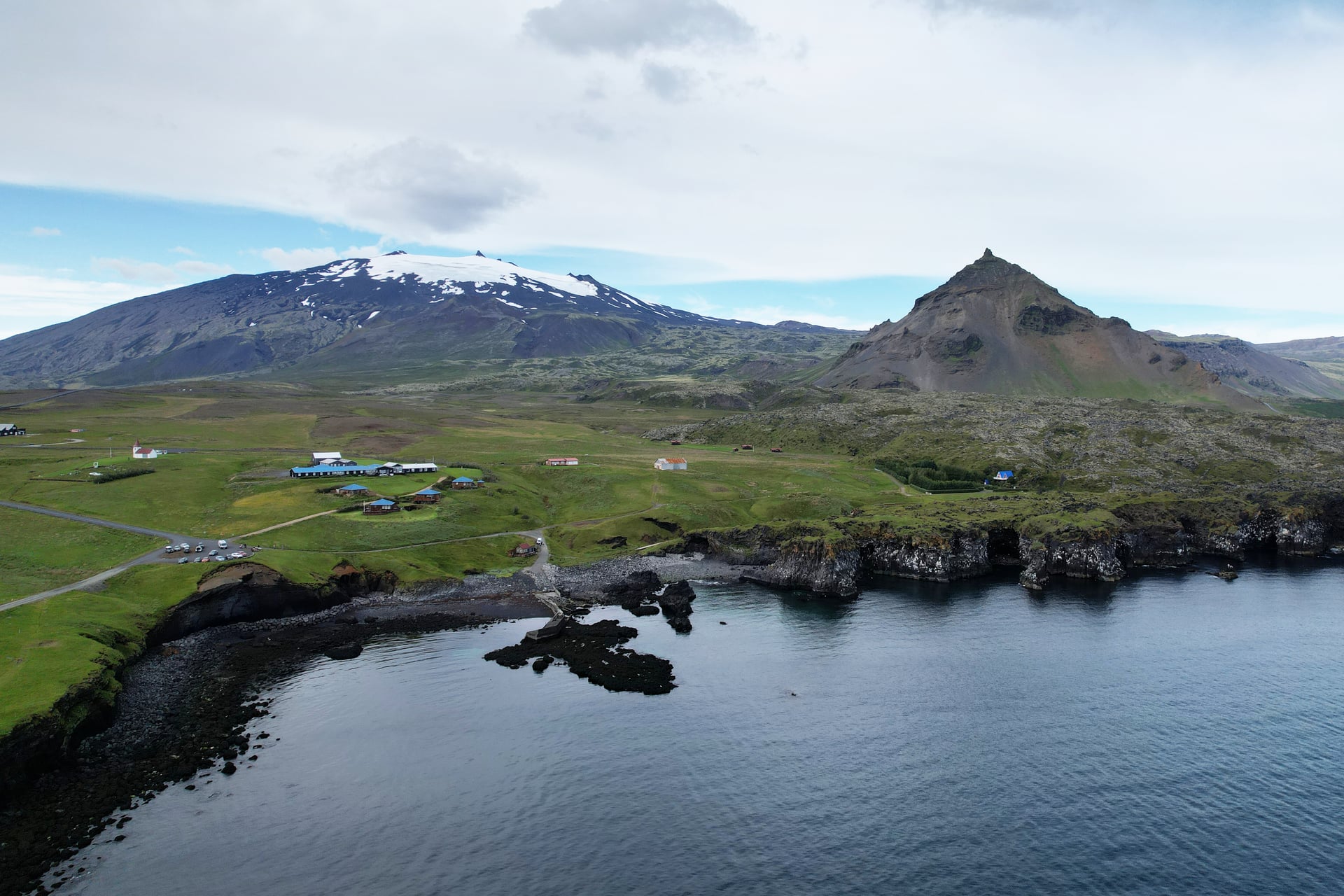
West Iceland's official description gives the essential historical key: for centuries, Hellnar was among the largest fishing villages beneath the Snæfellsjökull ice cap. That fact changes everything. Today Hellnar can feel intimate, almost delicate, but it was not built out of delicacy. It belonged to a serious working coast. People lived here because the bay, landing conditions, and access to the fishing grounds mattered. Once you know that, the quiet feels earned rather than accidental. It is the quiet left after a harder economy has receded.
The bay itself is a large part of the answer. Hellnar does not present the sea as spectacle alone. It holds the water in a more gathered, sheltered way than some nearby locations. That makes the place emotionally different from Arnarstapi. Arnarstapi tends to feel like cliff drama and exposed edges. Hellnar feels more like a small conversation between shore, harbor, and mountain weather. It is still volcanic and rugged, of course, but it has a softer center. The village invites lingering rather than just exclamation.
And yet the geology is hardly mild. West Iceland highlights Valasnös, the freestanding rock that stretches east of the bay, and points to one of Iceland's most peculiar caves, Badstofa, known for its special light and colorful interior. The Environment Agency's brochure reinforces the distinctiveness of this coast: the protected Arnarstapi-Hellnar shoreline was designated a nature reserve in 1979 for its surf-carved formations and birdlife. In Hellnar, these forms read a little differently than they do farther east. The rocks feel less theatrical and more inhabited, more woven into the shape of the cove and the old life around it.
Badstofa is one of those details that tells you Hellnar is not merely scenic but specific. Iceland has no shortage of caves, arches, and lava openings, so when an official source bothers to call one cave among the country's most peculiar, it deserves attention. The point is not only that the cave is visually striking. It is that Hellnar's coast contains a level of variation that rewards looking carefully. Light behaves differently here because the rock structure is doing something unusual. The place is not just pretty from a distance. It is textural up close.
The same is true of the spring at the lava's edge. West Iceland notes that a cold-water spring in Hellnar is dedicated to the Holy Virgin because, according to local tradition, she appeared there once. That is the kind of detail that can disappear in a rushed itinerary, but it matters enormously to the character of the place. Hellnar is not only a fishing station or a walking stop. It is also a village where sacred association, landscape, and daily life once lived close together. A spring can be geology, water source, devotion, and local memory at the same time.
The church carries that feeling further. West Iceland says the present Hellnar church was built in 1945 on a picturesque site where a church first stood in 1833, while the Environment Agency brochure notes the continuity of church presence there and places the building within the older fabric of the district. That layered church history matters because it prevents Hellnar from becoming just a coastal mood board. People prayed here, buried here, gathered here, and attached ritual meaning to a settlement that outsiders might otherwise reduce to a photo stop beneath a glacier.
Hellnar also belongs to the wider saga landscape around Snæfellsjökull. The park brochure is explicit that Bárðar saga Snæfellsáss unfolds around Arnarstapi and Hellnar, and that many local place names are tied to the story. It recounts Bárður's life in the district, his ties to nearby Laugarbrekka and Bárðarlaug, and the violence that drove him away from human society and eventually into the glacier. In Hellnar, this saga material feels less like decoration than like an old way of understanding the coastline. The strange rocks, the coves, the pools, the hiddenness of the shore all make narrative feel plausible.
One reason Hellnar works so well in writing is that it captures a specifically Icelandic overlap between labor and myth. Fishing villages are often written either romantically or economically, but Hellnar resists both simplifications. It was a major station for real reasons of work and survival. At the same time, it sits inside one of western Iceland's densest story-worlds. The result is a place where you can feel both the weight of daily necessity and the imaginative surplus that grew around it. Few villages hold those two registers this gracefully.
The walk between Arnarstapi and Hellnar is part of Hellnar's story too, but it should not swallow the village whole. Many people arrive from Arnarstapi and treat Hellnar as the endpoint of a scenic route. That is understandable, but incomplete. Hellnar deserves to be read from the inside as well: as a cove, a harbor memory, a church site, a place of springs and caves, and a former fishing community with its own tone. If Arnarstapi is about edges and openings, Hellnar is more about enclosure, arrival, and calm earned beneath the cliffs.
This distinction matters on a private itinerary. When the pacing is right, Arnarstapi and Hellnar do not compete; they answer each other. One is sharper, more immediately dramatic, and more overtly crowded with forms. The other is quieter, older-feeling, and more inward. Hellnar can be the place where travelers stop performing admiration and begin actually inhabiting the landscape for a little while. Sit near the water. Watch the bay rather than chasing only the biggest cliff line. Notice how Snæfellsjökull sits in the background not as a showpiece but as a constant authority over the whole district.
The Environment Agency brochure also helps place Hellnar in the larger geological system. It describes Snæfellsnes as a region with extraordinarily diverse geology, notes that much of the surrounding lava has flowed from Snæfellsjökull and associated craters, and explains that the coastal cliffs in the southern lowlands are ancient sea cliffs from land that rose after the ice age. That bigger frame matters because Hellnar can otherwise look almost too intimate to belong to a major volcanic story. In fact, it is one of the best places to feel that large geological history in small human scale.
Hellnar has a different rhythm from nearby Arnarstapi and deserves to be read that way. Travelers look for the village itself, Badstofa cave, the church, the bay, the old fishing history, and whether it is still worth stopping after seeing the busier coastal points. The answer is yes, because Hellnar is less about spectacle in one glance and more about depth gathered through attention.
What stays with many travelers after Hellnar is a feeling of proportion. The village is small, but it does not feel slight. The cove is calm, but not empty. The church is modest, but it changes the spiritual temperature of the place. The surrounding formations are strange, but not pushed into performance. Hellnar lingers because it shows how powerful an Icelandic landscape can be when it is scaled to human memory. It is not only beautiful. It is composed, and that composure is part of its charm.