Iceland Travel Guides
Hengifoss: Red Layers, Falling Water, and the Readable Time of East Iceland
A fuller private guide to Hengifoss, with its red-banded cliffs, fossil-forest traces, Litlanesfoss on the approach, Fljótsdalur setting, and the reason this East Iceland hike feels richer than a simple waterfall stop.
GlaciGo Iceland / May 2026 / 10 min read
Hengifoss is one of those Icelandic waterfalls that manages to look dramatic from a distance and even more interesting up close, because what makes it memorable is not only the falling water. It is the whole geological wall around it. Travelers often arrive expecting a tall waterfall and leave remembering the red stripes, the dark basalt, the layered bowl of the gorge, and the feeling that they have just walked into a cliff face that reads almost like a history book. That is why Hengifoss works especially well for tourists who want more than a checklist stop. It offers height, yes, but also narrative in the rock itself.
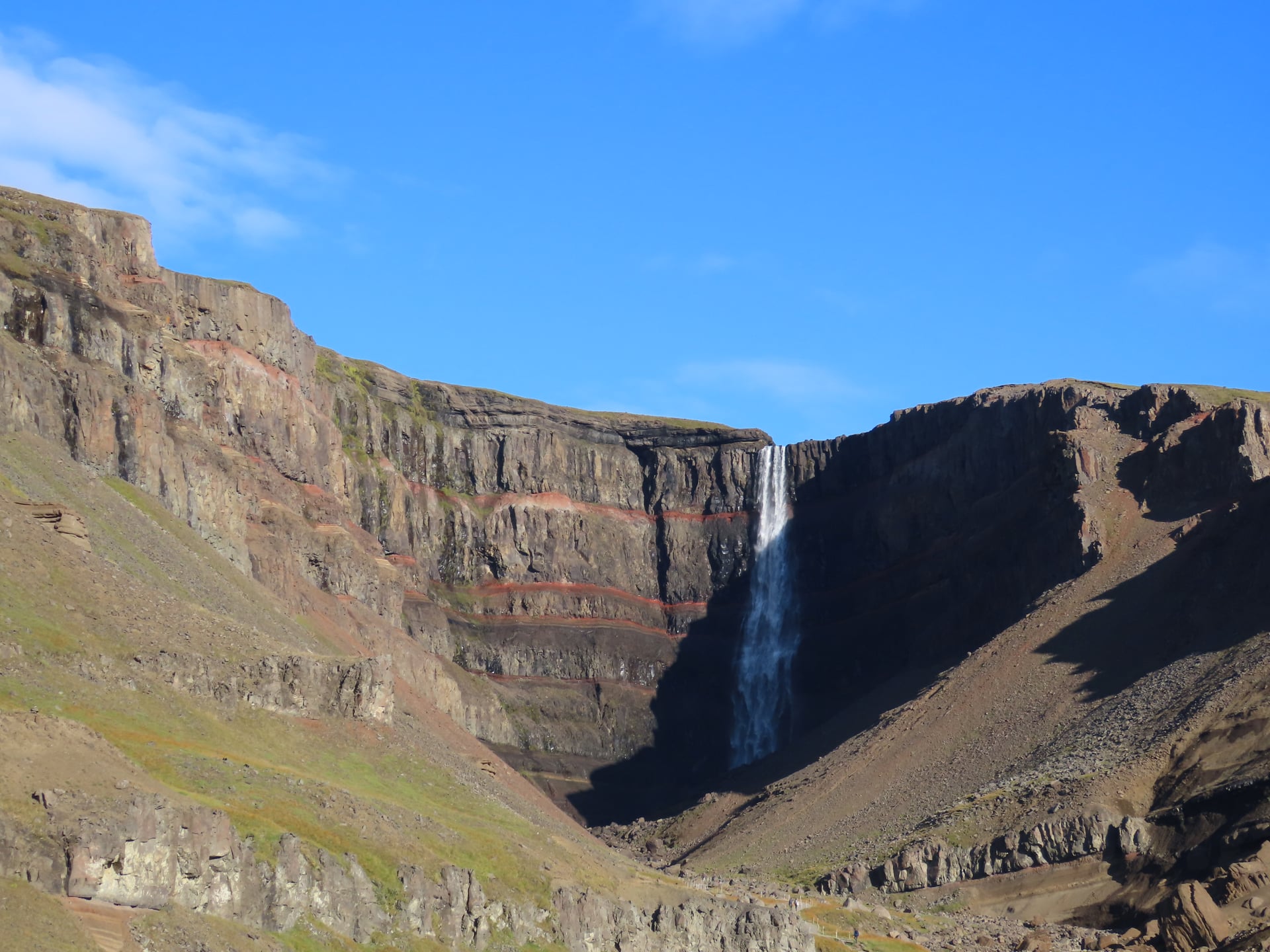
Visit Austurland describes Hengifoss as one of the best-known destinations in East Iceland and places its height at about 128 meters, making it one of the tallest waterfalls in the country. That statistic matters, but not in the simple bragging-rights way waterfall rankings often do. Hengifoss does not overwhelm primarily because of width or volume. It has a more vertical, composed, almost severe presence. The waterfall drops into a great gorge that forms what the official description calls a large bowl in the hillside. That bowl-like setting gives the falls a framed quality. You do not encounter it as loose water in open land. You encounter it as something set inside a deliberately dramatic chamber.
The first thing many visitors notice in photographs is the red color in the cliff, and that detail deserves real attention because it is the signature of the place. Visit Austurland explains that the gorge walls are basalt columns with notable red layers between them, and beneath the waterfall lie thick sedimentary layers formed 5 to 6 million years ago. At the top of those layers is lignite, the compressed remains of a large forest where pieces of trunks and roots are still sometimes visible. That is an extraordinary fact, and it gives Hengifoss a very different emotional texture from many Icelandic waterfalls. The red bands are not just pretty color contrasts. They are evidence of an older ecological world, a reminder that this now-open, high, stark East Iceland landscape once held substantial forest growth.
That forest story gives Hengifoss unusual depth. Basalt later flowed over that older world, and sedimentary layers gathered above it in turn. So the cliff around the waterfall is not just a volcanic wall. It is a layered archive of eruption, burial, pressure, and time. A good article on Hengifoss should slow down enough to let that sink in. Visitors are not only looking at a cascade. They are looking at a place where deep geological process and traces of living landscape have been pressed into one another. The waterfall becomes more affecting once you realize the rock around it contains memory in a literal sense.
This is one reason Hengifoss feels so different from the faster, broader waterfall drama found elsewhere in Iceland. Skógafoss impresses through force and immediacy. Dynjandi impresses through scale and shape. Hengifoss impresses by making the eye move between the water and the cliff. Again and again, your attention is pulled sideways into the strata, down into the gorge, and back up to the fall itself. The waterfall is the focal point, but it is not the whole performance. The wall participates equally.
The route to Hengifoss adds another layer of meaning because the walk is part of the experience, not just an inconvenience before the viewpoint. Visit Austurland notes that Litlanesfoss lies about halfway up the hillside. This smaller waterfall, around 25 to 30 meters high, is surrounded by exceptionally beautiful and unusually tall basalt columns. The official comparison to a choir or organ pipes is not overdone. Litlanesfoss feels like a prelude in stone before the red-banded drama of Hengifoss itself. A traveler who rushes past Litlanesfoss to get to the taller waterfall misses one of the best compositional decisions the landscape makes.
That two-waterfall sequence is part of why the hike feels satisfying rather than repetitive. Litlanesfoss gives you basalt order in its most sculptural form. Hengifoss then opens into something larger and geologically more complex. The walk in between becomes a transition between two ways of reading East Icelandic rock: first as vertical column, then as layered archive.
Visit Austurland also notes that the gorge from the road upward is covered with birch and rowan trees, and at the lower outer side lies Skógarhvammur, a hollow surrounded by cliffs. At the mouth of the gorge are the remains of the Hengifossá sheep corral, used for autumn gathering until around 1900. These details matter because they keep Hengifoss grounded in lived rural landscape rather than isolating it as pure spectacle. Like many of Iceland's most beautiful places, it sits inside an older world of farming practice, movement through valley land, and practical use of terrain. The corral is a small detail, but it changes the register of the article. It reminds the reader that this path once belonged to routines more demanding and more ordinary than sightseeing.
The wider setting around Hengifoss deepens the article even further. The waterfall sits above Lagarfljót, one of East Iceland's defining waters. Visit Austurland describes the lake as deep, glacial, and mysterious, and ties it to the famous Lagarfljótsormur, whose oldest recorded sighting dates back to 1345. It would be cheap writing to force the lake monster into the article as if every visit to Hengifoss must become a folklore hunt. But it would be a mistake to ignore that atmosphere entirely. Hengifoss belongs to the same regional imagination as Lagarfljót, Hallormsstaðaskógur, Skriðuklaustur, and the broader cultural landscape of Fljótsdalur. In East Iceland, scenery and storytelling live very close to each other.
Used carefully, that folklore context gives Hengifoss something valuable. The hike is not just a climb toward a scenic endpoint. It happens in a district where the land carries old narratives easily. The dark lake below has its worm. The valley has its historical farms and ecclesiastical sites. The cliffs hold the remains of ancient forests. The result is a place that feels intellectually and emotionally layered, not just visually layered.
For tourists, one practical but meaningful feature of Hengifoss is that the waterfall faces southeast. Visit Austurland recommends morning for the best light, which is worth noting not only for photographers but for the mood of the place. Morning light helps reveal the red bands and the cliff contours more clearly, and in June and July the river usually carries enough water to make the falls feel especially complete. In drier August conditions, the water can narrow, but the height and geology still hold the experience together. Hengifoss is one of those sites where lower flow does not ruin the visit, because the rock has enough personality to carry the scene.
The site also asks for a little humility. Visit Austurland points out that some trails descend into the canyon below the waterfall, but they are steep and loose with gravel, and the canyon edge itself can be dangerous, especially with children. There are hiker bridges connecting trails on both sides of the river, and a service center near the parking area where rangers provide information about the surroundings. These details make Hengifoss feel better managed than many romanticized waterfall hikes, but they do not turn it into a risk-free promenade. The walk still rewards steadiness and attention. That is part of its appeal. It gives a sense of earning the view without becoming an expedition.
Another strength of Hengifoss is how naturally it pairs with nearby cultural stops. The official site explicitly points toward Skriðuklaustur, just a few kilometers farther into the valley. That matters for itinerary design. Hengifoss is strong enough to stand alone, but it becomes richer inside a day that also includes literature, archaeology, monastic history, or the forests and lakeside atmosphere around Lagarfljót. For private travelers in East Iceland, that flexibility is a gift. You can build the day around geology, around atmosphere, around regional storytelling, or around a calmer Fljótsdalur rhythm that does not feel rushed.
Hengifoss is often reduced to three facts: it is tall, it has red layers, and there is a hike. Those facts are true, but they are not the whole reason the place stays with people. The stronger visit includes the fossil-forest traces in the lignite, Litlanesfoss on the approach, old corral remnants, Fljotsdalur context, and the imaginative shadow of nearby Lagarfljot.
What stays with many visitors after Hengifoss is often a feeling that the land briefly became readable. The red stripes explained time. Litlanesfoss explained basalt order. The lake below suggested story. The sheep-corral remains hinted at older labor. And the waterfall itself held all of it together with one long vertical gesture. Hengifoss lingers because it is not only beautiful. It feels legible, like a meeting point between geology, memory, and the patient seriousness of East Iceland.