Iceland Travel Guides
Hljóðaklettar: Echo, Basalt, and the Intricate Heart of Jökulsárgljúfur
A fuller private guide to Hljóðaklettar, with its echoing basalt formations, Vesturdalur setting, canyon walking routes, and the reason these North Iceland rocks feel like more than scenery.
GlaciGo Iceland / May 2026 / 10 min read
Hljóðaklettar is one of those Icelandic places whose name already tells you how to approach it. These are the Echo Rocks, and the best response to them is not to rush through taking pictures as if they were only another strange basalt stop. Hljóðaklettar asks for ears as much as eyes. The rock formations are visually impressive, yes, but what makes the place memorable is the sense that stone here is not silent. The name invites a slower kind of attention, one that notices form, acoustics, and the curious way a canyon landscape can feel at once sculptural and resonant.
Vatnajökull National Park's official page places Hljóðaklettar in Vesturdalur, beside the river Jökulsá á Fjöllum in the northern Jökulsárgljúfur area. It explains that the most famous formations here are examples of volcanic intrusions and unusual basalt structures revealed after the river swept away looser surrounding material. Visit North Iceland simplifies that for visitors by calling Hljóðaklettar a beautifully sculpted cliff area with unique rock formations of basalt columns. Taken together, these descriptions point to the same truth: the place is best understood not as one rock, but as a field of geological imagination made visible.
That field matters because Hljóðaklettar is not a simple scenic stop like a single waterfall or one viewpoint. It is a district of forms. The national park notes that from the parking area there are marked hiking routes around the formations and connections onward toward Hólmatungur and even the longer canyon routes between Dettifoss and Ásbyrgi. That changes the way the place reads. Hljóðaklettar is part of a living walking landscape, not a decorative interruption beside the road. The rocks belong to a wider river-canyon system shaped by catastrophic floods, volcanic history, and the long restlessness of Jökulsá á Fjöllum.
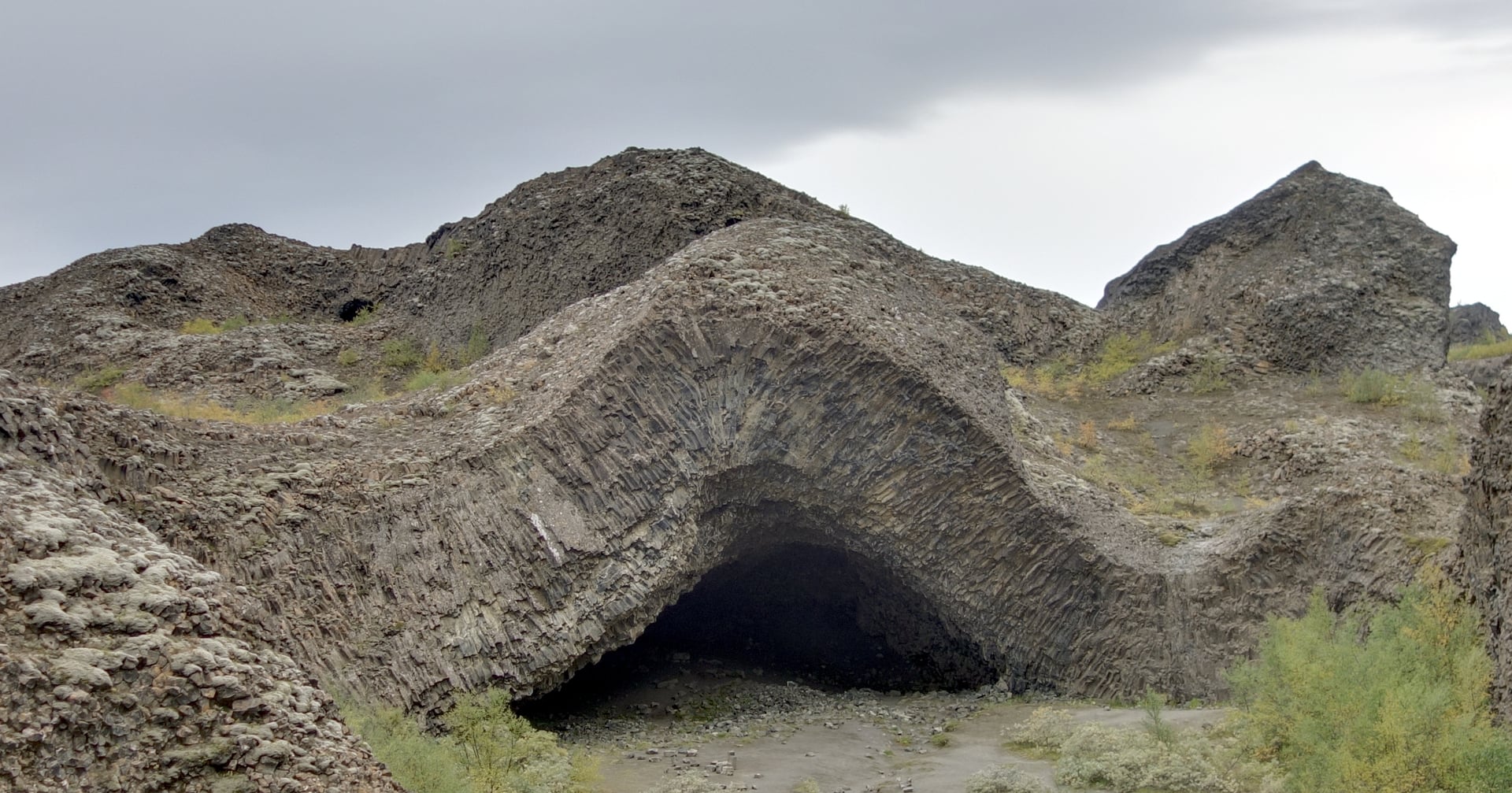
One of the strongest things about Hljóðaklettar is that it broadens what people think basalt can look like. Many travelers already know columnar basalt from places like Svartifoss or Litlanesfoss, where the columns behave almost architecturally, forming elegant vertical order. Hljóðaklettar is wilder than that. The basalt here arches, bunches, twists, forms caves and walls and recesses, and in places seems almost too inventive to be accidental. The effect is less like a neat lesson in geology and more like stumbling into a stone workshop where several different experiments were left standing.
The famous formation Kirkjan, represented in many photographs and well documented on Wikimedia Commons, helps explain that appeal. Its very name, meaning the Church, reveals how instinctively people try to translate these rocks into architecture. But as with the best Icelandic landscape nicknames, the metaphor is not only visual. Hljóðaklettar can feel liturgical in a looser sense too. There is an acoustical hush and repetition to the stone chambers and openings. The area does not merely look unusual. It alters the way sound and movement behave around you.
That acoustic character is exactly why the name matters so much. Visit North Iceland notes that the area is named for echoes that can be heard among the rocks. This is not an ornamental detail added for branding. It changes the experience fundamentally. Hljóðaklettar asks to be inhabited briefly, not only viewed. The rocks become more than geology when they begin reflecting sound back at you. The visitor's own presence becomes part of the interpretation. In a country where many attractions depend on sweeping distance, Hljóðaklettar becomes intimate instead. The scale closes in. The canyon listens back.
The wider setting of Vesturdalur gives that intimacy an ideal frame. Official North Iceland material describes the Hólmatungur and Hljóðaklettar district as one of contrasts, where clear brooks cross the land before joining the brown, forceful Jökulsá á Fjöllum. This matters because Hljóðaklettar is not emotionally identical to either Dettifoss or Ásbyrgi, even though all three belong to the same greater corridor. Dettifoss is impact. Ásbyrgi is shelter. Hljóðaklettar is intricacy. It asks you to read details inside a larger violent landscape rather than confronting you with force all at once.
The park's interpretation that these formations were revealed when the river swept away loose volcanic material is especially useful because it gives Hljóðaklettar a double nature. The rocks feel solid, almost stubbornly permanent, yet their visibility depends on removal, on what floodwater carried away. This makes the place a kind of edited geology. What remains is not the whole volcanic story but the harder, stranger sentence left after the river erased the rest. That is one reason Hljóðaklettar feels so concentrated. It is a surviving core landscape.
Walking here is a major part of the attraction. The national park emphasizes marked hiking routes, and that is exactly right, because Hljóðaklettar rewards movement from one angle to the next. A single photograph can suggest what the place looks like, but not how it unfolds. Arches become walls. Walls become clustered columns. Dark recesses give way to open canyon views. The eye keeps renegotiating the scale of what it is seeing. This is one reason Hljóðaklettar often stays with people who enjoy reading terrain rather than simply collecting famous names.
For that kind of traveler, the relation to Hólmatungur is important too. Visit North Iceland notes that the footpath between Hljóðaklettar and Hólmatungur, following Jökulsá á Fjöllum, is among the most beautiful in Iceland. Even if a traveler does not walk the full route, knowing that Hljóðaklettar belongs to a longer conversation of vegetation, river, and canyon changes its meaning. The site is not an isolated cluster of rocks. It is one chapter in a more complex district where ecological softness and volcanic severity repeatedly meet.
Photographically, Hljóðaklettar is both generous and difficult. It gives more shapes than most people know what to do with. That abundance can flatten into random oddity unless you choose a governing idea: a single arch, the contrast between black openings and pale sky, the vertical logic of a wall, the scale of a person against the formations, or the strange almost-architectural silhouette of Kirkjan. The place often rewards restraint. If you try to capture everything, you capture less of what makes it compelling.
Weather can improve it rather than diminish it. Bright sun can produce strong graphic contrast and sharpen the forms, but softer cloud often helps more by allowing the eye to stay with texture and depth. In shifting light, the openings and folds begin to matter more than color. The place becomes less postcard and more stone thought. That is one of the quiet virtues of Hljóðaklettar. It does not need spectacular weather to function. It already contains enough complexity on its own.
From an itinerary point of view, Hljóðaklettar is one of the smartest additions to a North Iceland route for travelers who want something beyond the most obvious Diamond Circle sequence. It pairs naturally with Ásbyrgi, Dettifoss, and Selfoss, but it does not feel redundant beside any of them. Instead it rounds out the emotional vocabulary of Jökulsárgljúfur. After the impact of waterfalls and the shelter of the horseshoe canyon, Hljóðaklettar offers pattern, echo, and the pleasure of geological eccentricity.
It also has a subtle human lesson built into it. Many Iceland stops are consumed too quickly because their meaning is visible from the parking lot. Hljóðaklettar resists that habit. You need to walk a bit, turn corners, let the formations accumulate, and perhaps even pause long enough to hear why the place was named as it was. The reward is not only beauty but attentiveness. Hljóðaklettar becomes memorable because it trains the senses differently.
Hljodaklettar benefits from being explained on its own terms because many people searching for it are not really asking for a one-line definition of 'echo rocks.' They want to know whether it is worth the detour, how it differs from the better-known North Iceland stops, what the hiking feels like, and whether the site is more than a curiosity. The fuller way to understand it is yes. Hljodaklettar matters because it is one of the most intricate places in Jokulsargljufur, where acoustics, basalt form, and flood-shaped geology come together with unusual force.
What stays with many visitors after Hljóðaklettar is often not one image but a sensation: that the landscape briefly became chambered, patterned, and responsive. The rocks did not only stand there. They held space. They caught sound. They made the canyon feel less like a backdrop and more like an instrument. That is why Hljóðaklettar lingers. In a country full of loud beauty, it is one of the rare places where stone teaches you to listen.