Iceland Travel Guides
Húsavík Whale Watching: Skjálfandi Bay and the Town That Learned to Watch Well
A fuller private guide to Húsavík whale watching, with Skjálfandi Bay, the town's long whale-watching history, sustainable local operators, and the reason this North Iceland experience feels so deeply rooted.
GlaciGo Iceland / May 2026 / 10 min read
Húsavík whale watching is one of those Iceland experiences that can be ruined by lazy description almost as easily as it can be elevated by the right one. If written badly, it becomes a simple promise of big animals and boat tours. If written honestly, it becomes something more specific and much more compelling: a North Iceland encounter shaped by Skjálfandi Bay, long local experience at sea, and a town whose relationship with whales is not ornamental but woven into its identity. What makes whale watching from Húsavík special is not only that whales are often seen there. It is that the entire setting helps the activity make emotional and ecological sense.
Visit North Iceland is useful on this point because it does not treat Húsavík as just another departure harbor. It openly calls the town the Whale Capital of Iceland, and its regional whale pages note that Húsavík and Eyjafjörður were among the first places in the country to offer whale-watching excursions. That history matters. Whale watching here is not a recent layer pasted onto a scenic bay. It has had time to shape local rhythms, expectations, harbor culture, visitor identity, and the town's reputation abroad. When travelers book in Húsavík, they are entering a place that has been thinking seriously about this experience for decades.
North Sailing's official material adds an even more precise historical anchor. The company describes itself as a family business based in Húsavík that has offered whale watching since 1995, and says it was the first Icelandic business to offer organized whale-watching trips in Skjálfandi Bay. Visit North Iceland echoes that founding role, describing North Sailing as a pioneer of sustainable tourism and the first company in Iceland to offer regular whale watching tours. Whether a traveler chooses North Sailing or another local operator, this origin story still matters because it explains why Húsavík feels so established in the field. The town did not merely benefit from whale-watching demand. It helped build the practice in Iceland.
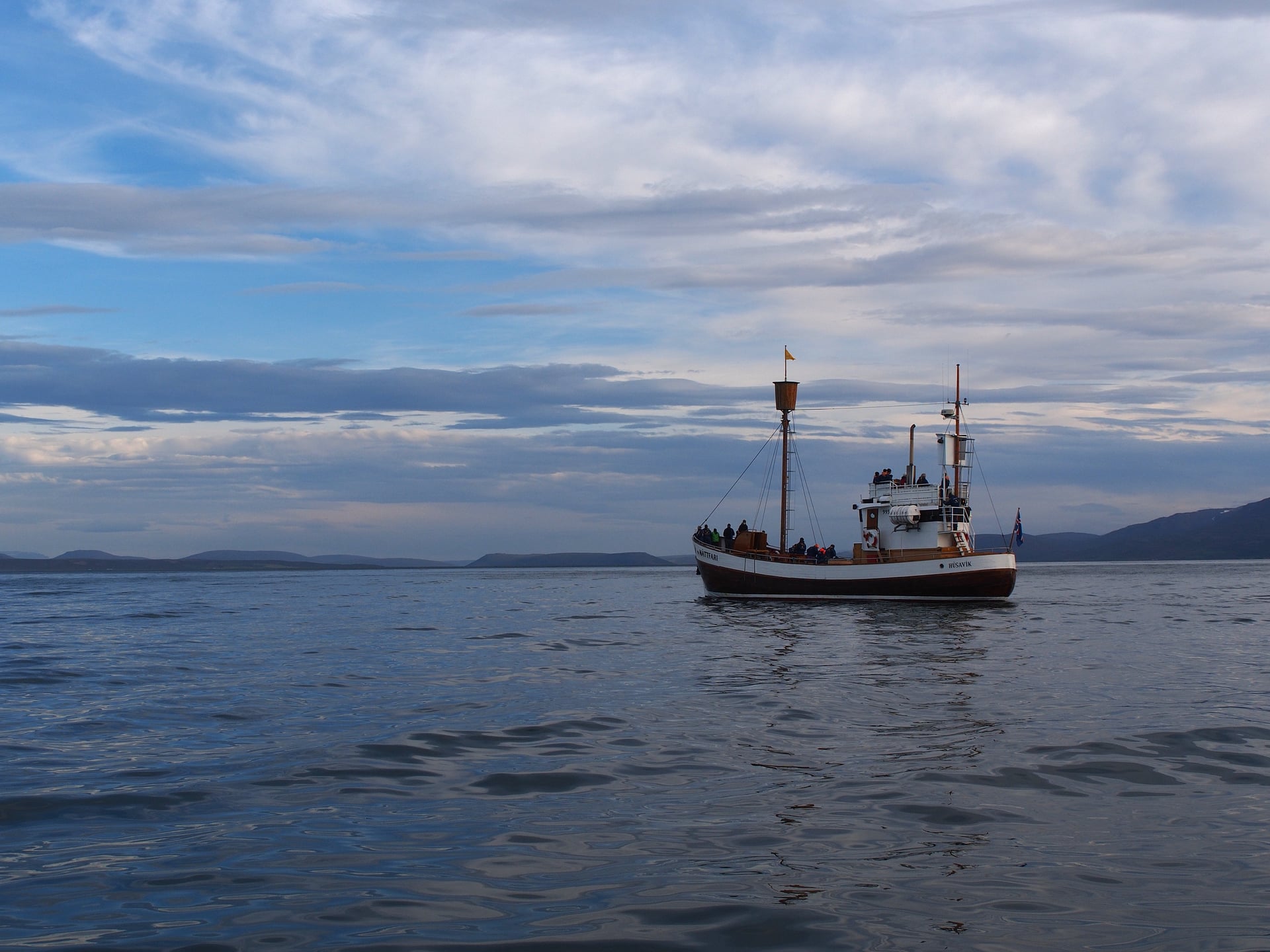
The bay itself is central to everything. Skjálfandi is not just open water beside a nice town. It is the living stage on which the whole experience depends. North Iceland's official whale pages emphasize how close visitors can get to humpbacks, dolphins, and minkes in the north, while Húsavík's own destination materials present sailing out in pursuit of these animals as an experience no one should miss. The combination of bay topography, marine life, light, and accessibility has given Húsavík its unusual confidence. The sea here does not feel abstract. It feels inhabited.
This inhabited quality is one reason whale watching in Húsavík tends to stay with people differently from more checklist-oriented wildlife trips. You leave from a real small harbor in a real northern town, pass out into the same bay that defines local life, and begin learning a discipline of attention that is part excitement and part patience. Whales do not appear on command, and good operators do not pretend otherwise. The experience becomes meaningful because it asks you to sit inside uncertainty without making that uncertainty feel like failure. When a blow appears, or a humpback rises and folds back into the water, the moment feels earned rather than delivered.
There is also a strong ethical difference between wanting to see whales and wanting the right kind of whale watching. Húsavík matters because the conversation has had time to mature there. North Sailing's official language leans clearly toward responsibility and sustainability, and its current material highlights silent whale watching on fully electric boats as part of that ongoing development. That detail should not be treated as mere novelty. It points toward the deeper question serious travelers increasingly care about: not just whether whales can be seen, but how the seeing is done. Húsavík remains one of the strongest places in Iceland for asking that question in public rather than hiding it behind glossy certainty.
This is also why the town pairs so naturally with the Húsavík Whale Museum and with GeoSea. They are not the same experience, but they reinforce one another beautifully. At sea, you encounter uncertainty, scale, weather, and the shock of seeing a living body break the surface for only a moment. At the museum, you deepen your understanding of whale bodies, species, and human histories around them. At GeoSea, you process the bay from warmth and stillness after having moved through it. None of these should replace the others, but together they help Húsavík become more than a one-activity town.
Season and mood matter too. A summer tour can feel bright, social, and full of movement, especially when birdlife adds another layer and the horizon stays open for longer than visitors from many countries are used to. A colder or more shoulder-season tour can feel sharper and more exposed, which is not a drawback if expectations are honest. Whale watching is not supposed to be entirely comfortable. Part of its dignity comes from meeting marine life in marine weather. That said, the right gear and the right pacing make a major difference, and Húsavík's long experience in the field is one reason people often trust the town so readily with this kind of outing.
Photographically, whale watching in Húsavík asks for a different sensibility from land-based sightseeing. You are working with distance, movement, glare, sudden appearances, and the reality that the best moments may happen too quickly for perfect framing. This is actually one of the strengths of the experience. It reduces the temptation to treat the entire outing as content extraction. Some images will work. Many won't. What people often remember most is not their best photo but the quality of presence required by the search. Húsavík encourages that kind of attention because the activity still feels rooted in the bay rather than overly choreographed for spectators.
From an itinerary perspective, Húsavík whale watching is strong enough to be a destination anchor, not just a side add-on. It can justify a night in town, especially when paired with GeoSea, the Whale Museum, or a wider Diamond Circle route. For travelers deciding between whale watching in Reykjavík and whale watching in North Iceland, Húsavík often wins not only because of reputation but because the experience is more spatially coherent. The town, the bay, the boats, and the larger identity of the place all reinforce one another. You do not feel like you have added a detached commercial excursion to an otherwise unrelated day. You feel like you have participated in what the town is known for most deeply.
traveler questions around Husavik whale watching is also much more specific than around Husavik as a town. People want to know whether it is really better than other Iceland options, whether it is worth structuring a route around, how much the town's reputation reflects reality, and whether the tours still feel human rather than overprocessed. The fuller way to understand it is yes, provided expectations stay honest. Husavik cannot guarantee the emotional schedule of the sea. What it can offer is one of Iceland's most mature, locally rooted, and place-specific whale-watching cultures.
The phrase whale capital can become cheesy if used carelessly, but Húsavík comes closer than most places to earning it. Not because it turns whales into branding alone, but because the town has built knowledge, infrastructure, and reputation around a real long-term relationship with the bay and the life inside it. When North Sailing's official material says whale watching gave Húsavík the reputation of being Europe's whale-watching capital, it reflects something that travelers can actually feel on the ground. This is a town where whales are not just talked about after the fact. They help shape why people come and how the town is understood.
Husavik Whale Watching benefits from a fuller explanation because too many summaries stop at the easiest claims: there are whales, there are boats, Husavik is famous. What matters on the ground is a clearer explanation of why the experience is distinct, how the town's history with whale watching matters, and why Skjalfandi Bay changes the whole emotional register of the trip. The stronger answer is that Husavik whale watching is not simply an excursion. It is one of the clearest places in Iceland where wildlife tourism, local identity, and marine atmosphere still feel connected to each other.
What stays with many travelers after Húsavík whale watching is usually not just the whale itself, though that can be unforgettable. It is the whole sequence: the harbor, the cold air, the scan of the bay, the first sign that something large is moving below the surface, the respectful distance, and the return to town with a slightly altered sense of scale. Húsavík lingers because it teaches that watching well is part of the experience. It offers not only sightings, but a better way of meeting the northern sea.