Iceland Travel Guides
Hverfjall: The Ring That Organizes Mývatn
A fuller private guide to Hverfjall, with its huge tephra-ring form, rim walk, orienting views over Mývatn, and the reason this crater feels so complete and so important in North Iceland.
GlaciGo Iceland / May 2026 / 10 min read
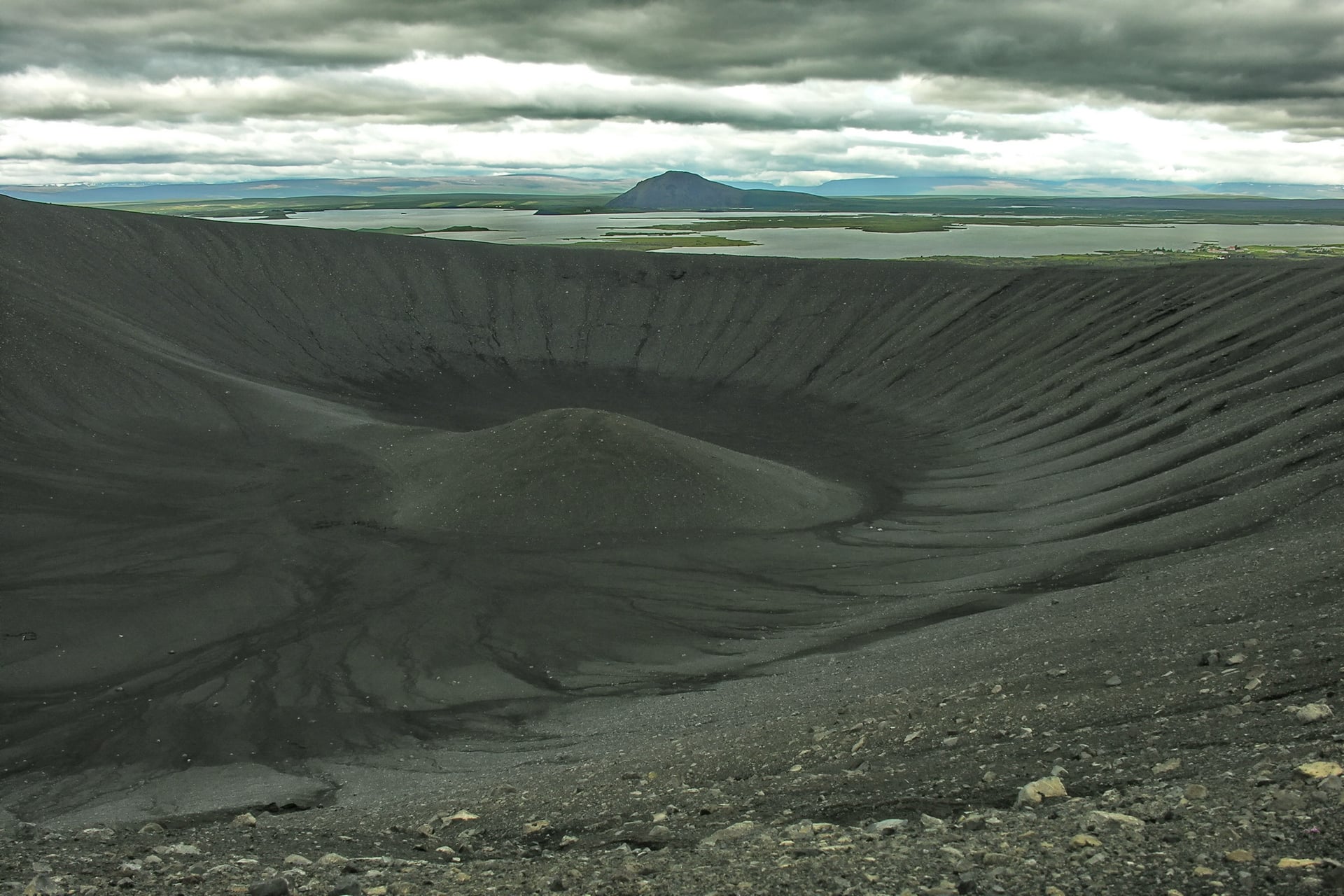
Hverfjall is one of those Icelandic landforms that looks almost too geometrically complete to be natural. Rising near Lake Mývatn as a near-perfect circular crater, it gives many first-time visitors the odd sense of seeing a landscape that has already been simplified into an ideal form. But Hverfjall becomes most interesting the moment that first visual impression gives way to scale. The crater is not only symmetrical. It is immense. Its lines are simple, but its presence is not. Hverfjall can feel like a single clean gesture laid across the whole Mývatn district, a form so legible that it begins to organize the surrounding landscape around itself.
Visit North Iceland describes Hverfjall as a large, circular explosion crater about 140 meters deep and 1,000 meters in diameter. The Environment Agency of Iceland strengthens that frame by calling it one of the most beautiful and regular tephra crater formations in Iceland and among the largest of its kind on Earth. Those official descriptions matter because they explain why Hverfjall is more than a pleasant climb near Mývatn. The crater is a major volcanic form in its own right. It does not need a dramatic cliff or visible steam to command attention. Its authority comes from shape, scale, and the way it rises out of the district with such complete self-definition.
The geological category matters here. Hverfjall is often also referred to as Hverfell, and it is best understood as a tephra ring or explosion crater formed in one immense eruptive event. That is important because it distinguishes the crater from neighboring volcanic features around Mývatn. Skútustaðagígar are pseudocraters made when lava crossed wetlands. Dimmuborgir is the emptied architecture of a lava lake. Hverir is exposed geothermal chemistry. Leirhnjúkur is young steaming lava. Hverfjall is the grammar of explosive form itself, a ring-shaped statement whose simplicity is the result of violent origin.
That violence can be easy to forget because the crater now feels so settled. The slopes are broad and dark, the rim line clean, and from a distance the mountain can look almost restful. But that visual calm is part of what makes Hverfjall such a good teacher. Like much of Mývatn, it transforms force into readability. The region repeatedly takes processes that sound brutal and leaves behind forms that look composed. Hverfjall is one of the clearest examples. It is the cooled after-image of a gigantic event, still legible enough for the eye to follow without much explanation.
This is why Hverfjall benefits from being explained on its own terms rather than a brief mention inside a general Myvatn guide. People searching for it are rarely asking only where it is. They want to know what makes it so famous, whether the climb is worth it, and why this crater feels different from the many other volcanic features in North Iceland. The better answer is that Hverfjall matters because it gives the Myvatn district one of its strongest orienting forms. It is not only a stop. It is a viewpoint, a shape lesson, and a way of reading the district from above.
The walking experience is central to that reading. Official regional materials encourage climbing Hverfjall and walking the rim, and this advice is exactly right because the crater changes character as soon as you move from its base into its upper line. From below, Hverfjall looks contained and almost abstract. From the rim, the Mývatn world opens. You begin to see the relationship between lake, pseudocraters, lava fields, geothermal zones, and distant volcanic edges. A crater that first seemed self-contained becomes one of the best platforms for understanding the district as a whole.
This shift from object to platform is one of the most satisfying things about Hverfjall. Many volcanic landmarks offer one dominant image. Hverfjall gives two. The first is the external symmetry of the crater itself. The second is the outward view from the rim, where the Mývatn district begins to explain its own composition. This dual role is rare and valuable. Hverfjall is beautiful as a form and useful as a viewpoint without sacrificing either quality.
Weather changes the mood dramatically without damaging the essential experience. In bright conditions, the crater can look almost classical in its simplicity, the dark slopes contrasting cleanly with the pale sky and the softer wetlands below. In low cloud or windier weather, the mountain becomes more severe and elemental. Snow can sharpen the rim and make the tephra ring feel even more sculptural. The important thing is that Hverfjall does not depend on one ideal atmosphere. Its form is strong enough to keep speaking under many conditions.
That strength is partly why Hverfjall often lingers in memory more than people expect. It is not the most chemically dramatic stop in the district, nor the most mythic, nor the most intimate. But it gives something many other Mývatn places do not: a feeling of order. Around the lake, so much of the landscape reveals itself through fragmentation and variation. Hverfjall gathers. Its circle draws scattered features into relation. That gathering power is deeply satisfying, especially in a district otherwise rich in dispersed complexity.
Photographically, Hverfjall can be surprisingly difficult in the best way. Because the crater is so large and so simple, the challenge is not finding subject matter but choosing scale. Do you show the whole ring as a dominant form? Do you use people on the slope to reveal mass? Do you frame the crater against Mývatn below so the district appears in relation? The place rewards clarity of intention. Its simplicity leaves nowhere to hide and that makes it stronger, not weaker, as a photographic subject.
The Mývatn district context remains essential throughout. Hverfjall is not just a mountain beside a lake. It belongs to the same wider volcanic system that produced Dimmuborgir, the pseudocraters, and later eruptive and geothermal features farther east. Once you understand that, the crater becomes less isolated and more interpretive. It is one of the district's great punctuation marks, a massive circular pause between wetland softness and darker volcanic terrains.
There is also a cultural pleasure in the fact that Hverfjall remains such a physically straightforward goal. The route does not depend on extreme technicality or secret access. You go up, and the district opens. That simplicity is part of why the crater has become one of the classic Mývatn experiences. It gives a real feeling of ascent and understanding without requiring the day to become a major expedition. In Iceland, those medium-scale achievements often become the ones people remember with the most affection.
From an itinerary perspective, Hverfjall works beautifully as a central or early-day anchor in the Mývatn area. If you climb it first, the district becomes easier to interpret afterward. If you climb it later, it can gather scattered impressions into one final visual understanding. Either way, it tends to improve the other nearby stops by giving them spatial relation. That makes it one of the smartest North Iceland volcano walks for travelers who like not only seeing things, but understanding how they fit together.
Hverfjall benefits from a fuller explanation because many summaries flatten it into a one-line definition: a crater by Myvatn. That is technically true and emotionally useless. People actually searching for Hverfjall want to know why it matters, how it feels, and whether it is distinct enough from all the district's other volcanic features to earn real time. The fuller way to understand it is yes. Hverfjall matters because it turns explosive origin into one of the most readable, walkable, and orienting forms in North Iceland.
What stays with many visitors after Hverfjall is often the ring itself. Not merely the crater as a hole in the ground, but the perfect confidence of its edge. The eye keeps returning to that line and to what can be seen from it. Hverfjall lingers because it gives shape to a whole region. It is one of those rare landforms that feels both singular and explanatory at the same time.