Iceland Travel Guides
Hvítserkur: Troll Legend, Sea Stack Drama, and the Calm Intelligence of Vatnsnes
A fuller private guide to Hvítserkur, with its troll legend, seal-rich shoreline, beach access, photography appeal, and the slower coastal mood of the Vatnsnes peninsula.
GlaciGo Iceland / May 2026 / 10 min read
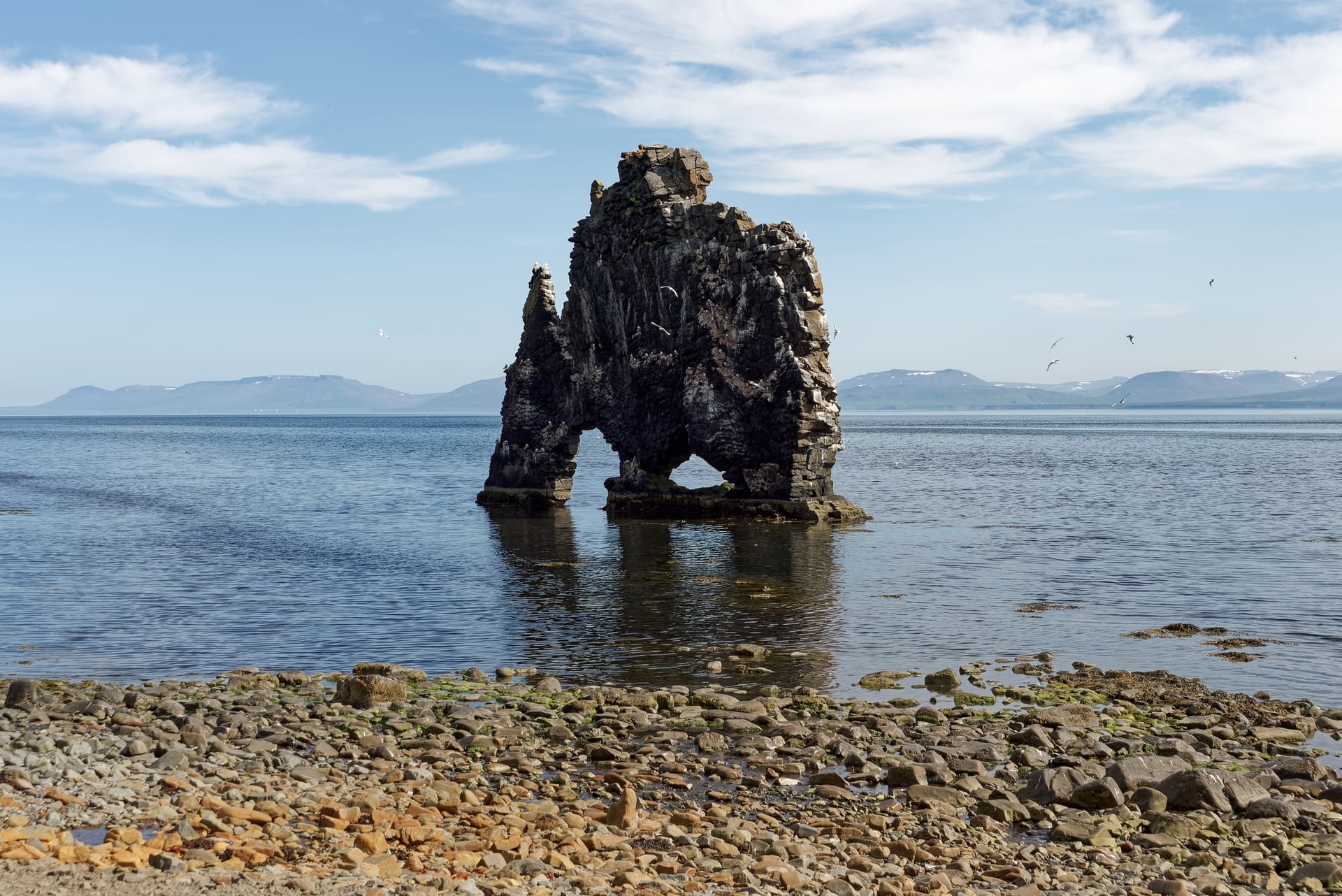
Hvítserkur is one of those Iceland places that can look almost too neat in photographs. A dark basalt form rises from shallow water, bent forward on narrow legs, as if some giant animal paused mid-drink and never moved again. On social media it is often reduced to a shape test: elephant, dragon, rhino, dinosaur. That is part of the fun, but it is not the whole experience. In person, Hvítserkur feels less like a novelty and more like a meeting point between three very Icelandic things: a coastal landscape shaped by weather, a local story shaped by imagination, and a visitor experience shaped by patience rather than speed.
Official regional tourism information keeps the essential facts clear. Visit North Iceland describes Hvítserkur as a 15 meter-high sea stack just off the eastern side of Vatnsnes. Húnaþing vestra, the local destination source, says the same more directly and adds the local legend that has helped the rock stay alive in memory. That balance is exactly right. You begin with geology and location, but the site becomes memorable because the people around it kept telling stories about what it resembles and how it came to be there.
The setting matters as much as the rock itself. Hvítserkur stands on the Vatnsnes peninsula in northwest Iceland, not far from Hvammstangi, in a region that many travelers still pass too quickly. Vatnsnes is often introduced for its seal colonies, its farming landscape, and its slower rhythm compared with Iceland's more famous southern routes. That wider context makes Hvítserkur stronger. You are not arriving at an isolated monument in a vacuum. You are arriving at one stop within a peninsula where wildlife, rural roads, estuaries, and old local stories all sit close together.
The Icelandic Seal Center gives one of the best practical descriptions of the site because it ties the rock to the surrounding life instead of treating it as a single object. From the parking area near Ósar, visitors can head to a viewing platform above the coast or walk down toward the beach. The same source notes that this is also an excellent place to watch seals, often in large numbers, near the river mouths and sandbanks. That changes the emotional register of the stop. Hvítserkur is not only a dramatic silhouette. It is part of a living coastal system where birds, seals, tides, and visitors share the same narrow edge between land and sea.
That wildlife layer is one reason the place deserves a fuller guide instead of another short "photo stop" entry. traveler questions around Hvitserkur is usually practical on the surface: how long to spend there, whether it is worth the detour, whether you can walk down to the beach. But underneath those questions sits a more interesting one: what kind of stop is this really? The best way to understand it is that Hvitserkur works when you give it enough time to be more than an image. Walk slowly, look at the estuary, watch what the birds are doing, scan the water, and the stop becomes broader and calmer than its iconic outline first suggests.
The folklore around Hvítserkur is not decorative background. It is one of the main ways local people have interpreted an already strange-looking formation. Húnaþing vestra preserves the old legend that Hvítserkur was once a troll crossing Húnaflói. In another version, reflected in the Icelandic-language North Iceland material, the troll was trying to interfere with the bells of Þingeyraklaustur and was caught by sunrise before completing the task, turning to stone in the first light of morning. That is a very Icelandic kind of story: not abstract myth, but a tale anchored to an exact landform and a real cultural landscape nearby.
Even the name contributes to that layered feeling. The Icelandic North Iceland page explains that the stack is white from bird droppings and that the name likely comes from that color. You do not need to turn the article into a language lesson to feel what that means. The rock is dark, but its upper surfaces are often marked by seabirds strongly enough that the naming still makes sense. Icelandic place names often preserve a way of seeing rather than a formal category, and Hvítserkur fits that habit beautifully. The place is geological, but the name is observational and human.
The physical experience of visiting Hvítserkur also helps explain why it stays with people. From above, the sea stack feels sculptural and composed. From the beach, it becomes heavier, stranger, and more tactile. The Icelandic Seal Center notes that one path leads down toward the shore, and that descent is worth making if conditions are good. From there, the scale changes. The holes at the base, the rough texture of the basalt, the water moving around the legs of the stack, and the sound of the coast all start to do work that photographs alone cannot do.
This is also where a more patient tourist will notice the mood of Vatnsnes itself. There is a quietness here that is different from the high-drama quiet of glacial lagoons or canyon lookouts. Hvítserkur belongs to a softer kind of northern space: open coast, low estuarine ground, birdlife, a gravel-road approach, and a horizon that feels wide rather than vertical. That softness is part of the beauty. The stack is visually bold, but the landscape around it is measured and breathable. It gives the place a rare balance between spectacle and stillness.
Photography is obviously part of Hvítserkur's identity now, and there is no need to pretend otherwise. Visit North Iceland even has a feature specifically offering photography tips at Hvítserkur, which tells you how central the place has become to the visual imagination of Iceland travel. But the better lesson is not simply where to put the tripod. It is understanding why the site photographs so well. The answer lies in the clean relationship between form and setting: the stack stands close enough to shore to be legible, far enough out to feel improbable, and low enough in the surrounding landscape that sky, sea, birds, and light all remain active in the frame.
For photographers, tide, season, and weather matter here more than people sometimes expect. In calm conditions, the water and wet sand can make the stack feel almost doubled by reflection. In rougher weather, it becomes more animal-like and severe. In softer light it can feel almost elegant; in hard gray weather it looks older, rougher, and more uncanny. That variability is important for tourists too, even if they are not carrying a camera. Hvítserkur is not a single experience. It is one of those landforms whose personality changes with the conditions around it.
The ethical side of the visit matters just as much as the aesthetics. The Icelandic Seal Center is explicit: do not scare seals into the water, do not shout, do not throw things, and do not fly drones. That guidance should not be treated as a footnote. Wildlife is one of the main reasons the stop is richer than a roadside landmark, and careless visitor behavior can damage exactly what makes the place special. This is especially important because the estuary near Hvítserkur can reward stillness. Quiet visitors often see more. The site improves when people behave as if they are guests in an active habitat rather than owners of a viewpoint.
A good human-scale way to understand Hvítserkur is to think of it as one of the best short stops in Iceland for travelers who like interpretation more than adrenaline. There is no long hike required, no ticketed spectacle, no overdesigned reveal. Instead, there is a compact sequence of rewards: the approach across Vatnsnes, the first sight of the stack, the choice between platform and beach, the possibility of seal watching, the local legend, the changing shape in different light, and the sense of being at a place that is famous without feeling entirely consumed by fame.
That last point is becoming rarer in Iceland and is worth protecting in your own pace of travel. Hvítserkur is known, but it still benefits from slowness. You can stop for fifteen minutes and collect the image. You can also stay longer and let the peninsula start explaining itself. Watch the waterline. Notice the birds. Look back from the shore toward the land. Think about why a troll story attached itself here instead of somewhere flatter and less strange. Think about why seals like the nearby coastal environment. The stop becomes more intelligent the longer you let it unfold.
For a traveler building a north or northwest Iceland route, Hvítserkur often works best not as the headline of the day but as the moment that gives the day shape. It pairs naturally with other Vatnsnes experiences, especially seal watching and the broader rural drive around the peninsula. In that sequence, the sea stack stops being a random detour and becomes a kind of emblem for the area: a place where geology, wildlife, and folklore remain legible without heavy interpretation panels or commercial staging.
Hvitserkur benefits from a fuller explanation because too many short summaries flatten it into a single line: a basalt rock that looks like a dragon. That line is not wrong, but it is thin. The stronger description is that Hvitserkur is one of Iceland's best coastal stops for visitors who want shape, story, seals, and a deeper feeling for the quieter intelligence of northwest Iceland. Its fame comes from the silhouette. Its lasting power comes from everything around that silhouette.
What many travelers remember afterward is not only the odd beauty of the stack itself, but the way the stop keeps widening while you are there. First it is a shape. Then it is a legend. Then it is a wildlife site. Then it is a lesson in how Icelandic places often work at their best: one clear visual hook, surrounded by weather, language, and local memory. Hvítserkur stays with people because it is not just strange to look at. It is also very good to think with.