Iceland Travel Guides
Imagine Peace Tower: Light, Ritual, and Yoko Ono's Reykjavík Memorial
A fuller private guide to Imagine Peace Tower, with its Yoko Ono origins, Viðey setting, annual lighting cycle, conceptual art background, and the reason this Reykjavík artwork feels more like a shared ritual than a monument.
GlaciGo Iceland / May 2026 / 10 min read
Imagine Peace Tower is one of those Reykjavík experiences that makes more sense when you stop trying to treat it like a conventional monument. It is not a tower in the usual architectural sense, and it is not simply a memorial that happens to be lit at night. It is an event-based work of art, a ritual of return, and a piece that depends on darkness, season, weather, ferry crossings, and shared attention. People often first hear about it as 'the Yoko Ono light installation on Viðey,' which is true but incomplete. What matters is not only what it is made of, but how it appears: suddenly, seasonally, and with a feeling that the landscape itself has agreed to hold the work for a while.
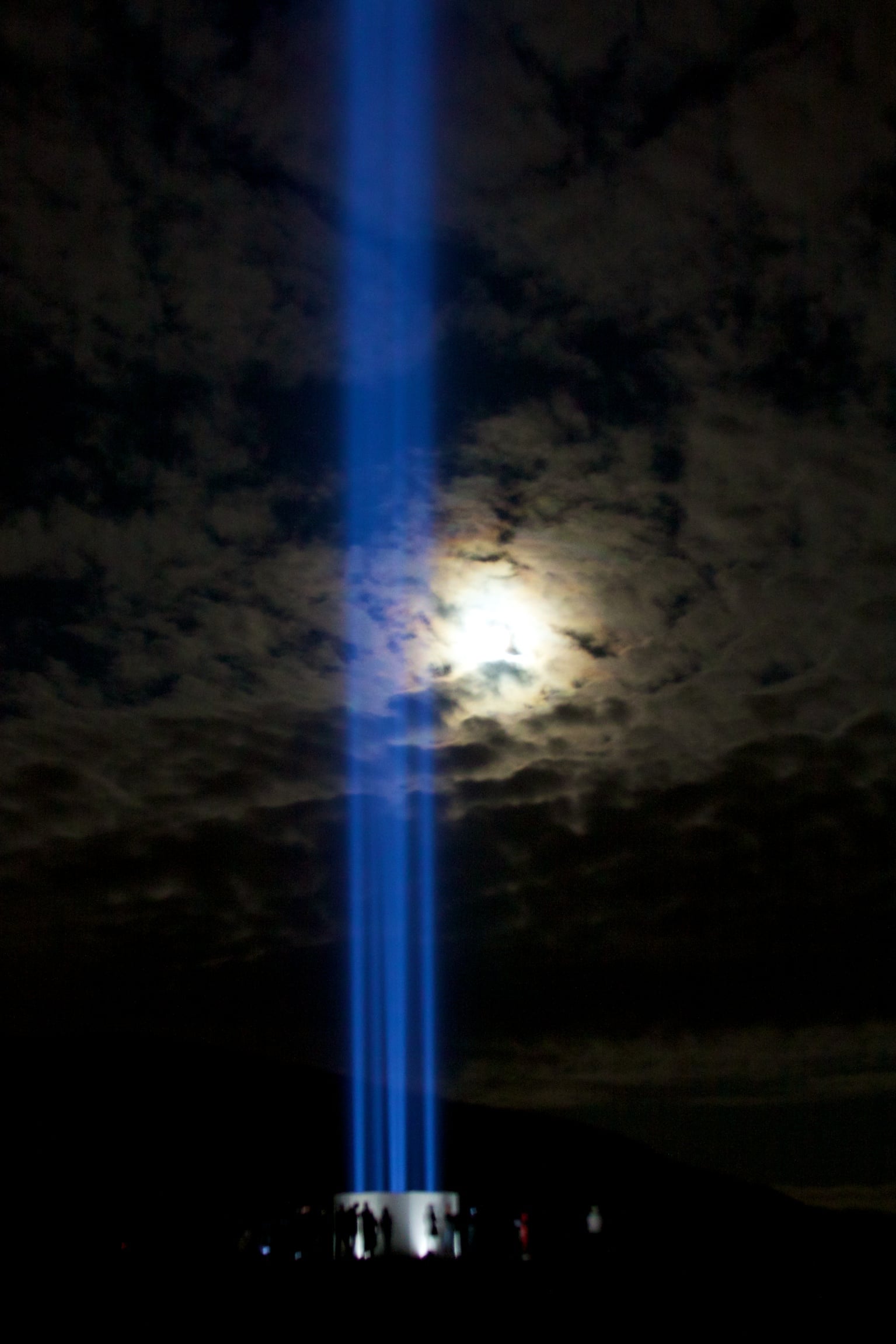
Visit Reykjavík describes the Imagine Peace Tower as a work conceived by Yoko Ono as a beacon to world peace. That phrase, 'beacon to world peace,' is not just publicity language here. It accurately reflects the scale of the idea. The work begins not with a sculpted figure or a closed memorial object, but with a wishing well from which a tower of light emerges. The words IMAGINE PEACE are inscribed around the well in 24 languages, and the artwork turns an act as private as a wish into something public, vertical, and communal. In that sense, it belongs to the same participatory spirit that runs through much of Yoko Ono's work. The audience is not outside the piece. The audience completes it by gathering, witnessing, and carrying its message onward.
The official Reykjavík Art Museum page places the work clearly within the city's contemporary art life. Installed on Viðey Island in 2007, it is part of the museum's collection and therefore part of the cultural inheritance of Reykjavík itself. That institutional detail matters. Imagine Peace Tower is famous enough to be treated as a freestanding icon, but it is also a carefully maintained public artwork with a civic home. It belongs to the island, to the city's art ecology, and to a wider conversation about how memory can be made visible without becoming static.
Its origin story is part of what gives the work emotional force. The tower was dedicated to John Lennon and inaugurated on 9 October 2007, the date that would have been his 67th birthday. Reykjavík and Visit Reykjavík both note that the beam is lit annually from 9 October until 8 December, the anniversary of Lennon's death in 1980. This annual cycle is more than scheduling. It shapes the meaning of the piece. The work does not remain on permanently in order to become background. It returns, which means people return with it. Memory is made rhythmic rather than fixed. That rhythm gives the tower a different kind of gravity from a monument you simply pass whenever you happen to be nearby.
There is also something quietly clever about the fact that the work is made of light rather than mass. Visit Reykjavík explains that the tower is formed by multiple individual lights, some reflected upward through mirrors and others shining directly into the sky, joining into a single beam. The visible result feels simple, but the conceptual effect is richer. Light is less possessive than stone. It cannot be entered, touched, or circled in the same way. It is there and not there at once. The work asks people to look up rather than around. That changes the social behavior around it. Visitors do not merely inspect it. They pause with it.
The weather in Iceland becomes part of the artwork too. Visit Reykjavík notes that the beam's strength, brilliance, and intensity change continually with atmospheric conditions. This is one of the reasons the tower suits Iceland so well. The piece is never quite identical from one evening to the next. Mist, wind, cloud, cold, and clarity all collaborate with the work. In another country this idea might feel ornamental. In Iceland it feels honest. The environment is not decoration around the art; it is part of the art's performance.
The location on Viðey matters for similar reasons. A major piece of the experience is the crossing itself. The official Reykjavík page explicitly mentions the boat trip offered during the lighting season, and that boat ride does important emotional work. It creates a threshold between ordinary city time and something more reflective. If the same beam rose from a downtown plaza, it would still be meaningful, but it would lose the island interval that gives it so much atmosphere. To go to Imagine Peace Tower, you leave shore, travel into the dark, and arrive with other people who have also chosen to make the crossing. That shared movement gives the work a ceremonial edge without making it heavy-handed.
For travelers, this is one of the strongest reasons to visit the tower during lighting season rather than only reading about it. The physical setting on Viðey keeps the work from becoming sentimental. The island is open, cool, and exposed. Around you are old histories, seabirds, grass, low landforms, and the presence of Reykjavík across the bay. Above you is the beam. The combination of intimacy and exposure is unusual. You feel both held by the gathering and made small by the dark sky. The work gains seriousness from that scale.
Yoko Ono's own artistic logic also helps explain why the piece works so well. Reykjavík Art Museum describes her as a leading experimental and avant-garde artist associated with conceptual art, performance, Fluxus, and happenings, and notes that many of her best-known works invite public participation. Imagine Peace Tower belongs to that lineage. Even if a visitor knows very little about Fluxus or postwar conceptual practice, the structure of the work is easy to feel. It is art that depends on idea, repetition, invitation, and collective imagination rather than on a single finished object. That makes it unusually accessible without making it simplistic.
The peace message itself can sound abstract when reduced to a slogan, but on Viðey it often feels more grounded than people expect. The Reykjavík Art Museum page speaks of the tower as a needed reminder to keep the vision of peace aloft, especially in a world marked by war. That wording is useful because it avoids pretending the work solves anything. It does not. Instead, it insists on continuity of attention. In practical terms, travelers often arrive unsure whether the experience will feel too symbolic, too Beatles-centered, or too brief. Many leave surprised that the strongest part was the setting: the cold air, the shared quiet, the beam's verticality, and the feeling that the island briefly becomes a site of civic hope.
There is another layer that gives the work a specifically Reykjavík character. Visit Reykjavík notes that the electricity comes entirely from Reykjavík Energy and is produced from geothermal power. This is not a minor technical footnote. It connects the artwork to a very Icelandic infrastructure story: a peace memorial powered by the earth's own heat. That fusion of idealism and local energy systems is part of why the piece does not feel imported. Even though Yoko Ono conceived it, and even though its message is global, the work has been materially folded into Reykjavík's own conditions.
Travel timing matters here more than it does for many other attractions. Unlike a church, museum, or sculpture that can be visited any clear afternoon, Imagine Peace Tower has a real seasonal logic. The main lighting period begins on 9 October and runs through 8 December, with additional appearances around the winter solstice, New Year's period, 18 February, and the spring equinox week, according to official Reykjavik and Visit Reykjavik information. That means a traveler planning an autumn or winter Reykjavik itinerary can treat the tower as a specific evening anchor rather than a flexible anytime stop. This is helpful too, because many people searching for the tower are trying to understand not only what it is, but when it can actually be experienced as intended.
A good article about Imagine Peace Tower also needs to be honest about what kind of experience it is not. It is not a long attraction full of exhibits. It is not a complicated technical tour. It is not best approached with a checklist mentality. The work tends to reward people who can accept a little simplicity. You go, you cross, you stand, you look, and you let the context do some of the work. For some travelers that becomes one of the most memorable moments in Reykjavík precisely because it is so stripped back. In a trip full of movement, bookings, weather decisions, and famous stops, the tower offers a rarer thing: a focused evening with one clear emotional note.
Imagine Peace Tower benefits from careful explanation because traveler questions around it is not the same as traveler questions for Videy Island generally. Someone searching for Videy may want a half-day walk, history, ferry times, or birdlife. Someone searching for Imagine Peace Tower usually wants the story of the artwork, its lighting season, what the visit actually feels like, and whether it is worth building an evening around. Those are different questions, and they deserve a different answer. The overlap with Videy is real, but the center of gravity is different.
What stays with many visitors after seeing Imagine Peace Tower is not only the John Lennon connection, though that matters for many people. It is the rarer sensation that a city chose to keep a work of hope both public and seasonal, both fragile and recurring. The beam vanishes again into ordinary darkness, but it comes back. In that recurring return lies the real strength of the piece. Imagine Peace Tower lingers because it does not ask you to admire permanence. It asks you to show up when the light appears.