Iceland Travel Guides
Into the Glacier: A Designed Journey Inside Langjökull
A fuller private guide to Into the Glacier, with its man-made ice tunnel, glacier-truck approach, climate interpretation, Langjökull setting, and the visitor logic that makes this West Iceland experience distinct.
GlaciGo Iceland / May 2026 / 10 min read
Into the Glacier is one of those Iceland experiences that immediately raises a strange and worthwhile question: what does it mean to go inside a glacier on purpose? Not onto it, not around it, not merely to a viewpoint beside it, but into its body through a man-made tunnel built high on Langjokull. That question is exactly why the experience benefits from being explained on its own terms rather than being absorbed into a broader guide to the glacier itself. Langjokull is the landscape. Into the Glacier is the designed, guided encounter that turns that landscape into something visitors can physically read from the inside.
The operator's own official material is very clear about the scale of the idea. Into the Glacier describes itself as offering access to the largest ice tunnel in the world, high on Iceland's second-largest glacier, Langjökull. West Iceland's official tourism site repeats that core claim and adds something important: this project was created not only to give people a new kind of adventure but also to let them study, explore, and learn from the glacier's history and from the reality of melting ice. That framing matters. Into the Glacier is not only a novelty product built inside frozen scenery. It is an interpretation of the glacier as a place of science, engineering, risk, climate awareness, and awe.
That is one reason traveler questions here is different from a general Langjokull search. Someone looking up Langjokull may want geography, climate, or route planning. Someone looking up Into the Glacier usually wants to know what the actual experience feels like, how much of the day it takes, whether it is too touristy, whether the tunnel is natural or man-made, and whether it still feels powerful despite being engineered. Those are fair questions, because the product lives right at the boundary where wild landscape and human construction meet.
The official homepage makes the current touring structure easy to understand. The classic tour is presented as a 3 to 4 hour experience departing from Húsafell Center or Klaki, while Reykjavík departures stretch the day to about 11 hours. There are also combo products, winter versions, snowmobile add-ons, and private tours. This matters because Into the Glacier is not just one object in the ice. It is a full visitor system: transport, timing, safety, weather judgment, check-in, glacier access, guiding, and tunnel interpretation. For many travelers, that system is the real story. The tunnel itself is extraordinary, but so is the logistical intelligence required to bring ordinary people into that environment at all.
The route up to the glacier is part of the experience, not just a transfer. Into the Glacier's materials show the massive eight-wheel glacier trucks as part of the identity of the tour, and the official About page confirms that the ice tunnel lies high on Langjökull, where most of the ice cap rises between about 1,200 and 1,300 meters above sea level. In practice, that means the journey does not begin when you step into the tunnel. It begins when you leave Húsafell behind, climb out of the more inhabited landscape, and start moving into a whiter, rougher, less domesticated zone. The vehicle is not theatrical decoration. It is part of how the glacier remains reachable without pretending to be gentle.
This upward transition matters emotionally. West Iceland at lower elevations can feel green, wooded, and deeply tied to farm, river, and settlement history. Into the Glacier shifts the day into a more exposed register. The road, the truck, the weather, and the increasing dominance of ice all tell you that you are leaving one Iceland and entering another. That contrast is part of why the experience stays in memory so well. Good travel design often depends on transitions, not just endpoints. Here, the transition into the glacier environment is one of the strongest chapters of the whole day.
The story behind the tunnel adds another layer. Into the Glacier's official About page says that in 2010 Baldvin Einarsson and Hallgrímur Örn Arngrímsson began pursuing the bold idea of taking people not just around and onto a glacier but into its heart, with engineers and geophysicist Ari Trausti Guðmundsson helping study and prepare the construction. The site is refreshingly open about the ambition involved. This was not a natural cave waiting quietly to be discovered. It was a serious act of imagination, engineering, and perseverance. That honesty actually strengthens the experience. The tunnel is powerful not because it is falsely marketed as untouched, but because it openly admits how much effort it took to make the glacier legible from within.
That engineered quality raises an obvious question: does a man-made tunnel inside a glacier still feel real? The best answer is yes, but for a different reason than people first expect. The tunnel itself is constructed, but the medium is not. The walls, the pressure, the melt, the shifting color, and the fact that the whole environment is physically temporary remain real and active. Human beings cut the passage. The glacier still provides the material truth. What visitors experience inside is not a fake ice exhibit. It is shaped ice in a living glacier, interpreted through infrastructure.
This distinction becomes especially important once the climate story enters the room. West Iceland's official description explicitly says the project contributes to understanding melting glaciers. Inside the tunnel, that is not an abstract talking point. A glacier is no longer just a distant white surface. It becomes layered matter around you, vulnerable and changing even while it feels massive. Into the Glacier is effective partly because it takes climate out of the category of remote data and places it into a human-scale encounter. You can feel temperature, confinement, compressed snow, and the logic of accumulation. That makes retreat and fragility emotionally understandable in a way that scenic overlooks often do not.
The official About page also gives useful context for the glacier itself: Langjökull covers about 950 square kilometers and rests on a massif of hyaloclastite mountains. That volcanic setting is one of the deeper reasons the tour matters in Iceland rather than anywhere else. Fire and ice are not marketing opposites here. They are structural companions. The tunnel lets visitors encounter ice from the inside, but the wider route also reminds them that the glacier belongs to a landscape built by volcanic activity beneath and around it. Into the Glacier therefore works best when understood not as an isolated entertainment product, but as one chapter in Iceland's larger argument between frozen water, magma-shaped ground, and time.
For itinerary design, the experience fits beautifully into a Húsafell and Silver Circle day, but it also carries enough weight to shape the day around itself. The operator offers departures from Húsafell and Reykjavík, which immediately creates two very different experiences. A Húsafell-based departure feels more regionally integrated. A Reykjavík departure turns the tour into a full-day excursion with stronger expedition energy. Neither is automatically better. The right choice depends on whether the traveler wants the glacier to be part of a broader West Iceland route or the central event of the day.
The private versions matter too. Into the Glacier lists both a private super jeep tour from Reykjavík and a private ice cave tour departing from Húsafell or Klaki. This is more than a luxury upsell. Private format changes the pace of a place like this significantly. Questions become easier, time can breathe differently, photography becomes less crowded, and the whole movement from lowland to glacier can feel less scheduled and more personal. For travelers already building a private West Iceland itinerary, that difference can be meaningful.
There is also something unexpectedly human about the best Into the Glacier tours. They are not only about blue light and monumental ice. They are about how people react inside the tunnel: the quietness, the way voices change, the sense of insulation from weather outside, the surprise that something so white and exposed from the surface can become so enclosed inside. The tour works because it changes not only what visitors see, but how they move, listen, and imagine the glacier.
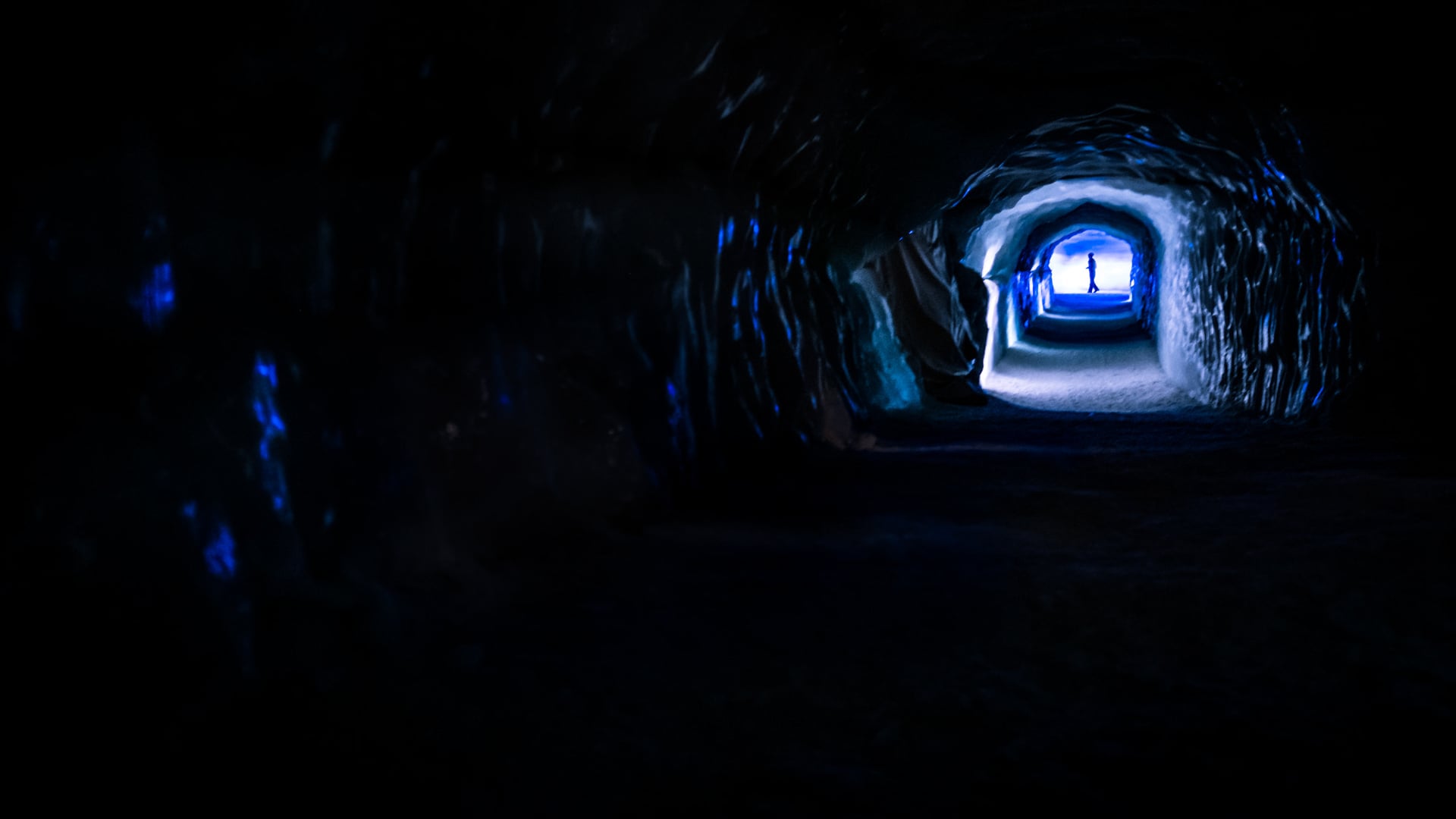
Photographically, Into the Glacier has its own discipline. The tunnel is not a wide scenic panorama but a controlled interior environment of blue-white walls, soft light, figures in jackets, and repeating curves of carved passage. The strongest images usually come when visitors accept the interior rhythm of the place instead of trying to force it into the visual language of a normal cave or a normal glacier hike. Here, scale is often best communicated by a person, a doorway, or a bend in the tunnel rather than by emptiness alone.
Into the Glacier deserves a separate guide because too many summaries flatten it into a phrase like "ice cave in Langjokull." That is not quite wrong, but it misses the point. The experience is not just a cave and not just Langjokull. It is a carefully built, guided, vehicle-supported, climate-aware journey into the glacier's interior. Once that distinction is made, the searcher has something much more useful than a generic label.
What stays with many visitors after Into the Glacier is not only the fact that they went inside ice, but that the experience managed to feel both designed and genuine at once. The trucks, the tunnel, the route planning, and the safety systems are unmistakably human. The ice, the altitude, the cold, and the changing material around you are unmistakably not. That tension is what makes Into the Glacier memorable. It does not pretend humans were never there. It shows what happens when human engineering tries, carefully and respectfully, to open a path into one of Iceland's biggest frozen bodies without completely domesticating it.