Iceland Travel Guides
Ísafjörður: Harbor Memory, Mountain Weather, and the Human Heart of the Westfjords
A fuller private guide to Ísafjörður, with its harbor history, old town, cultural life, mountain setting, and the reason this Westfjords capital deserves more than a quick overnight.
GlaciGo Iceland / May 2026 / 10 min read
Ísafjörður is one of those Iceland towns that becomes more interesting the longer you refuse to reduce it to logistics. Plenty of travelers know it first as the Westfjords hub, the place with flights, services, tour departures, rental cars, cafés, and roads radiating into a difficult, magnificent region. All of that is true. But if the town is described only as a base, it is flattened far too early. Ísafjörður has the sort of layered town life that many dramatic landscapes around Iceland do not: harbor memory, trading history, avalanche awareness, cultural institutions, old timber architecture, music and festival energy, and the daily seriousness of being a small urban center in a region where weather and mountains still set the outer rules.
Visit Westfjords introduces Ísafjörður exactly where a good article should begin. It calls the town the vibrant heart of the Westfjords, rooted in a trading history that reaches back to the sixteenth century and deeply shaped by fishing from the nineteenth century onward. That official framing matters because it keeps the town from sounding accidental. Ísafjörður did not become important just because it happens to have streets and shops in a scenic fjord. It became important because it was a point of exchange, labor, adaptation, and administration in a region that has never made easy living its basic offer.
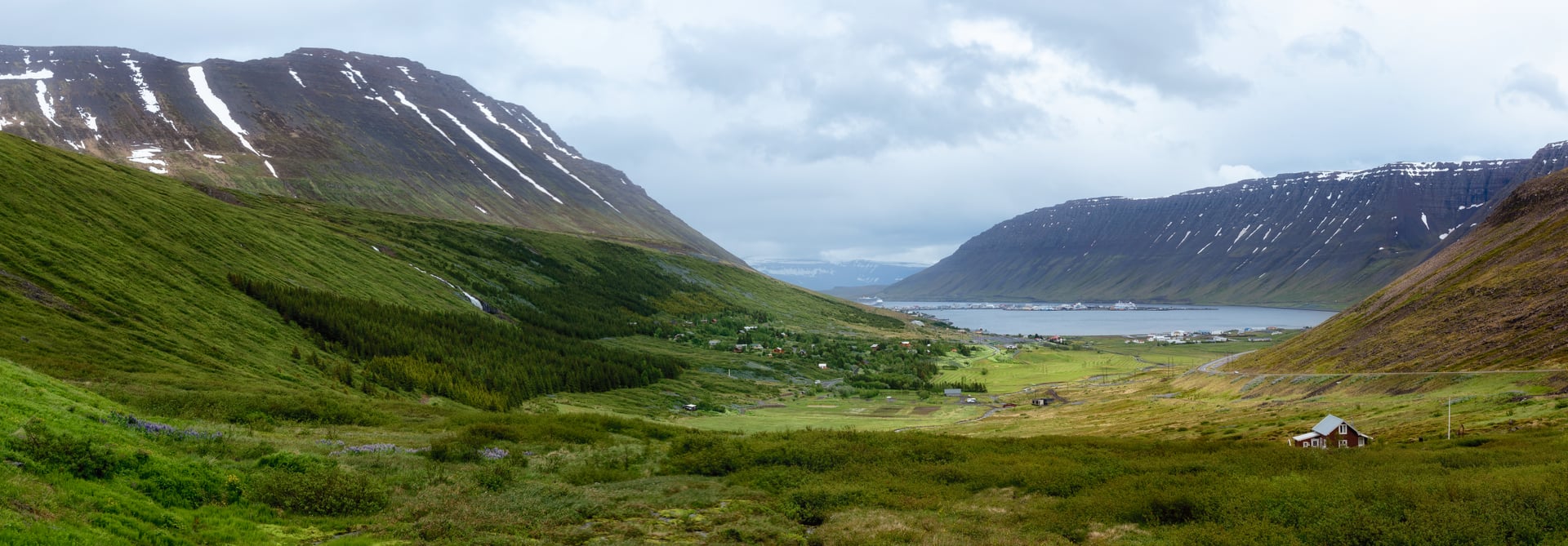
The physical form of the town explains a lot of its personality. Older guide material from Westfjords describes Ísafjörður as standing on a gravel spit that extends into the fjord. That detail is more than descriptive topography. It gives the town a kind of visible logic. Like other Icelandic settlements built on narrow useful landforms, it feels held between necessity and exposure. The mountains do not merely decorate Ísafjörður. They define its possibilities. The water does too. The town sits inside Skutulsfjörður, itself part of the larger Ísafjarðardjúp system, and the result is a place that is both sheltered and watchful.
That watchfulness has always been part of life here. The community guidelines for Ísafjörður, prepared for visitors, put it gently but clearly: this is the largest town in the Westfjords, but it remains a small place where local rhythms, outdoor conditions, and mutual consideration matter. Those materials also help remind readers that Westfjords towns are not stage sets for visitors passing through. People live here under real environmental pressure. In Ísafjörður, that includes the longstanding reality of snow, storms, and avalanche country. A serious article should not overdramatize this, but neither should it pretend the town's beauty is separable from the conditions that shaped it.
That is one reason Ísafjörður feels different from Iceland's more straightforwardly charming towns. The beauty is there, yes: old houses, harbor lines, mountain walls, and changing fjord light. But the town also carries a harder intelligence. It has had to persist in a region where access can be difficult, where fishing mattered profoundly, and where being the regional center means taking on responsibilities beyond its size. That makes the atmosphere feel lived rather than arranged.
The old town is especially important to this feeling. Visit Westfjords and local materials repeatedly point travelers toward the preserved timber houses around Neðstikaupstaður, one of Iceland's oldest urban clusters. This matters not only because the buildings are photogenic. It matters because they preserve the mercantile and maritime logic out of which the town grew. Walk there slowly and Ísafjörður stops feeling like a service node and starts feeling historical in a very specific way. Warehouses, shore adjacency, and the scale of the structures keep the old economy visible.
Culture adds another strong layer. Visit Westfjords emphasizes the town's festivals, museums, galleries, and workshops, and that is more than a tourism list. Ísafjörður is one of the rare places in Iceland outside the capital area where cultural life feels structurally important rather than decorative. The town has enough density of people and enough regional centrality to generate a real scene. That matters in a place whose natural setting might otherwise tempt visitors to think only in terms of departures into wilderness.
Aldrei fór ég suður, the famous Easter music festival, is a good example of this larger civic rhythm even when it is not the only one worth naming. Its existence tells you something essential: Ísafjörður does not understand itself only as remote. It understands itself as active, creative, and capable of gathering people even at a time of year when the rest of Iceland still often feels winter-held. That mood leaks into the town more generally. Ísafjörður has a cultural self-respect that makes it feel larger than its population.
The mountains around town deepen that feeling rather than shrinking it. In some places, steep mountains can make a settlement feel trapped. In Ísafjörður they also create drama, weather texture, and a daily visual seriousness that becomes part of normal life. You notice this especially when cloud drops low, when snow lines sharpen, or when evening light pulls the whole basin into one colder color. The town does not sit in front of scenery. It sits inside it.
This mountain setting also helps explain why so many travelers use Ísafjörður as a launch point for adventure. Visit Westfjords points outward toward hiking, kayaking, birdlife, skiing, and the route toward Hornstrandir. But the best way to phrase this is not that the town happens to be near these things. Ísafjörður is where the Westfjords become legible enough to enter. It has the services and the human scale needed to turn a difficult region into an inhabitable one for a few days. That is a subtler and stronger role than merely being a base.
The swimming pool deserves mention too, because in Iceland a pool is never only a pool. Visit Westfjords notes that the Ísafjörður swimming hall is the oldest pool in town, built just after the Second World War. That detail matters because it reminds us how Icelandic town life actually works. Public bathing, exercise, social conversation, and ordinary community rhythm remain central in places like this. If you want to understand Ísafjörður beyond the postcard level, you pay attention to the spaces where local life continues without explanation.
Food and cafés matter in the same way. A good Ísafjörður day often includes coffee against bad weather, a harbor walk, a museum visit, and a sense that the town rewards being occupied by more than movement alone. In regions famous for long drives and outdoor stops, towns often suffer from being treated as functional interruptions. Ísafjörður resists that because it has enough internal life to justify lingering even if the weather changes or the next fjord road can wait until tomorrow.
There is also something deeply Westfjords about how the town balances modest scale with regional responsibility. As the largest town in the peninsula, it is where many practical systems concentrate: transport, education, administration, healthcare, cultural programming, and visitor orientation. This can make it feel sturdier than many settlements of comparable size elsewhere. It has to be. That sturdiness becomes part of the atmosphere. You feel that people are not only living beside beauty here; they are managing a region from inside it.
From an itinerary perspective, Ísafjörður is worth much more than a sleep-and-go stop. It is strong as a real overnight, stronger still as two nights if a traveler wants to let the Westfjords open more slowly. It works for people heading toward Hornstrandir, for those circling the fjords by car, and for travelers who need one place in the region that combines human comfort with a real sense of place. Some towns are beautiful because they are still. Ísafjörður is beautiful because it remains in motion while still feeling rooted.
Isafjordur benefits from a fuller explanation because traveler questions around it is split between very different needs: where to stay, what to do, whether the town itself is worth time, how it compares to other Iceland towns, and whether it is merely a gateway or a destination in its own right. Most shallow travel pages never answer the last question honestly. The stronger answer is that Isafjordur is absolutely a destination in its own right. Its harbor history, preserved old core, cultural life, mountain setting, and regional importance combine to make it one of Iceland's most complete small towns.
What stays with many visitors after Ísafjörður is often not one iconic sight, but a total impression: the fjord, the old houses, the weather moving down the mountain walls, the harbor logic, the shops and cafés that feel genuinely used, and the sense that this town has learned how to live intelligently inside difficulty. Ísafjörður lingers because it gives the Westfjords a human center without diluting their character. It is not an escape from the region. It is the place where the region becomes inhabitable.