Iceland Travel Guides
Jökulsárlón: Where a Glacier Learns to Drift
A fuller private guide to Jökulsárlón, with glacier-lagoon formation, iceberg drift, tide, seals, crossing history, and the changing edge of Breiðamerkurjökull.
GlaciGo Iceland / May 2026 / 10 min read
Jokulsarlon is one of those Icelandic places that seems to arrive in the mind before it is fully seen. People know the image in advance: blue water, drifting ice, black shore nearby, seals if luck cooperates, and a glacier somewhere beyond the floating pieces. But the real experience is less like ticking off a famous view and more like standing inside a slow conversation between ice, ocean, and time. The lagoon is beautiful in the obvious sense, but what makes it unforgettable is that nothing in it feels fully still, not even the stillness.
Visit South Iceland describes Jokulsarlon as a glacial lagoon by the Ring Road, filled with icebergs from the edge of Breidamerkurjokull, an outlet glacier of Vatnajokull. The lagoon drains through a narrow outlet into the Atlantic, which is why the black beach nearby becomes scattered with ice. Those basic facts are already enough to explain why Jokulsarlon feels more dynamic than a normal lake. It is not simply a basin holding water. It is a threshold. Ice calves from the glacier, floats through the lagoon, and then continues toward the sea.
That threshold quality is deepened by the official glaciology material from Vatnajokull National Park. The park explains that glacial lakes form when outlet glaciers erode over-deepened troughs and, as they retreat, water fills the depressions they leave behind. It adds a particularly important detail for Jokulsarlon: this glacial lake is the mouth of a trough carved by the glacier that is about 25 kilometers long and 200 to 300 meters deep. That sentence changes the scale of the place. The lagoon is not a decorative surface accident. It is the exposed opening of a much larger glacial excavation.
The same park source describes Jokulsarlon as the largest and most active glacial lake in Iceland. That activity matters. Icebergs are not scenic extras floating for effect. They are evidence of calving, the process by which the glacier front breaks into the water. The lagoon therefore carries a strange emotional double meaning. Every iceberg is beautiful, but every iceberg is also a record of retreat. The spectacle and the loss are inseparable.
Visit South Iceland's glacial overview helps anchor that retreat in time. It says that around 1935 a lagoon began to form at the edge of the glacier, and around 1950 it began to expand rapidly as the glacier retreated due to ice melt. It also notes that the short glacial river Jokulsa, which flows from the lagoon to the sea, used to run 1 to 1.5 kilometers from the glacier before the lagoon formed. That is one of the most useful historical comparisons for visitors. It reminds you how quickly a famous landscape can be born. Jokulsarlon feels ancient, but as a lagoon it is startlingly young.
And it is still changing. Visit South Iceland points out that wave erosion has shortened the river to only about 500 meters, and that the effect of the tide can already be felt in the lagoon. If this process continues, the river may disappear and the lagoon will increasingly fill with seawater. This is exactly the kind of detail that makes Jokulsarlon more interesting when described carefully. It is not just a shrinking-glacier story, though it certainly is that. It is also a coastal story, a tidal story, and a story about how one landscape can transform into another within a human lifetime.
That complexity shapes the mood on site. Jokulsarlon does not feel tragic in a simple way, nor purely serene. Instead it feels lucid. You can watch ice drift almost silently while understanding that the lagoon itself exists because the glacier has withdrawn. You can admire color, light, and reflection while realizing the place is part of a changing climate reality. Good travel writing should not flatten that tension. Jokulsarlon deserves better than either empty alarm or empty wonder. Its emotional truth sits somewhere in the difficult middle.
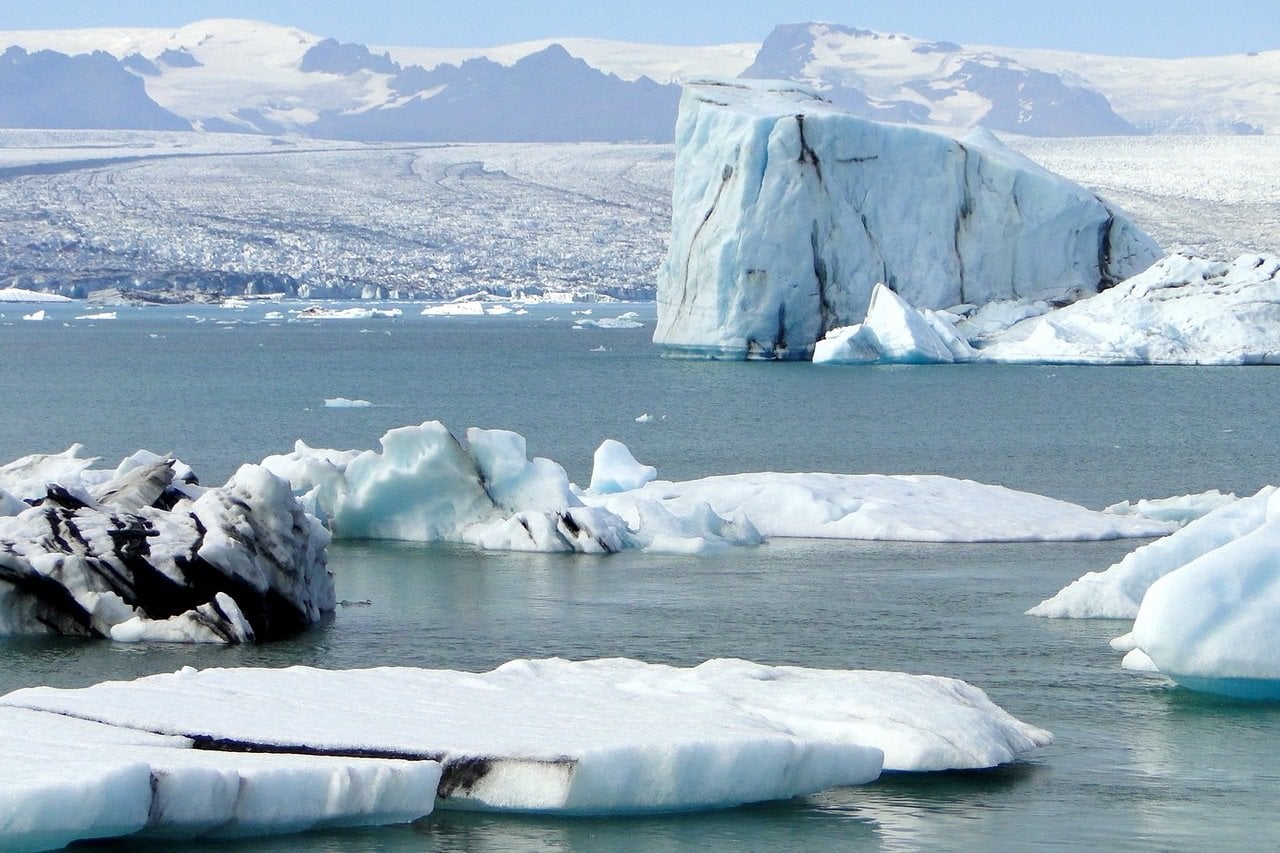
The blue tones of the ice are part of that truth too. Vatnajokull National Park's glaciology page explains why glacier ice can appear blue: the denser the ice and the fewer the air bubbles, the more it absorbs red and yellow wavelengths while reflecting blue. Snow, by contrast, looks white because air between the snow crystals reflects the full spectrum. This is not a trivial scientific aside. It gives language to something travelers often notice intuitively at Jokulsarlon. Some icebergs appear white, others glassy blue, others streaked with ash, and together they make the lagoon feel less like a single color field and more like a drifting archive of glacial life.
The wildlife layer matters as well, though it should be written with restraint rather than turned into bait. Visit South Iceland notes that in winter the fish-rich lagoon hosts seals looking for easy meals, and that curious seals can be seen year-round resting on blue-tinted icebergs. That possibility adds a living softness to a place otherwise dominated by ice and rock. Seals help prevent the lagoon from becoming too abstract in the imagination. They remind visitors that Jokulsarlon is not only a climate symbol or a photo icon. It is also habitat.
Nearby Fellsfjara, often folded into the more marketable phrase Diamond Beach, completes the movement of the lagoon in a way many people do not fully appreciate. The lagoon releases ice through the outlet, the Atlantic rearranges it, and pieces of glacier end up resting on black sand in temporary states of brilliance before melting away. This relationship between lagoon and beach is why Jokulsarlon works so well in a private itinerary. You do not have just one stop. You have a system: glacier, lagoon, outlet, beach, tide, and drift, all legible within a short distance.
The national park's trail material adds another dimension that many drive-by visitors miss. There is a marked hiking route between Fjallsarlon and Jokulsarlon across Breidarmork. Even if not every traveler takes the full route, the very existence of that path is telling. It means the area can be read not only from parking lots and viewpoints, but as connected glacial terrain. Jokulsarlon is strongest when understood as one part of a larger Breidamerkursandur and Vatnajokull landscape rather than a detached attraction by the highway.
There is also a human history of passage here that deserves to be remembered. Visit South Iceland notes that before the river was bridged in 1966 and 1967, crossing this area was often difficult and dangerous. A ferry operated from 1932, but before that many people drowned trying to get across because of strong current and icebergs. When the river could not be crossed safely on horseback, people sometimes tried to cross the glacier above its source, where crevasses made the route hazardous. This is one of those details that turns a famous stop back into a real place. Long before Jokulsarlon became universally photographed, it was part of an unforgiving travel problem.
For photographers, Jokulsarlon can be both generous and deceptive. It offers easy beauty, which is a gift, but easy beauty can make people stop looking too soon. The better images often come from noticing relationships rather than collecting isolated pretty objects. Blue ice against steel water. Dark ash lines inside a berg. A seal head barely interrupting a reflection. A distant glacier front that makes sense of the floating pieces in the foreground. Or a quieter frame where one iceberg occupies enough space to feel like a temporary sculpture rather than background decoration.
Private travelers often benefit from slowing down here more than they expect. Jokulsarlon is not a place to rush through in ten performative minutes. Light shifts. Ice rotates. Tides work subtly on the outlet. Birds and seals appear and vanish. Even the emotional reading of the lagoon can deepen if you stay long enough for the first wave of recognition to settle. The place begins as famous, but can become intimate if given time.
A useful Jokulsarlon guide has to answer several questions without reducing the lagoon to a photo stop: where it is, how it formed, why the ice is blue, how it connects to Diamond Beach, whether seals are possible to see, and what glacier retreat means here. Those practical answers matter because they help travelers look more carefully. The lagoon is most powerful when its beauty, movement, wildlife, and climate context are allowed to sit in the same frame.
What stays with most people after Jokulsarlon is not one isolated image, but a sequence: the distant glacier, the calving logic, the floating ice, the short river, the beach, the sea. The lagoon lets you watch a glacier becoming ocean in stages. That is an extraordinary privilege, even when it is sobering. Jokulsarlon is beautiful because it is honest about change. The ice is not posed there for us. It is in motion, and we are only briefly allowed to witness it.