Iceland Travel Guides
Katla Ice Cave: Where Ash Stays Inside the Ice
A fuller private guide to Katla Ice Cave, with year-round access context, volcanic ash in the ice, glacier safety, and the changing interior of Mýrdalsjökull.
GlaciGo Iceland / May 2026 / 10 min read
Katla Ice Cave is one of the few places in Iceland where people go underground in ice and come back feeling that the country has explained itself more clearly. Not because the cave is simple. It is the opposite. Black ash, blue ice, white layers, melt channels, volcanic memory, and shifting safety conditions all meet in one experience. But the contradictions are exactly what make the place legible. In many Iceland landscapes, fire and ice are described as a slogan. In the Katla Ice Cave, they stop being a slogan and become material.
Visit South Iceland places the cave near Vik and makes one point immediately that matters for both planning and interpretation: Katla Ice Cave is one of the rare Icelandic ice-cave experiences accessible all year round. The same official article explains that most ice caves in Iceland form seasonally, with meltwater carving channels through glaciers in summer and guides scouting safe caves in the colder months. Katla stands apart because it remains visitable beyond the usual winter-only rhythm. That does not mean it is static or permanently predictable. It means the cave belongs to a different pattern of access.
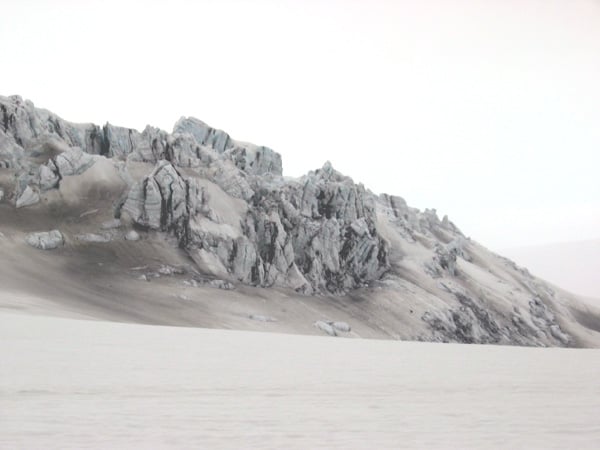
That difference is important because it changes what the cave means. Many travelers imagine all ice caves as versions of the same thing: blue chambers under a glacier, briefly open, photogenic, cold, and interchangeable except for location. Katla Ice Cave resists that flattening. Visit South Iceland describes black, white, and blue ice inside the cave and links those colors directly to volcanic eruptions from Katla, whose ash and sand have combined with the ice to create shades that can look almost like dragon glass. This is the defining mood of the place. You are not simply entering frozen water. You are entering ice that has remembered eruption.
The broader setting clarifies why. Visit South Iceland's page on Myrdalsjokull and Katla describes Myrdalsjokull as one of Iceland's major glaciers, north of Vik, and explains that Katla lies beneath it as one of the country's most powerful and historically consequential volcanoes. The same source notes sixteen eruptions since settlement, with the last in 1918, and explains how subglacial eruptions melt the ice above the vent and release violent jokulhlaup floods loaded with ice, rocks, silt, and sand. Most of the Myrdalssandur plain has been built by deposits from these floods. Once you know this, the cave stops feeling like an isolated attraction and becomes part of a much larger volcanic-glacial system.
That system is exactly what gives Katla Ice Cave its unusual visual language. In cleaner blue-ice caves elsewhere, visitors often focus on purity, translucence, and light passing through dense glacier ice. At Katla, the experience is rougher, darker, and in some ways more Icelandic. Ash bands, soot-black surfaces, and mixed tones prevent the cave from feeling like a polished fantasy chamber. The beauty is there, but it is a harder beauty, one that asks you to accept that the glacier is not innocent of the volcano beneath it.
Visit South Iceland's ice-cave overview also explains something that should always be said clearly: in Iceland, ice caves are not permanent interiors waiting faithfully for visitors year after year. Conditions change. Guides must search for caves that are large enough and safe enough. Warmer intervals, wind, and rain can flood caves and make them dangerous or impassable. This matters especially for Katla Ice Cave because year-round access can easily be misunderstood as year-round sameness. It is not the same cave in some museum sense. The experience is constantly adjusted to the glacier's condition.
That is where local guiding becomes part of the meaning rather than just a ticketing detail. Visit South Iceland's Katlatrack listing describes a locally based company operating out of Vik, best known for Katla Ice Cave tours. It notes that the experience combines Super Jeep travel with short glacier walks and is led by local guides who prioritize safety while explaining glacier formation, volcanic activity, and the changing nature of the cave. This is exactly the right frame. Katla Ice Cave should not be approached as a site you merely reach. It should be approached as a changing environment that has to be interpreted on the day.
There is a practical and emotional reason for that. Practically, glaciers are dangerous. Visit South Iceland explicitly says ice caves should never be entered without a trained guide and proper safety gear, and notes that visitors are given helmets and crampons. More broadly, the Myrdalsjokull guidance warns of crevasses, rapidly shifting weather, high winds, and snowstorms. Emotionally, guided access helps travelers understand what they are actually seeing. Without interpretation, many people would register only color and novelty. With good interpretation, they begin to read ash, melt, compression, instability, and volcanic influence inside the cave walls.
This is one reason Katla Ice Cave deserves a different tone from other South Coast highlights. A waterfall can often be described in terms of viewpoint, light, and pacing. A black-sand beach often needs geology and safety. Katla Ice Cave needs those things too, but it also needs humility. The cave can be astonishingly photogenic, yet it is not there for our consumption in the casual sense. It is a temporary opening inside an active relationship between glacier, meltwater, ash, and weather. The best article should preserve that seriousness without draining away the wonder.
The approach from Vik contributes to that feeling. Even before entering the ice, travelers move through a landscape already marked by Katla's longer influence: black sands, glacial margins, and rough volcanic terrain. By the time the cave appears, the experience already has context. This is not an underground chamber disconnected from the outside world. It is the interior extension of the same South Iceland story written across Myrdalssandur, Myrdalsjokull, and the village of Vik beneath them.
Photographically, Katla Ice Cave is strongest when travelers resist the urge to force it into the visual clichés of more pristine blue caves. The ash-darkened surfaces are not imperfections to work around. They are the point. A pale blue ceiling crossed by black streaks. A white curve of compacted snow beside a soot-stained wall. A small human figure under layered ice that reads almost like folded stone. The cave often becomes more powerful when the image retains some roughness rather than polishing everything into fantasy.
Because the cave changes, it also has a special relationship with memory. People do not all visit the same Katla Ice Cave, even when they use the same name. One season's chamber may collapse, flood, narrow, widen, or be replaced by another route entirely. This can sound disappointing if someone expects permanence, but it is actually part of the cave's integrity. The experience remains real because it is temporary. Katla Ice Cave asks to be visited as an event, not collected as a fixed object.
There is a deeper cultural fit here too. Icelandic landscapes often become more meaningful when they are understood as processes rather than monuments. The official Katla Geopark material describes the region as one of Iceland's most volcanically active areas, shaped by repeated eruptions, outlet glaciers, glacial rivers, moraines, ice-dammed lakes, and large outwash plains. Katla Ice Cave is a perfect small-scale expression of that larger reality. It condenses the geopark's grand themes into one walkable experience. You step into the cave and suddenly the phrase 'land of fire and ice' becomes less mythic and more geologic.
Katla Ice Cave is useful to explain carefully because travelers often want clear answers before committing: whether access is genuinely possible beyond winter, how it differs from seasonal crystal caves, why the ice can be black as well as blue, what safety gear and guiding mean, and whether it is worth adding from Vik. The fuller answer is that the cave is memorable precisely because it is not pristine in a simple way. It is ash, ice, weather, melt, and volcanic memory in one changing place.
What stays with most visitors afterward is usually not just the color, though the color matters. It is the feeling of having entered a place where the glacier is not cleanly separate from the volcano beneath it. Ash inside ice, danger inside beauty, movement inside apparent stillness. Katla Ice Cave does not offer the neatest version of Iceland. It offers one of the truest ones.