Iceland Travel Guides
Kerid Crater: Volcanic Color, Lake Views, and Private Touring Tips
A fuller guide to Kerid crater, with its 6,500-year-old volcanic form, seasonal color, rim and lake perspectives, and slower private Golden Circle planning.
GlaciGo Iceland / May 2026 / 8 min read
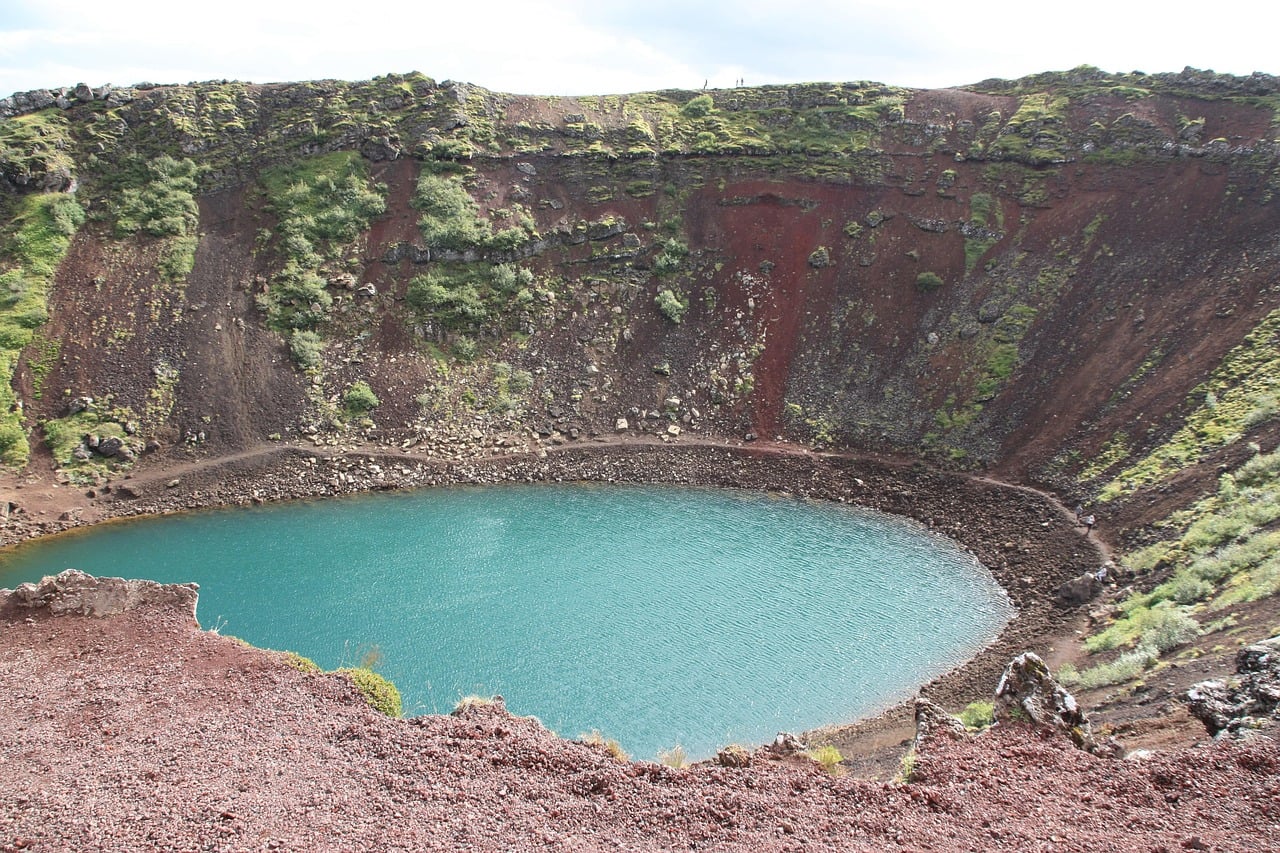
Kerid is one of the few Golden Circle places that explains itself in a single glance and still gets more interesting the longer you stay. You see the bowl first: red earth, dark volcanic rims, a lake held quietly in the center. Then your eye starts noticing the details. The slopes really do resemble an amphitheater. The color shifts are sharper than you expected. And the whole crater feels oddly intimate, as if Icelandic geology had briefly agreed to become readable at human scale.
The official Kerid site describes the crater as about 6,500 years old, approximately 55 meters deep, 170 meters wide, and 270 meters across. It also places Kerid within Iceland's Western Volcanic Zone, the same broad volcanic belt that includes the Reykjanes peninsula and reaches toward Langjokull. That relative youth is one reason the form still feels so crisp. In Iceland, where lava fields and glacial landscapes often stretch into huge, difficult-to-read panoramas, Kerid gives visitors a contained volcanic shape with edges the eye can follow immediately.
Its beauty depends on contrast more than size. The slopes carry red and rust tones that visitors do not always expect in Iceland, especially if they have spent the morning among gray rock, green moss, or the pale spray of Gullfoss. The lake at the bottom changes with weather and season, sometimes blue, sometimes greenish, sometimes quieter and darker under cloud. Kerid is therefore less about a single fixed look than about the meeting of minerals, water, and light.
That makes it especially useful on a private Golden Circle route. Thingvellir offers history and tectonic scale. Geysir offers motion and heat. Gullfoss offers force. Kerid offers form. It slows the day down and turns the visitor's attention away from spectacle for a moment. You stop waiting for something to erupt or crash, and you start reading shape, line, and color instead.
The walk itself is short, but it deserves to be treated as more than a checkbox. The rim gives the most complete understanding of the crater's geometry. The path downward, when conditions allow, changes the emotional feel of the place. From above, Kerid looks elegant and open. From lower down, the walls begin to close around the lake and the crater feels more enclosed, almost architectural. That shift is part of what makes the stop memorable.
Kerid does not come with a famous saga attachment in the way some Icelandic valleys, falls, and farm districts do. I actually think that helps. The crater does not need borrowed myth. Its story is right there in the ground: a volcanic depression, a basin filling with water, a rough bowl softening into a site people now circle for pleasure. The place feels ancient enough for imagination, but clear enough that the geology still leads the conversation.
Season changes the experience dramatically. In summer, Kerid can look almost improbably vivid, with red slopes, green vegetation, and blue water creating a palette visitors often associate more with paintings than with roadside geology. In autumn, the tones deepen and the whole crater feels more muted and thoughtful. In winter, snow and ice can simplify everything into stronger shapes, sometimes freezing the lake and turning the site into something quieter and more severe.
That seasonal flexibility makes Kerid surprisingly good for repeat visitors. It is not the sort of site that overwhelms you with variation in route length or dramatic access. Instead, it changes through color, wind, and mood. One day it feels bright and graphic. Another day it feels still and almost meditative. On a private tour, that is valuable because the stop can be slotted into different emotional places in the day: an opening scene, a cooling-down pause, or a final visual note before returning toward Reykjavik.
Photographers often do best here when they think less about postcard scale and more about relationships. Wide compositions from the rim can show the crater as a whole. Mid-range frames can emphasize the colored slope dropping into the lake. Lower viewpoints can turn the water into a mirror and the rim into a kind of enclosing stage. Kerid also benefits from softer light. Harsh midday sun can flatten parts of the scene, while cloud and angled light help the colors separate more elegantly.
There are practical reasons not to rush it either. The rim is exposed, and wind can make a short stop feel sharper than expected. Wet ground and snow also change how comfortable the path is. Good shoes are enough for many visitors, but steady footing matters more than the stop's modest length suggests. Because the crater is so visually accessible, people can underestimate it and walk carelessly. It rewards the opposite approach.
Culturally, Kerid belongs to that important class of Icelandic places that remind travelers not everything has to be huge to matter. The country often sells itself through grandeur: glaciers, volcanic eruptions, immense waterfalls, black-sand coasts. Kerid works by concentration. It gathers volcanic history into one legible shape and lets travelers encounter geology without needing to translate an entire horizon first.
That is why I like Kerid on a private route. It gives the Golden Circle a moment of focus. No crowds staring upward, no countdown to an eruption, no canyon swallowing a river. Just a crater, a lake, and enough time to look properly. When visited with that slower attitude, Kerid becomes one of the route's most graceful stops, not because it is the loudest, but because it is one of the clearest.