Iceland Travel Guides
Kerlingarfjöll: Steam, Color, and the Open Intelligence of the Highlands
A fuller private guide to Kerlingarfjöll, with rhyolite mountains, Hveradalir steam, Highland access, changing seasons, and the deeper mood that makes this interior region unforgettable.
GlaciGo Iceland / May 2026 / 10 min read
Kerlingarfjöll is one of those Icelandic places that changes the traveler's sense of scale before it even properly begins. Long before you arrive at the geothermal valleys, the area starts working on you through distance, color, and access. The road into the Highlands already strips away ordinary South Coast expectations: fewer built markers, more sky, more gravel, more weather, and a growing awareness that this is not a quick stop pasted onto a main sightseeing loop. By the time Kerlingarfjöll finally appears, it does not feel like a single attraction. It feels like entry into a different register of Iceland altogether.
The simplest official descriptions already suggest why the place resists flattening. Wikimedia's structured categorization identifies Kerlingarfjöll as a mountain massif, a volcano, and a rhyolite landscape in Iceland's Highlands. Even that bare summary is useful. Kerlingarfjöll is not only a mountain range, nor only a geothermal area, nor only a hiking base. It is one of those Icelandic regions where volcanic structure, color, steam, and terrain all overlap so completely that separating them weakens the experience.
The mountain range is made largely of rhyolite, and that fact matters visually as much as geologically. Basalt gives many Icelandic landscapes their dark authority. Kerlingarfjöll speaks in a different palette: reds, ochres, pale ash tones, steam-white patches, and strange, bruised earth colors that shift with cloud cover and moisture. This is one reason people remember the place so vividly. It can feel less like a conventional mountain area and more like a zone where the ground has been partially opened, stained, and left expressive.
The official Kerlingarfjöll destination site presents the area as an ideal place to begin a Highland experience and emphasizes that it functions year-round with accommodation, food service, and a wide range of outdoor activities. That framing is practical, but it also reveals something deeper. Kerlingarfjöll is not simply an untouched wilderness fantasy. It is one of the Highlands' more legible human thresholds, a place where people can actually stay, reset, and move outward into the surrounding terrain. The existence of this base changes the emotional reading of the mountains. Kerlingarfjöll feels remote, but not inaccessible in a theatrical way. It is remote with structure.
That structure matters because the Highlands can otherwise overwhelm newer travelers. Kerlingarfjöll offers a rare combination: genuine interior-Iceland atmosphere with just enough orientation to let people focus on the landscape rather than only on logistics. The destination site's emphasis on seasonal activities, from hiking and mountain biking to winter ski touring and snowmobiles, also helps make sense of the place. Kerlingarfjöll is not defined by one short seasonal trick. It is a full mountain environment whose personality shifts with snow, thaw, mud, steam, and light.
If there is one part of the region that most sharply captures its character, it is Hveradalir, the steaming geothermal valley. Even without turning the article into a route guide, this is where many visitors first understand what makes Kerlingarfjöll so different from Iceland's other geothermal areas. The steam is not appearing beside a roadside boardwalk in a lowland basin. It rises inside a Highland mountain context of red slopes, eroded gullies, and high open air. That changes everything. Geothermal activity here does not feel decorative. It feels embedded in the mountain body itself.
This is why Kerlingarfjöll should not be written as if it were merely another hot-springs destination. The official site understandably mentions the Highland baths and hot springs as part of the appeal, and that is real. But the deeper experience is not spa-like in the ordinary sense. It is environmental. Warmth here means something because cold, wind, and altitude are also present. Steam means something because the mountains around it remain stark and raw. Kerlingarfjöll works best when the writing preserves that tension rather than turning it into a comfort product.
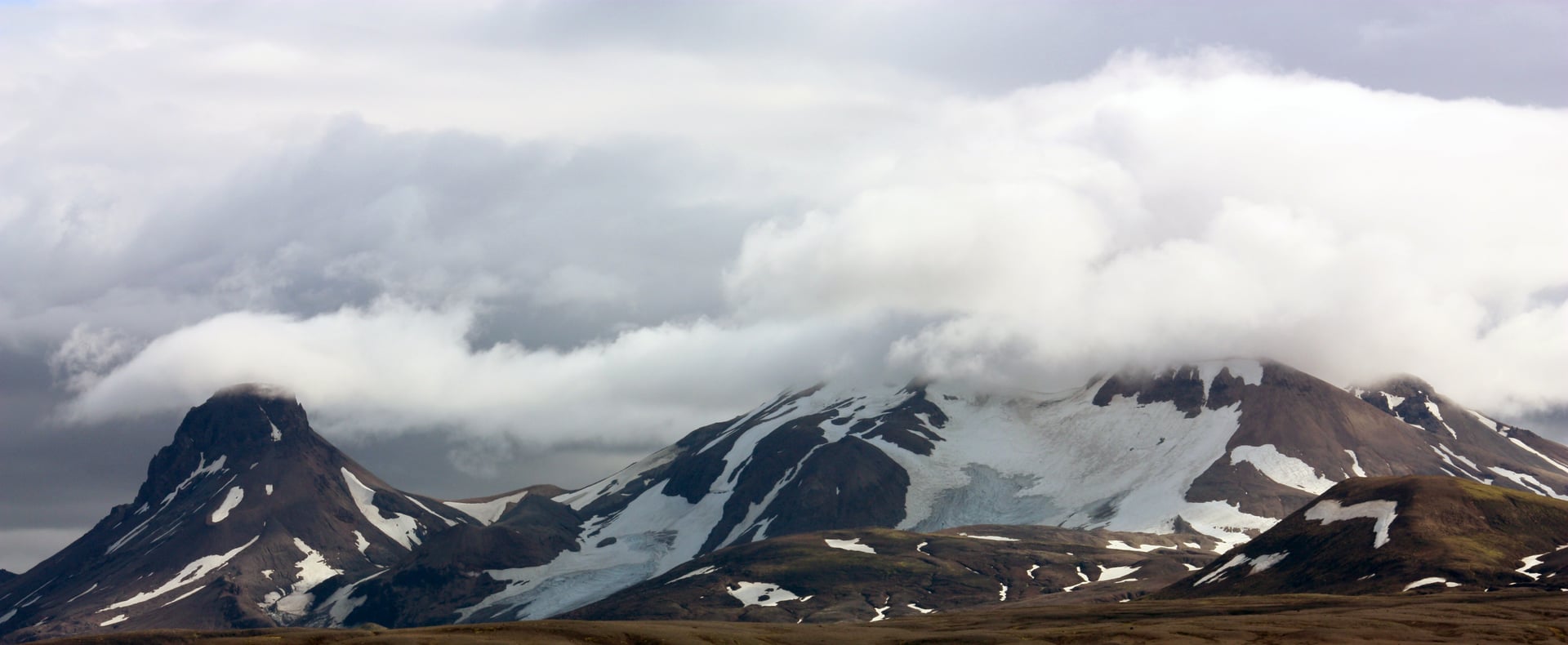
The access story contributes to the atmosphere too. The Commons description of one of the strongest free-use images locates the view from Kjölur, the F35 route, and that is exactly the right mental orientation. Kerlingarfjöll belongs to Iceland's interior crossing logic. You do not simply happen upon it while driving between waterfalls. Even when roads are open and the trip is straightforward by Highland standards, the approach still feels chosen. This helps the place resist casual consumption. A journey to Kerlingarfjöll always carries some sense of intention.
That intentionality is part of why the area stays memorable for people who like landscapes that demand a little more from them. Kerlingarfjöll asks for weather tolerance, slower pacing, and a willingness to let the land be more important than the checklist. It is not the kind of place that gives up all its meaning in ten minutes from a parking lot. Even the people who come mainly for photographs usually leave talking about the feel of the air, the silence between gusts, the unexpected softness of rhyolite colors, or the way steam reshapes a mountain scene into something almost painterly.
Photographically, Kerlingarfjöll is unusually rich because it supports several different visual grammars at once. Wide views from Kjölur or surrounding approaches reveal the massif as a distant Highland presence. Inside the geothermal valleys, the focus narrows toward texture, steam, mineral staining, and incision. In shoulder seasons, snow or frost can sharpen color contrasts even further, while in summer the looser paths and exposed ridges allow images that feel almost Martian without becoming abstract. Good Kerlingarfjöll photography rarely relies on one spectacular frame alone. It accumulates through contrast.
The emotional rhythm of the place also matters. Some Icelandic destinations impress immediately and then settle. Kerlingarfjöll often does the reverse. At first you notice color and steam. Then you begin to understand remoteness. Then the scale of the Highlands starts to register. Then, if you stay longer, the place becomes calmer and stranger rather than more familiar. This layered arrival is one reason people who love Kerlingarfjöll often love it fiercely. It is not a place that flatters quick attention. It rewards prolonged presence.
Compared with Landmannalaugar, Kerlingarfjöll feels a little less socially famous and a little more austere. Compared with Hverir, it feels less immediate but more total, because the geothermal element is nested inside a broader mountain world rather than standing alone. Compared with Langjökull or the Silver Circle volcanic experiences, it feels less about one headline phenomenon and more about the overall intelligence of a landscape. That combination gives Kerlingarfjöll a special place in Iceland travel writing. It is one of the Highlands' clearest arguments that beauty can be both rugged and subtle at once.
Kerlingarfjoll benefits from a fuller explanation because traveler questions around it is broad but specific in tone. People want to know what the place actually is, whether it is worth the extra effort compared with easier South Iceland stops, what makes Hveradalir special, whether the baths define the experience, and what sort of traveler will love it most. The strongest way to understand it is that Kerlingarfjoll is for people who want the Highlands to feel like the Highlands: geothermally alive, color-saturated, weather-exposed, and larger than a single attraction.
What stays with many travelers after Kerlingarfjöll is not one sight but one atmosphere: steam lifting off red slopes, the sense of driving into the interior on purpose, the feeling that the mountain is warm in some places and glacially cold in others, and the realization that Iceland's interior can be both harsh and inviting without contradiction. Kerlingarfjöll lingers because it does not behave like a polished destination. It behaves like a living Highland region that happens, generously, to let you in for a while.