Iceland Travel Guides
Kirkjubæjarklaustur: Prayer, Lava, and a Village of Deep Memory
A fuller private guide to Kirkjubæjarklaustur, with monastic history, the Fire Mass of 1783, Kirkjugólf, Systrafoss, and the village's role between lava and highland roads.
GlaciGo Iceland / May 2026 / 10 min read
Kirkjubaejarklaustur is one of those Icelandic place names that many travelers first meet as a practical problem. They try to pronounce it, fail nobly, laugh, and then shorten it to Klaustur like everyone else. That little moment is strangely appropriate, because the village itself also reveals its depth in stages. At first it can look like a useful stop between Vik and Skaftafell, a base with fuel, beds, and access to famous detours. Stay with it a little longer and a much stranger place appears: a settlement where nuns, lava, prayer, waterfalls, columnar basalt, and outwash landscapes all coexist in unusually close conversation.
Visit South Iceland begins in the right way by placing Kirkjubaejarklaustur in Skaftarhreppur, which it calls the center of the south and a strong base for day trips toward Skaftafell, Jokulsarlon, Langisjor, Eldgja, Lakagigar, Eldhraun, and Fjadrargljufur. It also uses a phrase that is almost too good to be tourism copy: this is an area where saga meets lava. That line deserves to be taken seriously. Klaustur is not memorable because of one isolated sight. It matters because human story and volcanic landscape remain legible here at the same scale.
The town page adds the key historical frame. In older times, the place was known as Kirkjubaer, the Church Farm, and it was an important farming estate. Today it is the only center of population in the district, with roughly 150 inhabitants, and roads radiate from it toward the highlands, Laki, Fjallabak, and the wider southeast. This makes Klaustur more than a roadside village. It is a hinge in the map, one of those Icelandic settlements where movement into much larger landscapes becomes possible.
Its religious and cultural memory runs even deeper than the modern road map suggests. Visit South Iceland notes under Systrastapi that in 1186 a nunnery was established at Kirkjubaer a Sidu and that the place later became known as Kirkjubaejarklaustur. The village name itself preserves that monastic history. This is not incidental heritage layered afterward onto a scenic area. Spiritual life helped name the landscape, and the landscape in turn preserved that naming. Even if travelers do not know medieval Icelandic church history in detail, they can still feel that this is a place where religious memory has soaked into the geography.
That memory becomes especially vivid in the story of Reverend Jon Steingrimsson, the so-called Fire Cleric. Visit South Iceland's chapel page explains that the memorial chapel in Klaustur was consecrated in 1974 in his honor, and recalls the famous Eldmessa, or Fire Mass, that he delivered on July 20, 1783, when lava from the Skafta Fires threatened habitation. Many believe that the mass stopped the lava flow at what is now called Eldmessutangi, west of Systrastapi. Whether one approaches that story through faith, folklore, or historical imagination, it gives Klaustur one of the strongest narrative identities on the South Coast. Here, prayer is not remembered abstractly. It is remembered against moving lava.
That same 1783 eruption remains one of the central geological and emotional facts of the region. Visit South Iceland's local listings repeatedly point back to Skaftaeldahraun, the lava field created by the Lakagigar eruption, one of the greatest lava events in recorded history. In Klaustur, that history is never very far away. The village lives not beside a symbolic volcano, but within a landscape repeatedly rewritten by eruption, ash, flood, and deposit. This makes even the calmest present-day view feel historically charged.
And then there is Kirkjugolf, the Church Floor, one of the most satisfying examples in Iceland of how local naming turns geology into cultural metaphor. Visit South Iceland describes it as an 80 square meter expanse of columnar basalt slabs slowly eroded when the sea covered the area. The hexagonal surface looks man-made, yet there has never been a church on the site. That detail is delightful because it captures something essential about Klaustur: the human imagination keeps finding architecture and devotion in the forms of the land, even when the land made them by itself.
Systrafoss and Systravatn extend that blend of story and place. The official South Iceland geosite page describes Systrafoss as the waterfall where the river Fossa falls from Lake Systravatn above Kirkjubaejarklaustur, and notes that the hiking path Astarbrautin begins there. The route also passes Kirkjugolf. This is a small but meaningful pattern. In Klaustur, walking routes are not just exercise tracks between viewpoints. They connect names, local memory, waterfall, forest, and geology into one readable village landscape.
The village's geography sharpens that readability. Klaustur stands in a district where roads head toward highland fissures, pseudocraters, waterfalls, glacial margins, and lava fields. A traveler can spend the morning reading monastic and fire-mass history, then drive out into a raw volcanic plain or toward Fjadrargljufur in the afternoon. Very few places in Iceland hold that kind of compression. The human scale remains small, but the surrounding horizons are enormous.
This is why Klaustur works so well on a private itinerary. On a rushed schedule it can be flattened into a sleep stop or lunch stop between better-known icons. That misses its real gift. Klaustur is one of the best places in South Iceland for stitching a route together intellectually and emotionally. It helps explain why this region is not just a collection of dramatic sights. It is a lived landscape shaped by church history, hardship, road access, jokulhlaup country, lava memory, and local adaptation.
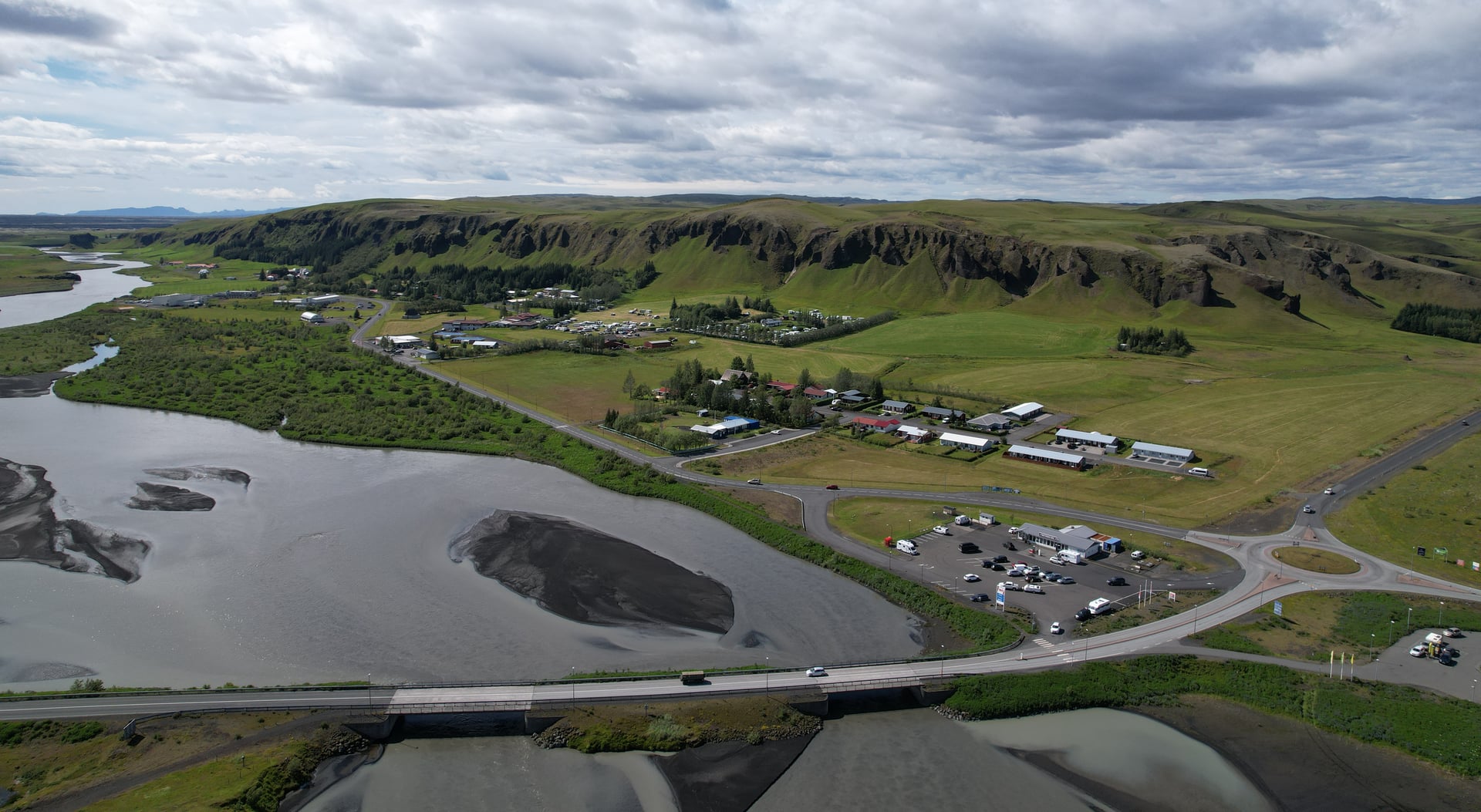
Photographically, the village is strongest when it is not forced into the conventions of grand-scenery Iceland. This is not primarily a hero shot destination in the manner of Jokulsarlon or Reynisfjara. It works better through layered signs of habitation and memory: the chapel, the old cemetery, the slopes above the village, Kirkjugolf's improbable geometry, a road leading toward open country, or an aerial view that shows how small the settlement remains inside the larger district. Klaustur photographs best when it still feels inhabited rather than mythologized.
Its modesty is part of its strength. Some places are memorable because they dominate attention. Klaustur lasts because it keeps giving attention back to the traveler. It asks you to notice how names hold history, how geology shapes belief, how communities survive inside risky landscapes, and how some villages act as cultural readers for entire regions. The more carefully you move through it, the more coherent South Iceland becomes.
Kirkjubaejarklaustur deserves more than a passing mention because travelers often use it in several ways at once: as a practical stop between Vik and Skaftafell, as a village with its own monastic and lava history, and as a base for places such as Kirkjugolf, Systrafoss, Systrastapi, and Fjadrargljufur. The village becomes more rewarding when those layers are held together instead of being reduced to convenience on Route 1.
What remains after a thoughtful visit is usually not one attraction but a composite atmosphere. The long name. The chapel and cemetery. The memory of lava stopping. The church floor that was never a church. The waterfall above the village. The sense that roads heading out from here lead into some of Iceland's most severe country. Kirkjubaejarklaustur is, in that sense, a rare kind of destination: not spectacular in one direction only, but quietly dense in every direction at once.