Iceland Travel Guides
Kirkjufell: Shape, Light, and the Most Photographed Mountain in Iceland
A fuller private guide to Kirkjufell, with glacial geology, Grundarfjörður context, old names like Sukkertoppen, photography culture, and the mountain's deceptive climbing risk.
GlaciGo Iceland / May 2026 / 11 min read
Kirkjufell is one of those rare landmarks that arrives with a reputation so large it can almost get in the way of the place itself. By the time many travelers reach Grundarfjorour, they have already seen the mountain in calendars, drone reels, Northern Lights photographs, guidebooks, and the long afterlife of Game of Thrones. That familiarity can create a strange risk: people come expecting only a perfect shape and leave without really understanding why the mountain feels so magnetic in person. A good Kirkjufell article has to do more than repeat that it is photogenic. It has to explain how one relatively modest mountain became such a durable Icelandic icon.
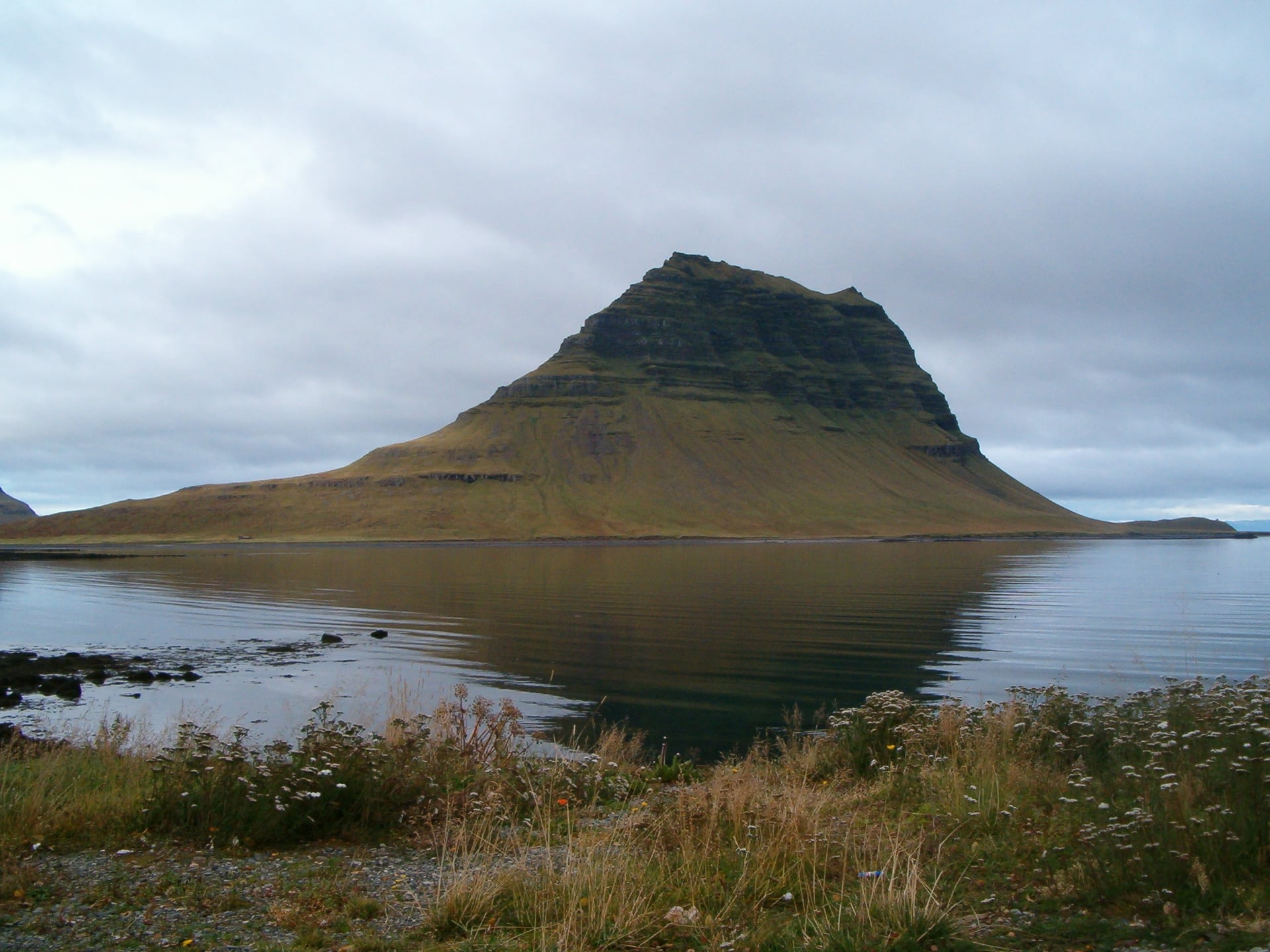
The first answer is form. West Iceland's official description is simple and accurate: Kirkjufell rises 463 meters above sea level beside Grundarfjorour on the Snaefellsnes Peninsula and stands alone like a sentinel over Breidafjordur Bay. In real life, that isolation matters more than the number. Kirkjufell is not Iceland's tallest or wildest mountain, but it is unusually legible. Its shape reads instantly, even at a distance. Many Icelandic mountains impress through scale, glacier mass, or dramatic remoteness. Kirkjufell impresses through clarity. It seems almost drawn rather than eroded.
That apparent simplicity is deceptive, because the mountain is also a geological lesson. West Iceland notes that its exposed and distinct layers offer valuable insight into the glacial history of the region. A local geology handout prepared in Grundarfjorour explains that the lowest part of Kirkjufell is made of fossil-bearing sediments likely formed early in the Ice Age more than one million years ago, while the upper parts developed during the last million years from both lava layers formed in warmer periods and tuya-like subglacial material formed during colder periods. The mountain's current profile, according to that same guide, was shaped by glacial erosion during the later Ice Age. In other words, Kirkjufell is not only beautiful because of its form. It is beautiful because ice carved a volcanic and sedimentary mass into something unusually clean and memorable.
This is one reason the mountain feels so complete from so many angles. A lot of famous mountains depend on finding exactly the right viewpoint. Kirkjufell certainly has its classic frame, especially with Kirkjufellsfoss in the foreground, but the mountain's personality survives even when the postcard composition disappears. Seen from the harbor area of Grundarfjorour, it becomes part of town life rather than a separate scenic object. Seen from the road, it looks like a threshold marker for the north side of Snaefellsnes. Seen across water, it carries the old maritime authority of a landmark that sailors would have remembered immediately.
The names attached to the mountain tell their own story. West Iceland notes that Danish sailors once called it Sukkertoppen, or the Sugarloaf, because its peak rose sharply from the sea, and older Icelandic sources refer to it as Firoafjall. The local geology sheet from Grundarfjorour adds that Kirkjufell itself takes its Icelandic name from a shape that reminded people of a church. These names matter because they show different kinds of recognition. One name comes from comparison to trade-era visual culture, another from older local usage, another from the mountain's almost ecclesiastical silhouette. The mountain did not need modern tourism to become memorable. It had already lodged itself in navigational and cultural memory long before Instagram turned it into a global image.
Grundarfjorour is part of the story too, and it deserves more than a passing mention. On a rushed loop around Snaefellsnes, travelers often treat the town simply as the place where Kirkjufell is parked. That misses the human scale that makes the mountain more affecting. Grundarfjorour is a small fishing town facing a wide bay, and the mountain lives beside it not as wilderness spectacle alone but as a daily presence. The official municipal tourism material still introduces Kirkjufell as the town's most famous landmark, which sounds obvious until you think about what that means. This is not an isolated summit far from ordinary life. Boats, roads, weather, houses, and harbor rhythm all continue in the shadow of a mountain that the world now treats like a symbol.
That tension between ordinary life and international fame is part of what makes Kirkjufell interesting for tourists who want a more human reading of Iceland. The mountain has become so overphotographed that some people arrive defensively, expecting a place ruined by its own success. Yet the experience often recovers once they slow down. The point is not to pretend the fame is irrelevant. The point is to see why the fame happened, and how the mountain still exceeds it. Good light changes the slopes minute by minute. Clouds can turn the peak from crisp to elusive in a few breaths. Winter makes it severe; summer evenings make it almost theatrical. The mountain keeps producing new moods even when the composition is familiar.
Photographically, Kirkjufell is a minor case study in how tourism teaches people to see. The classic pairing with Kirkjufellsfoss is popular for a reason. West Iceland calls the waterfall one of Iceland's most photographed, and together mountain and falls create a frame with foreground, middle ground, and a near-perfect subject. But there is a subtle trap here. Once visitors know the famous shot, they can start relating to the place only through the pressure to reproduce it. A private visit works best when it resists that pressure a little. Walk a little farther. Look back from a less obvious angle. Include the bay, the weather, the town, or the traces of movement around the shore. Kirkjufell can handle being iconic. It does not need to be flattened into one image.
There is also a cinematic layer now that cannot honestly be ignored. West Iceland notes that Kirkjufell gained international fame when it appeared in Game of Thrones as Arrowhead Mountain, the symbolic peak north of the Wall seen during the struggle against the dead. That association matters because it introduced the mountain to many travelers who might otherwise never have learned its name. But Kirkjufell was never merely a film set. It worked onscreen because the mountain already looked mythic. The camera borrowed a power that the landscape already possessed.
At the same time, this is not a harmless mountain in every sense. West Iceland is unusually direct in warning that climbing Kirkjufell is highly challenging and dangerous, with steep, slippery slopes and vertical rock faces, and that multiple serious accidents and fatalities have occurred when people underestimated the route. That warning belongs in any honest tourist article. Kirkjufell's shape invites confidence because it appears compact and readable. In reality, the mountain's steep sections and exposure demand experience, good conditions, and proper judgment. For most travelers, the wiser relationship is visual rather than summiting. You do not have to stand on top of Kirkjufell to understand why it matters.
This is where the mountain becomes more interesting than a simple bucket-list stop. Kirkjufell teaches a useful Iceland lesson: access does not equal possession. You can admire a place closely, learn its history, understand its geology, spend real time with its changing light, and still leave the summit alone. In fact, that restraint often produces the better experience. The official guidance to enjoy the mountain from a safe viewpoint is not a killjoy footnote. It reflects the reality that some landmarks are most meaningful when they are encountered with proportion.
Season also changes the tone of Kirkjufell more dramatically than many first-time visitors expect. In summer, the western light can stretch the evening and give the mountain a soft, nearly painted edge above green slopes and calm water. In winter, the cone becomes harsher and more graphic, especially when snow emphasizes the lines cut by older geological processes. West Iceland also notes that Northern Lights often appear above the mountain and reflect in surrounding waters, which helps explain why Kirkjufell became such a magnet for aurora photographers. Still, the real subject is not the aurora alone. It is the relationship between sky movement and an already memorable form.
The mountain also belongs to a larger Snaefellsnes logic. Travelers often speak of the peninsula as 'Iceland in miniature' because so many landscapes appear in compressed form there: fishing villages, lava, cliffs, beaches, glacier views, birdlife, and dramatic mountains. Kirkjufell acts almost like the north-coast emblem of that idea. It is not as mythically layered as Snaefellsjokull, not as historically weighted as some church sites or fishing stations, but it is perhaps the clearest visual summary of why Snaefellsnes is so satisfying. One sharp form, rising beside the sea, carrying both geological depth and immediate readability.
Kirkjufell attracts mixed expectations. Some travelers want the classic photography viewpoint, some know it through television, some wonder about climbing safety, and others ask whether such a familiar image can still feel worthwhile in person. The answer is yes, but not because fame alone proves anything. Kirkjufell works because the fame grew around something genuinely distinctive: glacial sculpture, maritime setting, memorable naming history, and a rare balance between simplicity and depth.
What many visitors remember most, in the end, is not a single fact but a feeling of visual inevitability. Kirkjufell looks as if it had to be there, exactly in that shape, above that bay, beside that town. Of course geology tells a longer and messier story involving sediments, volcanic layers, ice ages, and erosion. But the finished result feels almost impossible in its neatness. That is why the mountain stays with people. Kirkjufell is not Iceland's grandest mountain. It is something rarer: one of its most perfectly composed ones.