Iceland Travel Guides
Krafla: Fire, Steam, and the Usable Power of North Iceland
A fuller private guide to Krafla, with its caldera, Stóra Víti crater, Leirhnjúkur lava, geothermal power station, and the reason this volcanic district feels both scientifically legible and emotionally raw.
GlaciGo Iceland / May 2026 / 10 min read
Krafla is not the kind of place that resolves neatly into one attraction, and that is exactly why it matters. Some visitors think first of the teal water in Víti. Others remember the steaming black-and-red lava of Leirhnjúkur. Others notice the power station and realize, perhaps with a small shock, that this is one of the places where Iceland's underground force is not only admired but actively harnessed. A strong article about Krafla has to keep those layers together. Krafla is a volcanic system, a historical memory of eruptions, a present-tense geothermal field, and one of the clearest places in Iceland where beauty, danger, and utility remain visibly entangled.
Visit Mývatn describes the Krafla caldera as a cauldron-like geological feature about 10 kilometres long and 2 kilometres deep, perched on the edge of the Eurasian and North American tectonic plates. Even if that phrasing simplifies deeper geology, it gets at the essential feeling: Krafla is not just a mountain with a crater. It is a wider structure, an active district, a place where the earth seems architecturally unsettled. When you arrive there, the sensation is not only that you have come to a scenic viewpoint. It is that you have entered a zone where the ground has been repeatedly reworked and could never convincingly pretend otherwise.
That wider scale matters because Krafla is often flattened into one or two roadside highlights. Visit Mývatn makes clear that tourists usually encounter three principal expressions of the area: the geothermal power station at Leirbotn, Stóra Víti, and the lava fields at Leirhnjúkur. Those are useful anchors, but they are not separate attractions accidentally parked near each other. They are three ways of reading the same volcanic system. One shows the landscape's eruptive memory in a crater lake. One shows the landscape's continuing heat in the lava and steam fields. One shows the human attempt to convert that heat into power.
Stóra Víti is often the first emotional hook. Visit Mývatn explains that this maar, around 300 meters in diameter, was formed during the major eruption that began with the Mývatn Fires in 1724, and that the disturbance continued more or less non-stop for years. That historical detail matters because it gives the crater real weight. Víti is not merely photogenic turquoise water inside a dark rim. It is the cooled memory of a violent phase in the district's life. The beauty of the crater depends partly on the knowledge that the shape was made by explosive force, not by calm accumulation.
The Mývatn Fires belong near the center of any serious Krafla article. They are one of the reasons the place feels historically close rather than geologically remote. Around Krafla, volcanism does not belong only to deep time. It belongs to the eighteenth century in a way that can still be narrated, imagined, and spatially traced. This gives the area a different atmosphere from landscapes whose eruptive past feels too ancient to be personally meaningful. Krafla's history still has narrative sharpness. You can stand in it without much effort of abstraction.
Then Leirhnjúkur changes the register again. Visit Mývatn's hiking material describes an easy trail through hot spring areas and steaming lava to craters formed during the Krafla Fires of 1975 to 1984. That date range is crucial. It means the lava field many travelers walk across is not ancient mythic ground. It is recent enough that the site still carries living heat and very recent eruption memory. Leirhnjúkur is one of the places in Iceland where visitors can feel how young some 'finished' lava landscapes really are. The colors, sulfur stains, cracks, and steam keep the surface from settling into scenic calm.
This is one of the reasons Krafla often feels more intellectually satisfying than a simple crater stop. The area teaches sequence. At Víti you see eruption translated into shape and water. At Leirhnjúkur you see eruption translated into crust, smoke, and rough black movement arrested mid-flow. Together they make volcanic process legible. The land around Krafla does not merely look dramatic. It explains itself if given enough time and attention.
The hiking framework from Visit Mývatn adds another important layer: movement through Krafla is part of understanding it. Trails link Leirhnjúkur southward toward Reykjahlíð, cross older lava from the 1725-1729 fires, and extend across nearby heights such as Hlíðarfjall. This matters because Krafla is not a one-angle viewpoint. The more you move, the more the system begins to read as a connected field of eruptions, ridges, hot ground, cooled lava, and human paths. Walking here is interpretive, not just recreational.
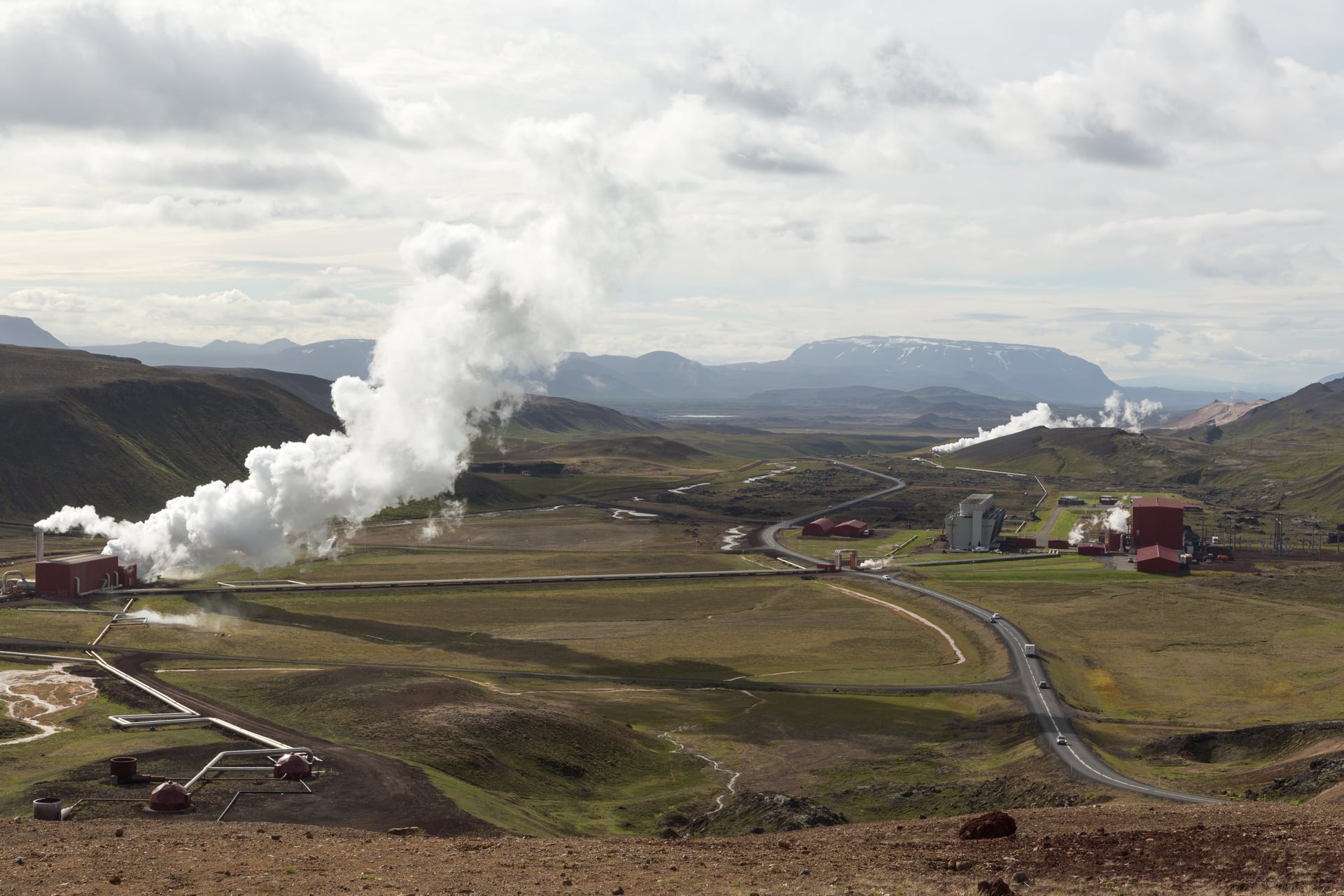
And then there is the power station. The Krafla Visitor Centre, according to Visit North Iceland, explains the geology of the area, the generation of geothermal energy, the history of geothermal energy in Iceland, and the potential of its use. Landsvirkjun's own information on the station places Krafla clearly within Iceland's energy story. This matters because the power station is not an embarrassing industrial interruption inside a landscape that would otherwise be purely natural. At Krafla, industry belongs to the place honestly. It reveals another truth of Icelandic volcanic landscapes: they are not only admired from a distance, but lived with, studied, drilled, and transformed into warmth and electricity.
That relationship between wildness and use is one of Krafla's most compelling qualities. Many travelers divide Iceland mentally into pure nature on one side and modern infrastructure on the other. Krafla does not let that division survive intact. Here, a violent volcanic system becomes a place of research, power generation, visitor interpretation, and walking routes without losing its severity. The result is unusually Icelandic. The country does not simply preserve geothermal energy as spectacle. It also inhabits it technologically.
For tourists, Krafla often becomes one of the most memorable stops in the Mývatn region because it sharpens the whole district. After Hverir, you understand geothermal surface activity better. After Mývatn, you understand how volcanic force and life coexist in one landscape better. After Krafla, the region starts to feel truly systemic. This is one reason the place works so well on a private itinerary. It can be approached through geology, through photography, through energy history, through moderate hiking, or simply through the strangeness of being in terrain that is still, in meaningful ways, unfinished.
Photographically, Krafla is unusually rich because its surfaces are so different from one another. Víti offers a crater-lake image of startling clarity. Leirhnjúkur offers cracked lava, steam, red earth, sulfur colors, and black crust. The power station introduces another vocabulary altogether: engineered lines and industrial forms against volcanic terrain. The best encounters usually come from allowing those vocabularies to coexist rather than pretending one of them is the only authentic one.
Krafla can be confusing because the name may point to the crater, the lava field, the power station, or the broader volcanic area. The value of a fuller guide is that it keeps those layers together. Krafla is a caldera, a recent eruption landscape, a geothermal resource field, and one of the clearest volcanic districts in Iceland for travelers who want more than a quick photograph.
What stays with many visitors after Krafla is a sense of the earth as both creator and problem-solver. Fire made the crater. Fire spread the lava. Fire still vents through the ground. And fire, in a quieter industrial form, also lights homes and heats buildings through the station below. Krafla lingers because it shows Iceland not as a postcard of nature apart from people, but as a place where people have had to learn how to live intelligently with an active planet under their feet.