Iceland Travel Guides
Krýsuvík: Church, Steam, and the Wider Silence of Reykjanes
A fuller private guide to Krýsuvík, with church history, geothermal districts, Kleifarvatn, crater lakes, bird cliffs, and the wider mood of Reykjanes.
GlaciGo Iceland / May 2026 / 10 min read
Krysuvik is the kind of Icelandic place that quietly resists simplification. People often think they are going there for one thing, usually Seltun's steaming mud pools, and only later realize that the name actually belongs to something larger and more layered: a former estate, a church standing alone in open country, a geothermal district, crater lakes, dark mountain ridges, and a stretch of the Reykjanes Peninsula where geology and memory seem to lean unusually close to each other. If Seltun is the most photogenic punctuation mark in the area, Krysuvik is the full sentence around it.
Visit Reykjanes describes Krysuvik as a popular recreational destination with many interesting hiking paths, and that is a fair beginning. But the official place page also does something more useful: it lists the area's main geothermal zones, points to Kleifarvatn and nearby lakes, and reminds visitors that Krysuvik was once a separate parish with one of the largest estate farms in the country and many tenant crofts. That combination is the key. Krysuvik is not merely a scenic area with a church nearby. It is a historical human landscape embedded inside an active volcanic one.
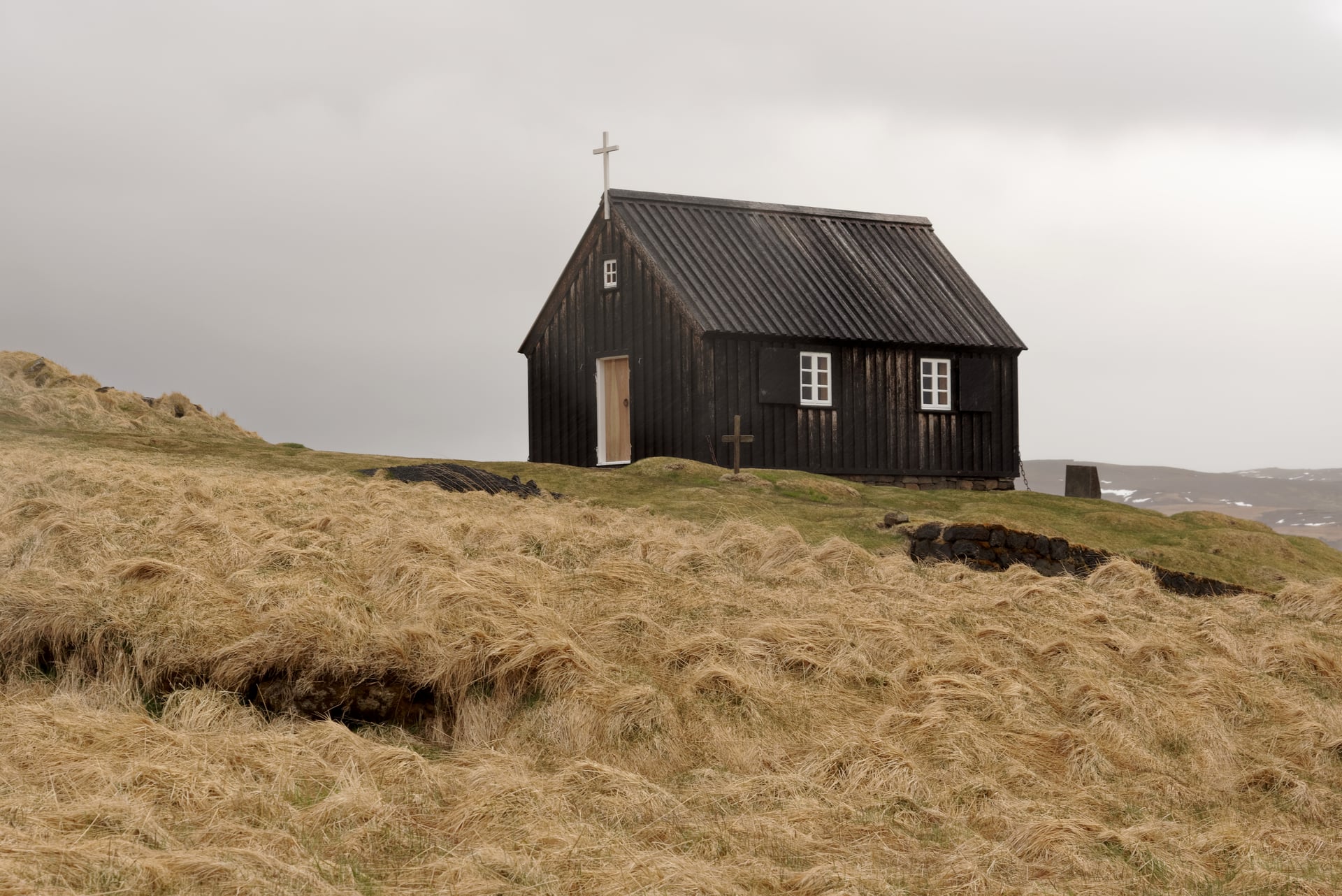
The name itself carries that older life. According to the same official page, Krysuvik was once a substantial farm estate with numerous dependencies. The church that survives today stands as a visible remnant of that world. Visit Reykjanes dates the current church to 1857, notes that it ceased to serve as a parish church in 1929, and explains that for a time it was used as living quarters. The farm was abandoned around 1950, restored in 1964, and the church is now protected by the National Museum. Those details change the mood of a visit. You are not looking at a decorative chapel placed in a dramatic landscape for effect. You are seeing one surviving structure from a working rural world that receded while the land around it remained theatrically alive.
That contrast is one of Krysuvik's deepest pleasures. Stand near the black church and the atmosphere is almost minimalist: turf, open ground, quiet slopes, weather moving fast, and the sense of distance from urban Iceland. Drive a few minutes north and the landscape begins to vent, stain, hiss, and bubble. Continue through the broader district and you find crater lakes, ridges, and volcanic forms that make the whole area feel like a field notebook left open by the earth itself. Few places so close to Reykjavik give visitors this much variety without requiring them to choose only one mood.
Seltun, of course, remains one of the area's main draws, but in a Krysuvik article it should be treated as a chapter rather than the whole story. Visit Reykjanes identifies the principal geothermal areas in Krysuvik as Seltun, Hverahvammur, Hverahlid, Austurengjar, the southern part of Kleifarvatn, and Sveifla beneath Hettutindur. Even if travelers only see one of those zones directly, it is helpful to know they are moving through a wider geothermal district rather than a single isolated attraction. Krysuvik feels larger once you understand that heat is distributed across the landscape, not concentrated only where the boardwalk is.
Lake Kleifarvatn adds another kind of scale. The official page from Visit Reykjanes describes it as the largest lake on the peninsula and the third largest in southern Iceland, about 10 square kilometers in area and around 97 meters deep. It also notes that the lake diminished after major earthquakes around the year 2000 likely opened fissures in its bottom. That small sentence contains a lot of Krysuvik's identity. Here, the ground is not a passive stage. Earthquakes alter the lake. Hot springs warm one end of it. The surrounding ridges make it look still and closed, but the hydrology is restless underneath.
Kleifarvatn also brings folklore into the district in a way that feels completely natural. Visit Reykjanes records the local story that a monster in the shape of a serpent or worm, as large as a medium-sized whale, lives in the lake. In another context that might feel like easy tourist seasoning. Here it feels earned. Deep cold water, limited surface outflow, earthquake memory, nearby geothermal heat, and mountain walls already make the lake uncanny before anyone says the word monster. The legend simply gives language to a feeling the landscape already produces.
Then there are the lakes and craters beyond Kleifarvatn. Visit Reykjanes describes Graenavatn as two maar-type explosion craters, probably more than 6,000 years old, their lake-filled basins aligned with the southwest-to-northeast trend of the Reykjanes Peninsula's earthquake fractures. This is one of the most useful things an official local source can do for a traveler: it makes the landscape readable without draining it of wonder. The green water is striking enough as an image, but once you understand it as part of a larger fracture-and-explosion story, the whole district starts to feel coherent rather than random.
Krysuvik is also larger than its inland surfaces. The area reaches toward Krýsuvikurberg, one of the biggest bird cliffs on the peninsula. Visit Reykjanes' birdlife material notes that roughly 57,000 pairs of seabirds nest there in summer, including guillemots, razorbills, kittiwakes, puffins, fulmars, cormorants, and others. That matters for how one imagines Krysuvik. It is not only a church-and-geothermal district. It is also connected to a dramatic Atlantic edge where seabird life gathers in huge numbers. The human experience of the area changes when you realize that its volcanic slopes run all the way toward a living cliff ecology at the sea.
This breadth is what makes Krysuvik different from a single-stop Seltun visit. Seltun gives the most immediate geothermal color and steam, but Krysuvik as a district asks for a wider reading: church, lakes, old settlement memory, volcanic hills, geothermal fields, and the lonely feeling of Reykjanes away from its busier edges. A private route can let those pieces connect instead of treating them as scattered nearby attractions.
On a private itinerary, Krysuvik works beautifully because it lets a day have chapters. You might begin with Kleifarvatn under low cloud, when the lake looks almost metallic. Then move toward Seltun as the air sharpens with sulphur. After that, the black church reintroduces stillness and human proportion. If time and road conditions suit, the wider Reykjanes day can continue toward coastlines, lava, or other geopark sites. The sequence matters. Krysuvik is not one sight to tick off but a structure for pacing a day more intelligently.
Photographically, the area is unusually generous if you do not force it into one format. The church rewards simplicity and weather. Seltun rewards texture, steam, and mineral color. Kleifarvatn rewards distance and mood. Graenavatn rewards color contrast and geological strangeness. Krýsuvikurberg rewards movement and life, especially in seabird season. A traveler interested in photography can spend hours here without feeling repetitive because the district changes visual language from stop to stop.
There is also an emotional honesty to Krysuvik that many visitors appreciate. Iceland is often marketed through clean icons: waterfalls, glaciers, black beaches, and symmetrical peaks. Krysuvik is less tidy, which is part of its charm. It carries abandonment, restoration, sulphur, fractures, old parish memory, monster stories, birds on cliffs, and roads that feel slightly out on the margin. It is not polished into one meaning. It remains mixed, and therefore more human.
That mixture is perhaps why Krysuvik stays with people longer than they expect. The church in particular has a way of lingering in memory. Visit Reykjanes notes that only two graves are visibly marked in the churchyard, while the uneven ground suggests more lie nearby. Even without elaborate storytelling, that image does its own work. You begin to feel Krysuvik not as a scenic district alone but as a place of former households, buried lives, vanished routines, and a parish that once mattered much more directly to the people living there.
The practical virtue of Krysuvik is that it can deliver all this richness without demanding a heroic journey. Because it sits within easy reach of Reykjavik, it is ideal for arrival days, departure days, weather-flexible touring, and custom Reykjanes loops for travelers who want something intellectually fuller than simply driving to one headline attraction. It is also useful for repeat visitors to Iceland, especially those who have already seen the Golden Circle and want a landscape that feels more open-ended.
What remains after a thoughtful visit is not one postcard image but a layered impression: steam in one direction, a black church in another, deep lake water under faulted ridges, crater lakes with unnatural color, birds out toward the cliff line, and the sense that a once-prosperous rural district now survives mostly as atmosphere, traces, and geological force. Krysuvik is one of the best places on Reykjanes for travelers who want Iceland not only as scenery, but as a meeting point between land, weather, memory, and time.