Iceland Travel Guides
Kvernufoss: Canyon Calm, Hidden Presence, and South Coast Balance
A fuller private guide to Kvernufoss in South Iceland, with canyon approach, walk-behind atmosphere, Skogar Museum context, and slower South Coast pacing.
GlaciGo Iceland / May 2026 / 9 min read
Kvernufoss is the kind of waterfall that changes a traveler’s mood before it changes their itinerary. It does not rise out of nowhere on a huge official plaza. It asks for a short walk. You leave the better-known bustle around Skogar behind, move into the narrower landscape of Kvernugil canyon, and then the waterfall appears with an intimacy that feels almost private even when other people are there. On a South Coast that can sometimes feel crowded at its most famous stops, Kvernufoss often arrives as relief.
Visit South Iceland keeps the basic description simple: Kvernufoss lies in a small canyon about 1.5 kilometers east of Skogafoss, and a hiking path reaches it from the museum car park at Skogar. That directness is helpful because the walk is part of the appeal. You do not drive right to the lip of the falls. You approach gradually, which means the landscape gets a chance to prepare you. By the time the water comes fully into view, the place already feels earned.
The Katla UNESCO Global Geopark guide refines that geography a little more. It places Kvernugil canyon about 500 meters east of Skogar Museum and says the walk to Kvernufoss takes around 20 minutes. Those are small details, but they matter for the rhythm of a private day. Kvernufoss is not a major expedition, and it is not a car-window sight either. It occupies a sweet spot that many travelers love once they discover it: short enough to fit easily into a South Coast route, but long enough to feel like a brief departure from the main flow of traffic.
That sense of departure is one reason Kvernufoss works so well after Skogafoss. Skogafoss is a public declaration: huge, frontal, loud, and famous. Kvernufoss is more inward. The canyon narrows the experience, the walk quiets the body, and the waterfall feels less like a stage set for everyone and more like a place you have come upon through attention. The two stops belong together geographically, but emotionally they do very different work.
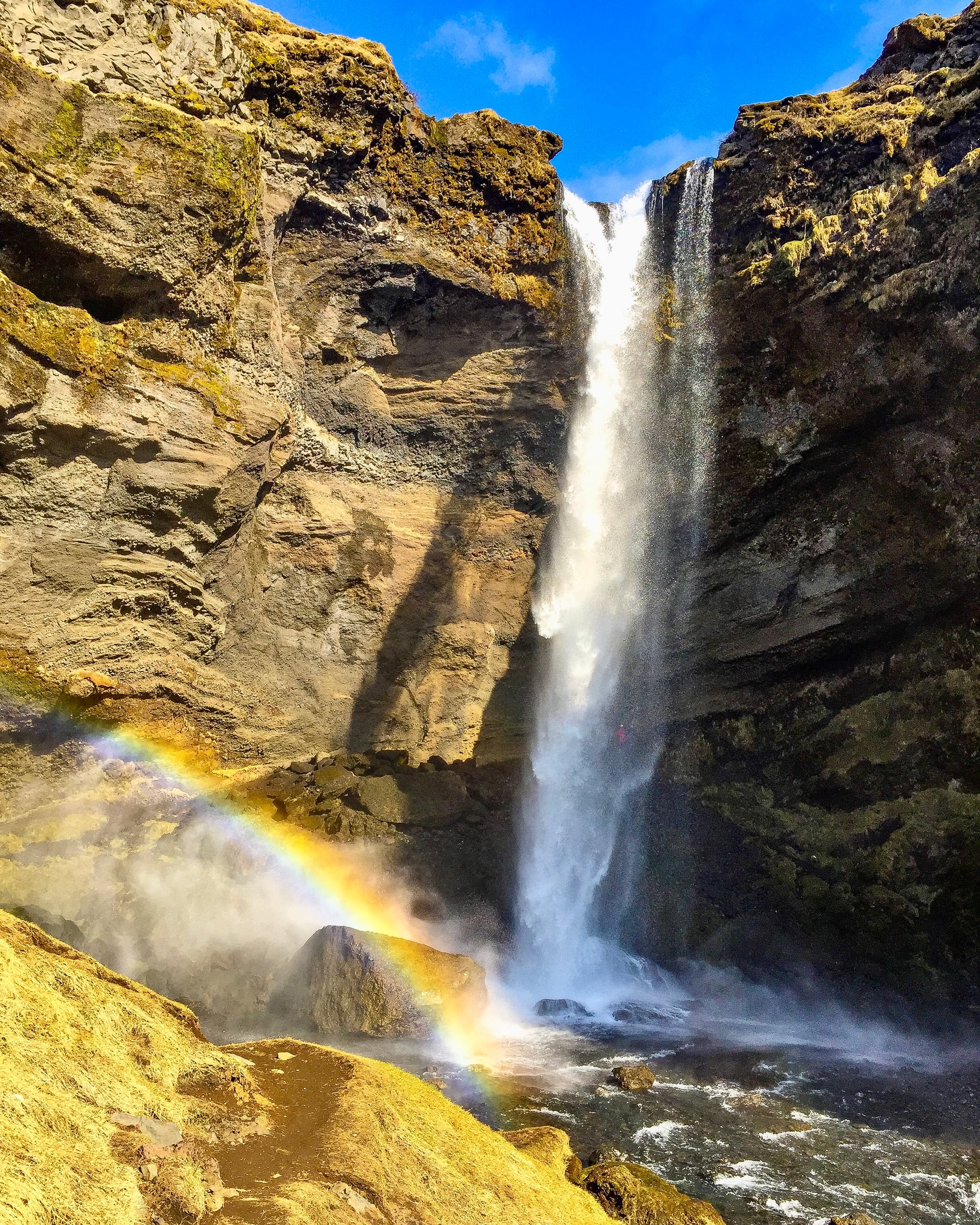
Kvernufoss also rewards one of the things travelers most enjoy in Iceland: the chance to pass behind falling water. The rock recess behind the waterfall gives the place a sense of enclosure without making it feel confined. From there, the view back outward becomes one of the strongest visual experiences on the South Coast. Water falls in front of the opening, mist catches light, and the green canyon beyond seems framed by motion. If Seljalandsfoss is the famous walk-behind waterfall, Kvernufoss is the more quietly satisfying one for people who prefer less ceremony and more atmosphere.
That atmosphere is part of what makes the place feel human rather than merely scenic. A path through a canyon, a short approach from the museum area, a waterfall large enough to impress but not so overwhelming that it turns every visitor into a tiny extra in a blockbuster image: Kvernufoss leaves more room for reflection. People tend to talk more softly there. They slow down without being told to. The scale is still dramatic, but it does not flatten experience into one obvious reaction.
The surrounding Skogar context deepens the stop more than many visitors expect. Visit South Iceland encourages travelers to check out the museum on the way, specifically to learn about the history of the area and how people crossed glacial rivers before bridges were built. That is a beautiful piece of guidance because it prevents Kvernufoss from becoming just a hidden-photo detour. The waterfall belongs to a district shaped by difficult travel, exposed farming, and the long practical intelligence required to live on the South Coast.
The museum itself makes that context concrete. Skogar Museum’s official material shows just how broad the collection is: fisheries, agriculture, furnishings, handcrafts, natural history, technical heritage, and archives from the region. The fisheries material is especially revealing. On Iceland’s sandy south shore, boats historically launched directly from beaches exposed to North Atlantic waves because there were no proper harbors. Once you carry that knowledge back into the landscape, even a small canyon walk to Kvernufoss begins to feel embedded in a much tougher human world than the peaceful path might first suggest.
This is one of Kvernufoss’s quiet strengths for SEO writing as well as for actual travel value: it links naturally to several kinds of reader intent at once. Some people are searching for a hidden waterfall near Skogafoss. Some want a short hike on the South Coast. Some want a quieter alternative to the iconic stops. Some are interested in places where they can walk behind the falls. Kvernufoss genuinely serves all of those searches without needing the article to exaggerate anything.
Photographically, Kvernufoss is generous. The walk-in view works. The reveal from below works. The frame from behind the waterfall works especially well, and the rainbow image is not a fantasy either; even the Wikimedia Commons record for one of the freely usable images describes Kvernufoss with rainbow. But the place is most convincing when it is not forced into a single postcard formula. Its charm comes from layers: path, canyon walls, grass, falling water, recess, and the little feeling of discovery that remains even now that it is much better known than it once was.
Season changes the texture of the walk more than the identity of the stop. In greener months, Kvernugil can feel soft and sheltered, almost pastoral compared with the harsher open stretches of the South Coast. In colder or wetter conditions, the canyon gains a sterner edge and the path deserves more care. Because the approach is on foot, weather always becomes part of the experience. That usually helps the place rather than hurting it. Kvernufoss is one of those Iceland stops that benefits from being slightly weathered.
For private travelers, Kvernufoss is excellent because it solves a pacing problem that many South Coast itineraries have. A day can easily become a march through famous names: Seljalandsfoss, Skogafoss, Reynisfjara, Vik, maybe more. Kvernufoss breaks that pattern. It introduces a smaller-scale chapter without feeling minor. Guests step out, walk, pay attention, and then re-enter the larger route with a different energy. Good itineraries need that kind of modulation.
It also pairs beautifully with Skogar as a cultural stop rather than only a waterfall stop. Visit the museum, read the landscape a little, walk to Kvernufoss, and suddenly the area feels much fuller. You are no longer collecting attractions. You are moving through a district where rivers, memory, tools, footpaths, and old patterns of crossing all belong together. That is a richer experience than simply comparing which waterfall is bigger.
Kvernufoss does not need grand mythology to matter, and perhaps that suits it. Skogafoss has the treasure chest. Seljalandsfoss has the iconic image. Kvernufoss has something quieter and, for many travelers, more enduring: proportion. The walk is manageable, the waterfall is beautiful, the canyon is intimate, and the cultural context nearby is real. Few South Coast stops balance those qualities so naturally.
On the right private itinerary, Kvernufoss becomes the place that people mention later with a little surprise in their voice. Not because it was the largest or loudest, but because it felt discovered. That feeling is increasingly rare on famous routes. In Iceland, where scale can dominate memory, Kvernufoss reminds travelers that nearness, texture, and the sense of arriving on foot can still be just as powerful.