Iceland Travel Guides
Landmannalaugar Hot Springs: The Bath That Makes the Highlands Physical
A fuller private guide to Landmannalaugar Hot Springs, with rhyolite-mountain context, Laugahraun contrast, the bath-after-hike rhythm, and the rough Highland warmth that makes the experience memorable.
GlaciGo Iceland / May 2026 / 10 min read
The hot springs at Landmannalaugar are among the few bathing experiences in Iceland that feel fully earned by the landscape around them. They are not set apart from the place as a spa product, nor inserted into it as a comfort station with scenery attached. They belong to Landmannalaugar's very logic: rhyolite mountains, black lava, long walks, weather exposure, geothermal warmth, and the relief that follows effort. This is why people remember the bath there so vividly. It is not only warm water. It is timing, terrain, and contrast.
Umhverfisstofnun's official Landmannalaugar page places the area inside the Fjallabak Nature Reserve and describes it as one of Iceland's most popular destinations, famous for colorful mountains and numerous hiking routes beginning near the huts and campsite. That context matters because the hot spring is not the whole story of Landmannalaugar. It is part of a larger system of movement. Most people do not arrive, bathe immediately, and leave. They walk. They climb Bláhnjúkur or move through Laugahraun. They cross rough ground, notice steam, wind, and shifting color, and only then return to the bathing area with a different body than the one they arrived with. The spring matters because the mountains came first.
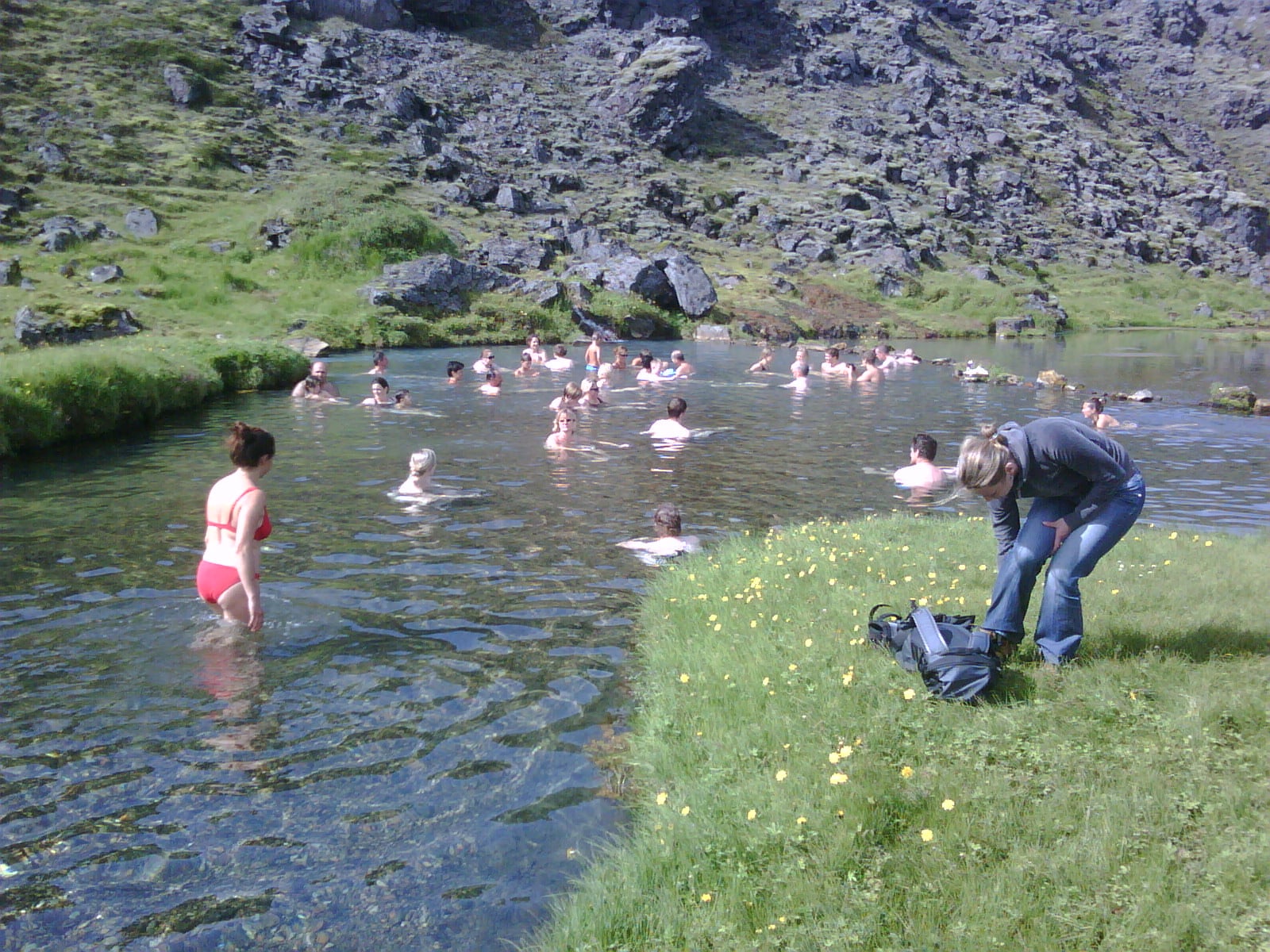
The Commons description of Landmannalaugar captures a small but essential truth in passing: after hikes into the lava field and surrounding mountains, there is a bath in a hot spring creek near the mountain hut. That little phrase is almost more useful than pages of promotion. It gets the sequence right. The bath is an after. It comes after terrain, after weather, after movement. The experience is built around the release that follows a day in the Highlands, not around luxury detached from context.
The geological setting makes the bath feel unusually integrated with its surroundings. Commons material on the area explains that Landmannalaugar lies within the caldera of the central volcano Torfajökull, surrounded by rhyolite mountains and lava formations such as Laugahraun. The hot spring itself exists because hot and cold waters meet under and along the edge of this volcanic landscape. The result is not a symmetrical pool designed for visual perfection. It is a usable, beloved, irregular bathing place formed by the same forces that shaped the rest of the valley.
This is why Landmannalaugar Hot Springs should not be written in the same tone as Blue Lagoon, Sky Lagoon, or even Mývatn Nature Baths. Those places are curated experiences with stronger boundaries between bathing zone and surrounding landscape. Landmannalaugar's hot pool is more porous. The campsite is nearby. The hut area is nearby. Hikers come and go dusty, wet, wind-flushed, tired, cheerful, quiet, or half frozen. The spring is not a world apart. It is the warm social and physical center of a very active outdoor place.
The official Fjallabak brochure adds the kind of local detail that gives the place texture rather than only grandeur. It mentions coffee made with hot spring water at Landmannalaugar. That detail is almost absurdly Icelandic in the best sense. It tells you that geothermal warmth here is not merely something to admire from afar. It enters daily habit, hospitality, and the practical rhythms of staying in the Highlands. The bath belongs to that same culture of immediate geothermal use.
There is also something emotionally intelligent about the imperfection of the pool. Unlike polished lagoon architecture, the Landmannalaugar bathing area asks visitors to accept a rougher encounter. The banks are natural and irregular. The atmosphere can be crowded at certain hours. The weather may be cold even when the water is comforting. You may walk in under rain, or step out into biting wind, or change in conditions that feel undeniably Highland rather than cosseted. All of this sounds like inconvenience on paper and often becomes part of the memory in practice. The bath feels better because it never fully stops being outdoors.
The contrast with Laugahraun is especially important. Black lava and warm water are one of Iceland's best recurring pairings, but in Landmannalaugar they have unusual narrative force. You hike through a hardened volcanic field and then return to a place where geothermal energy still rises in immediately usable form. The bath becomes more than relaxation. It becomes one of the simplest possible ways to understand Icelandic geothermal intimacy. Fire made the land difficult. Fire also keeps the water warm enough to hold you at the end of the day.
Season and logistics matter here in ways that shape the mood of the article. Umhverfisstofnun's current Landmannalaugar page reflects modern access management, including seasonal booking systems tied to parking and visitation. That matters because the spring no longer belongs to an era of total improvisation. Landmannalaugar remains wild in feel, but visitor pressure means the place must now be managed. The hot springs therefore sit at an interesting intersection: they still feel loose and natural, yet they exist within a protected and actively regulated environment. That tension is part of present-day reality.
Photography around the bath requires a little more judgment than people expect. The obvious temptation is to frame happy bathers against colorful mountains and call it a day. That can work, but the stronger visual story often lies in transitions: steam lifting in cold air, wet skin against dark lava, the bathing area seen in relation to campsite and hut, or small human figures returning from a hike before stepping into the water. The point is not just that the pool looks nice. The point is that it sits in a whole Highland life-system.
There is also a social dimension worth naming gently. The Landmannalaugar hot spring is one of the places in Iceland where strangers often become briefly easier around one another. Part of that comes from exhaustion, part from weather, part from the shared absurdity of bathing comfortably in such an exposed place. Unlike urban spas, the bath tends to gather people who have already done something to be there. That creates a different tone: less performance, more mutual recognition. Everyone is a little weathered. Everyone has earned the warmth.
Compared with Seljavallalaug, the bath at Landmannalaugar is less nostalgic and more embedded in an active hiking center. Compared with Kerlingarfjöll's bathing offer, it feels less like a mountain resort threshold and more like a communal creek inside a legendary trekking zone. Compared with Reykjadalur, it is less about a single hiking reward and more about being part of a larger basecamp world. These differences matter because they help protect the article from generic geothermal language. Landmannalaugar Hot Springs are specific in their mood, not just their temperature.
this topic benefits from careful explanation because traveler questions is narrower than general Landmannalaugar research. People want to know whether there is really a hot spring or natural bath there, what the bathing experience is actually like, whether it is worth bringing swimwear into the Highlands, how it connects to the hikes, and whether the spring is a headline reason to go or a secondary reward. The strongest way to understand it is that it is both secondary and unforgettable. You do not go to Landmannalaugar only for the bath, but the bath is one of the reasons the whole place locks into memory.
What stays with many travelers after Landmannalaugar is often the moment the body finally stopped resisting the weather. The boots came off. The volcanic dust and effort gave way to heat. The mountains stayed visible. Steam rose into cold air. The Highlands, for a brief time, became not only something to cross or admire, but something to inhabit physically. That is why the hot springs matter. They turn Landmannalaugar from a spectacular landscape into a lived experience, and that is a much harder thing to forget.