Iceland Travel Guides
Látrabjarg: Birds, Vertigo, and the Atlantic Edge of the Westfjords
A fuller private guide to Látrabjarg, with its immense bird cliffs, puffin-rich grassy edges, geology, reserve guidelines, lighthouse history, and the reason this Westfjords landmark demands real respect.
GlaciGo Iceland / May 2026 / 10 min read
Látrabjarg is one of those Iceland places that can be badly misunderstood by its own fame. Say the name too quickly and many travelers hear only one thing: puffins. Puffins do matter here, and they are one of the great accessible bird experiences of Iceland. But if that is all the article says, it shrinks a vast and slightly terrifying landscape into a postcard animal stop. Látrabjarg is much more than that. It is one of Europe's great bird cliffs, the westernmost point of Iceland, a line of headlands and precipices where geology, wind, seabird life, and human caution all remain very close to the surface.
Visit Westfjords describes Látrabjarg with admirable clarity. It calls it one of Europe's biggest bird cliffs, 14 kilometres long and up to 441 metres high, steep enough to make the sensation of standing there unforgettable. The same official material notes that the birds are fearless because they are safe from foxes, and that the puffins frequent the grassy upper parts. That is already enough to understand why the place is so famous. It offers scale, wildlife, and unusual closeness at once. But the same source also gives the warning that matters just as much: the edges are loose and fragile, and the fall is high.
That warning should not be treated as routine tourism boilerplate. Visit Westfjords published dedicated guidelines for the nature reserve in April 2025, and the tone is appropriately serious. The guidance emphasizes unstable cliffs, staying well back from the edge, supervising children closely, keeping dogs on a leash, and avoiding damage to the fragile ecosystem. It also notes that the reserve was officially designated in March 2021 to protect the unique bird habitats, landscape, and cultural heritage of the area. L?trabjarg is not a thrill lookout. It is a protected living cliff where beauty and danger are inseparable.
The birdlife is extraordinary enough that even the plain official language carries force. The English page says the cliffs are home to birds in unfathomable numbers. The Icelandic page is more specific and richer, calling Látrabjarg the largest seabird cliff in Iceland and one of the largest in Europe. It names razorbills, guillemots, puffins, kittiwakes, and others, and notes that Stóraurð contains the world's largest razorbill colony. This is not only useful birding information. It explains why the cliffs feel so physically alive in summer. Ledges, grassy shelves, air currents, and the sea face below all become inhabited space rather than mere scenery.
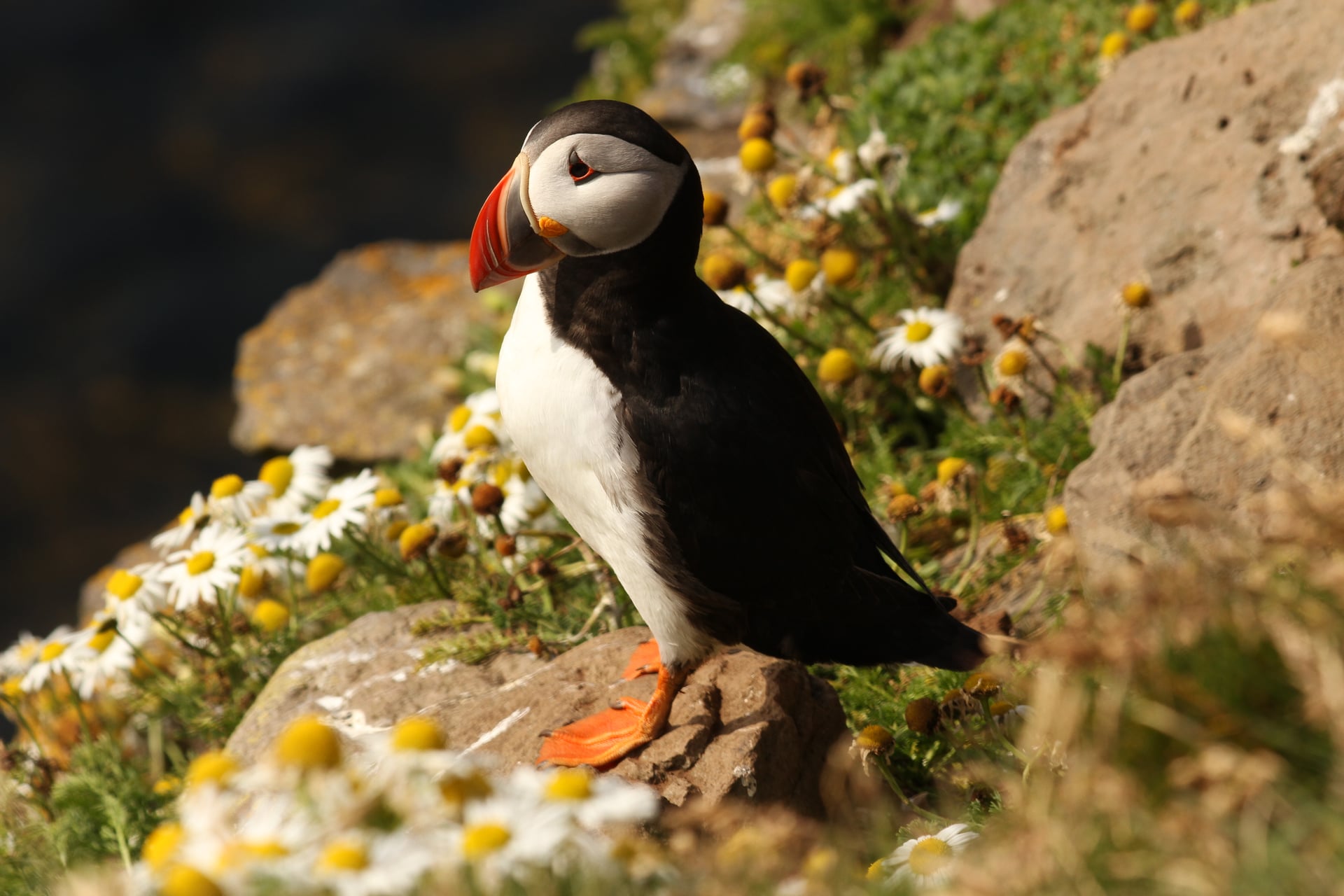
Puffins, of course, are the most emotionally famous part of that living system. Visit Westfjords notes that they are particularly tame here and easy to photograph from close range. That is true, but it is worth saying carefully. The point of Látrabjarg is not that puffins are there for people. It is that the ecology of the cliffs allows human visitors, if they behave properly, to stand unusually near a thriving seabird world without forcing it into theatrical proximity. That is a privilege, not an entitlement. The best mood to bring here is wonder moderated by restraint.
Geology gives the cliffs their authority even before the birds arrive. The Icelandic official page explains that the western part of Látrabjarg is largely a sheer wall from cliff edge to sea and that the whole formation is a cross-section through stratified lava layers of the Westfjords, built by repeated eruptions 13 to 16 million years ago. It also notes that these are among the oldest rocks in Iceland. That detail matters because it anchors the site in the deeper timescale of the country. When you stand at Látrabjarg, you are not only meeting seasonal wildlife. You are also standing on very old Iceland, in a place where erosion rather than fresh volcanism has long been the dominant sculptor.
This older geological character helps explain the emotional difference between Látrabjarg and some of Iceland's more immediately volcanic landmarks. Many famous Iceland stops feel young, raw, eruptive, or obviously still forming. Látrabjarg feels older, carved back, exposed. The drama is not about new fire but about long duration, collapsing edges, stacked rock, and the endless Atlantic pressure below. That gives the place a different gravity. It feels less like spectacle produced for a visitor and more like a stern natural boundary that humans are permitted to observe from a respectful distance.
The westernmost identity of the cliffs adds another layer. Official Westfjords pages point out that this is the westernmost point of Iceland and, depending on how Europe is counted, one of its great outer edges as well. That geographic fact does not change the cliff physically, but it changes how many people feel there. Edge places create a particular psychology. They sharpen direction, weather, and horizon. At Látrabjarg, the sea is not background. It is the full argument. You feel the country ending under your feet and the North Atlantic taking over.
Bjargtanga lighthouse deepens that edge feeling beautifully. Visit Westfjords records that a lighthouse was first built on Látrabjarg in 1913 and that the present structure dates from 1948. It notes later electrification and the addition of an automatic weather observation station in 1995. This is exactly the kind of practical history that improves a travel article. The lighthouse is not just a pleasing visual punctuation mark. It is a sign that this headland has long required navigation, monitoring, and respect. People have not come here merely to admire the cliff. They have also had to reckon with it.
From a travel perspective, Látrabjarg works best when you give it more than one emotional register. Birdwatchers come for species and colonies. Photographers come for puffins, sea stacks, and light. General travelers often come because the place is famous and because it pairs naturally with Rauðisandur and Breiðavík. The site can satisfy all of these intentions, but only if the pace is right. This is not a destination to sprint through in a single triumphalist pass. You park, walk, stop, watch the edge, watch the birds, notice how the wind shifts, and keep feeling the pull between beauty and caution.
The relationship with nearby Rauðisandur is one of the smartest itinerary pairings in the Westfjords. Rauðisandur gives width, tide, shell color, and quiet horizontality. Látrabjarg gives height, sound, density of life, and vertigo. Together they create one of the strongest single-day emotional arcs in Iceland. The coast goes from soft to severe without losing coherence. That is part of why the southern Westfjords linger so strongly for travelers who reach them.
Photographically, Látrabjarg offers far more than cute puffin portraits, though it does offer those too. The longer cliff line, the abrupt drop, the grassy lip against empty air, the lighthouse, the bird-saturated ledges, and the marine weather all give multiple valid ways to read the place. Some of the best images are not the closest ones but the ones that preserve risk and scale. If everything is framed as adorable wildlife, the cliff loses its truth. A strong article should make room for both tenderness and severity because the place itself contains both.
L?trabjarg deserves more than a puffin-season note because the questions around it are broader than birdwatching alone. It is a long drive, a serious cliff environment, a major seabird habitat, and one of the defining landmarks of the Westfjords. Its deeper value is that it condenses the region into one place: remote, dramatic, ecologically rich, and impossible to enjoy properly without respect.
What stays with many visitors after Látrabjarg is often not a single puffin image, but the whole sensation of the cliff. The wind, the drop, the noise of birds, the age of the rock, the grass ending suddenly in air, and the understanding that the beauty here is inseparable from fragility. Látrabjarg lingers because it is one of the few places in Iceland where closeness to wildlife, deep geological time, and real physical exposure all meet at once. It asks you not only to look, but to behave like someone who understands where they are.